Lesson 10 — Conflict Is Not Violence
In this **capstone** lesson, learners explain the **difference between conflict (disagreement) and violence**, and **why disagreement can be healthy when handled well**. They analyze a fork diagram, sort examples, and revisit the unit's four strands — values (S1), rights and fairness (S2), government and collective action (S3), and peace (S4) — in one reflection note.
Objectives
Objectives
- D09.S4.05.02 Explain the difference between conflict (disagreement) and violence, and why disagreements can be healthy when handled well.
- D09.S1.05.01 Explain how a person's values can shape their choices, using a story or example.
- D09.S2.05.01 Explain what a right is, where some rights come from (such as the UN Convention on the Rights of the Child), and why they apply to all children.
- D09.S3.05.01 Explain what government is and what it does, and compare how decisions are made in more than one country.
Essential question
What is the difference between conflict and violence, and how can disagreement be healthy?
Key vocabulary
Materials
Standard materials
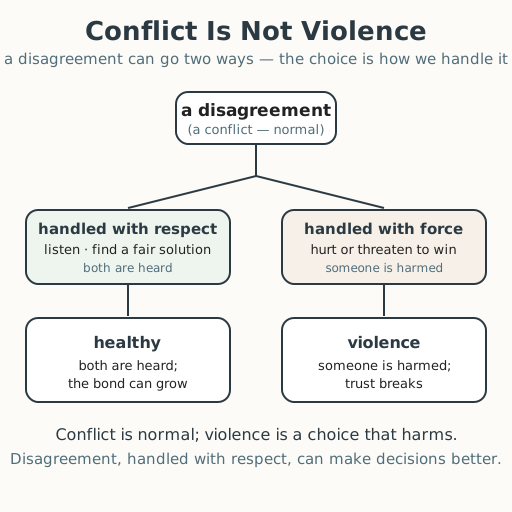
- Conflict-vs-violence fork poster · 1 A fork diagram: a disagreement splits into two paths — handled with respect (listening, fair solution → healthy) or with force (hurting → violence)
- Disagreement example cards · 1 set per pair Short disagreements (a rule, a plan, a preference) for pairs to sort as 'handled with respect' or 'handled with force' and to predict the outcome
- Unit reflection page · 1 per learner A capstone page to record the conflict-vs-violence difference and one idea from each strand of the unit (values, rights/fairness, government, peace)
Low-tech / no-cost
- A spoken fork Tell a disagreement aloud and walk two paths in the air — respect or force — naming what each leads to; no paper needed
- A standing spectrum Mark a line on the ground from 'healthy disagreement' to 'violence'; stand where each example belongs and say why
Enriched / lab & device
- A short film or read-aloud on disagreement · 1 A brief video or story where people disagree but handle it with respect, analyzed with the fork diagram
- A class 'disagree well' charter · 1 A shared display where learners post their conflict-vs-violence notes and one rule for disagreeing well
Works in different contexts
- large-group Build the fork together, then have pairs sort examples and share one 'healthy' and one 'violent' outcome
- multi-age Younger learners sort an example as 'respect' or 'force'; older learners explain the outcome of each path
- self-directed A learner reads the fork, sorts the examples alone, and completes the unit reflection page
- level-grouped Learners ready to extend name a real disagreement and write how each path (respect vs. force) would likely end
- outdoor-only Use the standing spectrum outdoors; name examples and step to where each belongs, then say what the path leads to
Lesson 10 — Conflict Is Not Violence
Summary
In this capstone lesson, learners explain the difference between conflict (disagreement) and violence, and why disagreement can be healthy when handled well. They analyze a fork diagram — a disagreement can go two ways, respect or force — sort examples, and revisit the unit’s four strands in one reflection note: values (S1), rights and fairness (S2), government and collective action (S3), and peace (S4).
Objectives
- Explain the difference between conflict (disagreement) and violence, and why disagreements can be healthy when handled well. (D09.S4.05.02)
- Revisit the unit’s ideas: values shape choices (D09.S1.05.01), rights and fairness (D09.S2.05.01), and government and collective action (D09.S3.05.01).
Connection
Two people disagree about a game rule — that is a conflict, and it is normal and ordinary. One of them shoves or hurts the other to win — that is violence, and it harms. The difference is not in the disagreement itself but in how it is handled. Handled with respect, a disagreement can even be good: it surfaces real needs and leads to better, fairer solutions. Handled with force, it breaks trust and hurts people.
Materials
- Conflict-vs-violence fork poster
- Disagreement example cards
- Unit reflection page
Preparation
- Print or draw the conflict-vs-violence fork poster.
- Copy example cards for each pair and a unit reflection page for each learner.
- Prepare one spoken disagreement for the whole-group opening.
Facilitator note
This is the unit capstone, written to the learner (“you”). The ideas to land: (1)
conflict (disagreement) is normal and can be healthy; violence (hurting a person’s
body, dignity, or belongings to get one’s way) is a choice that harms; and (2) the
difference is how we handle it. Teach this non-violently and non-shamingly — no
child is labeled “violent”; the lesson names behaviors and their consequences, never
people. Distinguish evidence from values (docs/philosophy.md §5): what conflict
and violence are, and what each path tends to lead to are observable; that we should
handle disagreement with respect and without violence is a value this curriculum holds.
Close with retrieval across all four strands (a spaced, interleaved review — Dunlosky et
al., 2013). See docs/facilitation.md.
Procedure
- Gather (5 min). For nine lessons you have thought about values, choices, rights, fairness, government, collective action, and solving conflicts. Today you put it together with one clear line: conflict is not violence.
- Meet the difference (10 min). A conflict is a disagreement — two people want different things. It is normal, it happens everywhere, and it is not a failure. Violence is different: it is hurting someone’s body, dignity, or belongings to get your way. A disagreement can turn into violence, or it can stay peaceful — the difference is the choice of how to handle it.
- The fork (15 min). Look at the poster. A disagreement sits at the top. It can go two ways. Handled with respect — each side speaks, each listens, and they find a fair solution — the disagreement becomes healthy: both are heard, and the bond can even grow. Handled with force — hurt or threaten to win — it becomes violence: someone is harmed, and trust breaks. Sort your example cards onto one path or the other, and say what each path leads to.
- Why disagreement can be healthy (10 min). Disagreement is not the enemy. When we disagree and listen, we learn things we had not seen; we find solutions that work for more people. A group where no one ever disagrees can quietly miss what is unfair. Disagreement, handled well, makes decisions better.
- Capstone reflection (5 min). On your page, write the conflict-vs-violence difference in your own words. Then, one line for each strand of the unit: a value that shapes choices; a right that belongs to every child; one thing government and collective action do for the common good; and the fair-solution step that keeps conflict peaceful.
Differentiation
- Support: Provide the fork with the outcomes filled in and sentence starters for the four reflection lines.
- Extension: Take a real disagreement you have seen and write how each path (respect vs. force) would likely end, in one short paragraph.
Assessment
- Summative (portfolio): The unit reflection page — can the learner state the conflict-vs-violence difference and recall one idea from each of the four strands? The page is kept as a unit artifact.
- Self-check: The learner asks, “Can I tell conflict from violence? Can I name one way disagreement helps, and one way to handle it without hurting anyone?”
Home connection
Tell someone at home the difference between conflict and violence, and one way to disagree without hurting anyone — then ask how they handle disagreements well.
Resources
- Restorative practice frames conflict as an opportunity to listen and repair rather than to harm: International Institute for Restorative Practices, https://www.iirp.edu/
- On spaced retrieval and interleaving as high-utility learning techniques: Dunlosky et al. (2013), https://doi.org/10.1177/1529100612453266