Lesson 03 — Starting a New Movement Skill
Learners begin a new movement skill — the traveling step (a side step with a cross behind, known by many names in dances across many regions). They meet a worked example of the four counts, practice slowly in short repeated rounds, and start a practice log they will carry through the unit. Explicit steps and guided practice carry the new skill.
Objectives
Objectives
- D03.S2.06.01 Learn a new movement skill, such as a dance step or sport skill, through practice, feedback, and correction.
Essential question
How do I begin to learn a new movement skill, step by step?
Key vocabulary
Materials
Standard materials
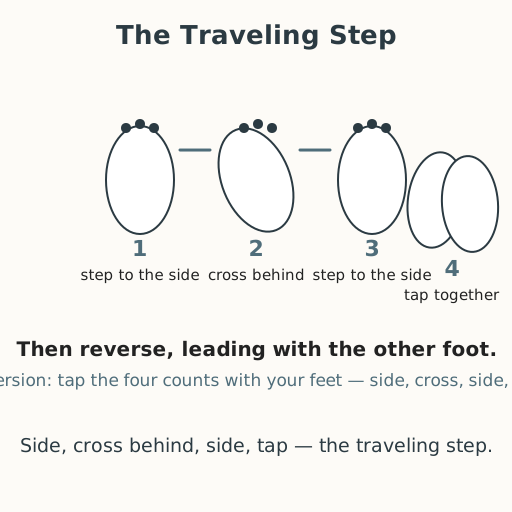
- Traveling-step poster · 1 A poster showing the four footprints of the step — side, cross behind, side, tap together — labeled with counts 1–4
- Practice log page · 1 per learner A page to tally practice rounds and note what felt steadier each round — the running log used through Lesson 7
- Open floor space or a clear line · 1 per pair Space to step side to side; a line on the floor or a chair back to steady an adapted version
Low-tech / no-cost
- Your body and a counted voice Say the four counts aloud and step them on the ground; no page or line needed
- Marks or a stick line in the dirt Draw or scratch four foot positions on the ground and step them in order
Enriched / lab & device
- A slow metronome or steady beat · 1 per group A steady beat to practice the step in time, then gradually speed up
- A video of the step, filmed by learners · 1 per group Record early attempts to compare with later ones in Lessons 4 and 7
Works in different contexts
- large-group Model the step slowly to the whole group in lines, then have pairs practice and tally rounds; rotate through stations
- multi-age Older learners demonstrate each count while younger learners try it, then all tally their own rounds; pair older as peer guides
- self-directed A learner follows the four counts alone at their own pace, tallies rounds, and compares the first round to the last
- level-grouped Learners ready to extend add a turn or reverse direction mid-step and track steadiness over more rounds
- outdoor-only Step the four counts on open ground or along a path, counting aloud; tally in the dirt with marks
Lesson 3 — Starting a New Movement Skill
Summary
Learners begin a new movement skill: the traveling step — a four-count side step
(side, cross behind, side, tap) that appears, by many names, in dances and games across many
regions. They meet a worked example of the four counts, practice slowly in short repeated
rounds, and start a practice log they will carry through Lessons 4 and 7. Because this is
a new skill, the lesson uses explicit steps and guided practice before independent work
(see docs/philosophy.md §13).
Objectives
- Learn a new movement skill, such as a dance step or sport skill, through practice, feedback, and correction. (D03.S2.06.01)
Connection
Think of the first time you learned a clapping game, a song with hand movements, or a footwork pattern — at first it felt impossible, and then, try after try, your body just knew it. Everywhere in the world, people teach movement the same way: one small step at a time, repeated until it becomes smooth. The traveling step you will learn today is one such step — a cousin of the grapevine in some line dances, the chassé in ballet, and side-stepping steps in folk dances from many lands. Wherever people gather to dance or play, they build skill one counted step at a time.
Materials
- Traveling-step poster
- Practice log page
- Open floor space or a clear line
Preparation
- Print or draw the traveling-step poster (four footprints labeled counts 1–4: side, cross behind, side, tap).
- Copy a practice log page for each learner (this log runs through Lesson 7).
- Clear space for pairs to step side to side; set a line or provide a chair back for adapted versions.
Facilitator note
This lesson is written to the learner (“you”). The idea to land is that a new skill begins
with small, counted steps and grows through repetition. Teach it with explicit steps and a
worked example (novice skill, not discovery). Frame the step as one of many movement
traditions — do not present it as the “correct” dance of any one people, but as a shared human
pattern with many names. Keep it non-competitive: the learner compares their own first
round to their own last round. Offer seated/adapted versions — tap the four counts with the
feet while seated, or trace the pattern with a hand on a table or knee — so every body can
practice; a seated step is a full step. Honor every body’s pace. See docs/contexts.md and
docs/facilitation.md.
Procedure
- Gather (5 min). You know how stress shows up in your body and one way to release it. Now the joy of movement: today you begin a brand-new movement skill, the traveling step.
- Meet the skill (10 min). Look at the poster — a worked example of four counts: ① step to the side with your lead foot; ② cross the other foot behind it; ③ step to the side again; ④ tap the feet together. Then reverse, leading with the other foot. Watch a slow demonstration, or trace the footprints with your finger: side, cross behind, side, tap.
- Guided practice (10 min). In pairs, step the four counts slowly, saying each count aloud, ten times. A partner watches and counts with you. Each round, tally it on your practice log.
- Repeat and steady (15 min). Do three more rounds of ten. After each round, notice: do your feet know the order without your voice? Does your last round feel smoother than your first? Log it. Compare your own early tries to your own later tries — not to your partner’s.
- Close (5 min). A skill is not a gift you either have or do not have — it is something you build, one counted step at a time. Your log is the proof, and it will grow with you.
Differentiation
- Support: Break the step into two parts — side-tap first, then add the cross — and use a chair back or a partner’s hand for balance; offer a seated foot-tap version; scribe the log.
- Extension: Add a quarter turn on the tap, or reverse direction mid-step, and note in the log what each change did to the step’s steadiness.
Assessment
- Formative (performance): Can the learner follow the four counts of the step, tally their rounds, and describe how their later tries improved over their earlier ones?
- Self-check: The learner compares their first and last logged round and says in one sentence what changed — steadiness, smoothness, or confidence.
Home connection
Teach the four counts — side, cross behind, side, tap — to someone at home and practice it together for one minute.
Resources
- Repeated, structured practice builds a motor skill, reflecting well-established research on motor learning and deliberate practice; for novice skills, explicit instruction with worked examples and guided practice beats discovery alone (Kirschner, Sweller & Clark, 2006). The side-traveling step appears across many folk and social dance traditions; the curriculum presents it as a shared human pattern rather than the property of one culture. For children’s movement guidance, see the World Health Organization: https://www.who.int/news-room/fact-sheets/detail/physical-activity