Lesson 10 — Evidence and the Counterargument
Learners strengthen their argument by adding evidence under each reason and by answering a counterargument. They see the full modeled argument — claim, reasons with evidence, a counterargument, and a concede-and-answer response — then add both to their own drafts. This is step two of three toward a complete argument.
Objectives
Objectives
- D04.S3.06.01 Write a well-developed argument with a claim, reasons, evidence, and a response to a counterargument.
Essential question
How do I add evidence to my reasons and answer a counterargument?
Key vocabulary
Materials
Standard materials
- Full-argument poster · 1 A poster showing the complete modeled argument — claim, reasons with evidence under each, a counterargument, and a response that concedes and answers
- Evidence sentence frames · 1 per learner Frames such as "For example, ___." and "The evidence is that ___." and "This shows ___."
- Counterargument frames · 1 per learner Frames such as "Some people say ___, and they have a point, but ___." and "It is true that ___, yet ___."
Low-tech / no-cost
- Voice and a real objection Take your claim and reasons from last lesson, have a partner raise one honest objection, and answer it aloud with evidence; no paper needed
- A 'evidence or assertion?' game Say a sentence and have partners signal "evidence" (point to something checkable) or "assertion" (hand on chest); no cards needed
Enriched / lab & device
- A class argument wall · 1 A shared wall where learners post their completed argument — claim, reasons, evidence, counterargument, response — to read and compare before revising
- A source-checking sheet · 1 per learner A simple sheet to note where each piece of evidence came from (observed, measured, told by an expert) to keep evidence honest
Works in different contexts
- large-group Build the full modeled argument on the board step by step, then have learners add evidence and a counterargument response to their own drafts and check each other's
- multi-age Younger learners add one piece of evidence and restate one objection, while older learners add evidence to every reason and write a full concede-and-answer response
- self-directed A learner adds evidence under each reason and writes one counterargument with a response, then checks each evidence claim against "where did this come from?"
- level-grouped Learners ready to extend raise two counterarguments, answer both fairly, and reflect on which response is stronger and why
- outdoor-only Add evidence by pointing to something real outside (a hot stretch, a treeless corner) and answer a partner's honest objection aloud; record it in the dirt or on paper
Lesson 10 — Evidence and the Counterargument
Summary
Learners strengthen their argument by adding evidence under each reason and by answering a counterargument. They see the full modeled argument — claim, reasons with evidence, a counterargument, and a concede-and-answer response — then add both to their own drafts. This is step two of three toward a complete argument.
Objectives
- Write an argument with evidence and a response to a counterargument. (D04.S3.06.01)
Connection
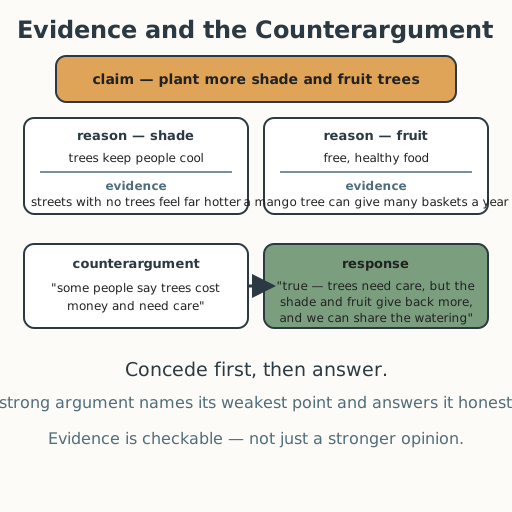
Your reasons say why; now someone asks how do you know? and what about the person who disagrees? “Trees are nice,” says your neighbor, “but they cost money and need care.” If you answer only with more reasons, you sound like you are repeating yourself. The strong move is twofold: evidence for your reasons (“streets with no trees feel far hotter than shaded streets”) and a fair response to the counterargument (“true — trees do need care, but the shade and fruit give back more each year, and we can share the watering”). Notice the response concedes first — it admits the other side has a point — and then answers. That is what makes an argument honest instead of just loud.
Materials
- Full-argument poster
- Evidence sentence frames
- Counterargument frames
Preparation
- Print or draw the full-argument poster (claim, reasons + evidence, counterargument, response).
- Copy the evidence frames and counterargument frames for each learner.
- Have learners bring their claim and reasons from Lesson 9.
Facilitator note
This lesson is written to the learner (“you”). The two ideas to land are evidence (each
reason needs support you can point to) and the counterargument response (concede what is
fair, then answer). Teach both with the worked example (a novice skill; model step-by-step —
Kirschner, Sweller & Clark, 2006). Retrieval: connect evidence here to the text evidence of
Lessons 5–6 (same idea, now for your own claim) and to Grade 5’s fact/opinion work. The ethics
lens matters: a good argument names its own weakest point and answers it honestly — that is
intellectual honesty, not weakness (docs/philosophy.md §5). Honor every home language; write
in the strongest language. Watch that “evidence” stays checkable, not just a stronger opinion.
Procedure
- Gather (5 min). Recall your claim and reasons. Today you add the two things that make an argument strong: evidence and a response to the counterargument.
- Meet the full argument (10 min). Look at the poster. The claim and reasons are joined now by evidence: under “shade” — “streets with no trees feel far hotter than shaded streets”; under “fruit” — “a single mango tree can give many baskets of fruit each year.” Then the counterargument: “some people say trees cost money and need care.” And the response: “true — trees do need care, but the shade and fruit give back more each year, and we can share the watering.” The response concedes what is fair, then answers.
- Learn the frames (5 min). Evidence: “For example, ___”, “The evidence is that ___”. Counterargument: “Some people say ___, and they have a point, but ___”, “It is true that ___, yet ___”. Practice one of each aloud.
- Strengthen your argument (20 min). Under each of your reasons, write one piece of evidence you could check or point to. Then write the counterargument — the best honest objection someone could raise — and your response, conceding what is fair before you answer. Read it to a partner; ask them: “Is my evidence checkable? Did I answer the objection fairly?”
- Close (5 min). You now hold a nearly complete argument: claim, reasons, evidence, and a fair answer to the other side. Next lesson you will revise and publish it so it is clear, complete, and ready to be read.
Differentiation
- Support: Provide one reason with its evidence already written and one counterargument to answer; ask the learner to write just the concede-and-answer response.
- Extension: Raise two counterarguments and answer both, then write one sentence on which response is stronger and why.
Assessment
- Formative (peer/portfolio): Does each reason carry checkable evidence, and does the response concede what is fair before answering the counterargument?
- Self-check: The learner asks, “Can I point to where each piece of evidence came from, and would the other side feel I heard them before I answered?”
Home connection
Tell someone at home your argument, ask them to raise the strongest objection they can, and answer it — conceding first, then responding.
Resources
- Argument writing with evidence and counterargument (Toulmin’s claim/evidence/rebuttal) is
standard; see Graham & Perin, “Writing Next” (Carnegie Corporation, 2007) and the IES
“Teaching Secondary Students to Write Effectively” guide. Intellectual honesty in answering
the strongest objection is an ethics commitment (
docs/philosophy.md§4–5). On explicit instruction and worked examples, see Kirschner, Sweller & Clark (2006).