Lesson 11 — Revising and Publishing My Argument
Learners revise and publish their argument. They run a revision checklist — claim clear, every reason supported, evidence checkable, counterargument answered, order strong — make at least two revisions, and write a final published copy for real readers. This completes the three-lesson argument arc.
Objectives
Objectives
- D04.S3.06.01 Write a well-developed argument with a claim, reasons, evidence, and a response to a counterargument.
Essential question
How do I revise and publish my argument so it is clear, complete, and ready for readers?
Key vocabulary
Materials
Standard materials
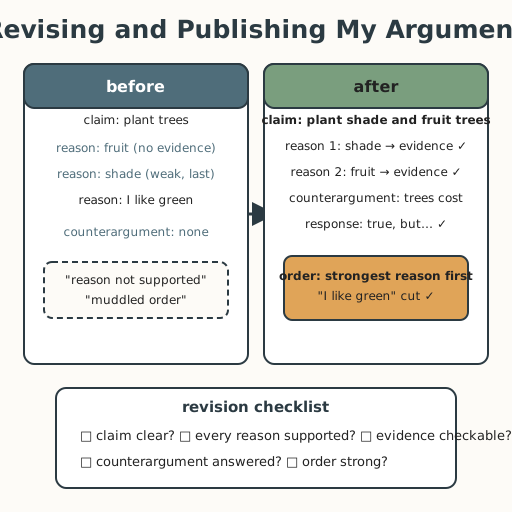
- Revision-check poster · 1 A poster with a checklist — claim clear? every reason supported? evidence checkable? counterargument answered? order strong? — plus a before/after example
- Revision checklist · 1 per learner A simple yes/no checklist matching the poster, for the learner and a peer to use
- Publishing page · 1 per learner A clean page to write the final, published argument with room for the title and the learner's name
Low-tech / no-cost
- Voice and a re-read Read your draft aloud once — you will hear where it stumbles — then fix the two weakest spots; no checklist needed
- A 'read it to the wall' pass Read your final argument aloud to a wall or a tree as your "audience," and notice what a listener would need clarified
Enriched / lab & device
- A peer-editing circle · 1 per group Learners exchange drafts and use the checklist on each other's work before publishing, giving one piece of specific, kind feedback
- A class publication wall or booklet · 1 A shared place — wall, booklet, or digital folder — where the final arguments are published for real readers
Works in different contexts
- large-group Revise one class draft together on the board using the checklist, then have learners revise their own and publish to the wall or booklet
- multi-age Younger learners read their draft aloud to an older peer who helps spot one fix, while older learners run the full checklist independently
- self-directed A learner runs the checklist on their own draft, makes at least two revisions, and writes the final published copy, then re-checks it once
- level-grouped Learners ready to extend revise for *voice and order* too — the strongest first sentence, the clearest link between claim and reasons — and explain each change
- outdoor-only Revise by reading your draft aloud in the open air to a partner, marking the two weakest spots, and publishing the final copy on a clean sheet
Lesson 11 — Revising and Publishing My Argument
Summary
Learners revise and publish their argument. They run a revision checklist — claim clear, every reason supported, evidence checkable, counterargument answered, order strong — make at least two revisions, and write a final published copy for real readers. This completes the three-lesson argument arc.
Objectives
- Write a well-developed argument with a claim, reasons, evidence, and a response to a counterargument. (D04.S3.06.01)
Connection
The first version of anything is rarely the best version. A potter doesn’t stop at the first shape; she smooths it, checks it, and only then sets it out for others. Writing is the same: the draft is the clay, and revising is the smoothing — checking that the claim is clear, every reason is supported, the evidence is checkable, and the counterargument is answered — before you publish it for readers. Publishing is not a contest; it is the moment you hand your honest thinking to other people, in your own words, in your own language.
Materials
- Revision-check poster
- Revision checklist
- Publishing page
Preparation
- Print or draw the revision-check poster (checklist plus a before/after example).
- Copy the revision checklist for each learner (and peers).
- Copy the publishing page, and prepare the publication wall, booklet, or folder.
Facilitator note
This lesson is written to the learner (“you”). The idea to land is that revision is
re-seeing — checking the thinking (claim, support, evidence, counterargument), while
editing checks the surface (spelling, punctuation). Model one revision on the board — take a
real draft sentence and improve it with the checklist (a novice skill; worked example first —
Kirschner, Sweller & Clark, 2006). Retrieval: this lesson pulls together Lessons 9 and 10 and
revisits the listening and evidence skills of Lessons 1–6. Frame publishing cooperatively: the
goal is a strong, honest piece shared for real readers, never a ranking (docs/philosophy.md
§8). Honor every home language — publish in the learner’s strongest language, and celebrate a
published piece in any language as complete and worthy. Keep peer feedback specific and kind:
one thing that works, one thing to try.
Procedure
- Gather (5 min). Look at your draft from the last two lessons. It is almost an argument. Today you revise it — make it clearer and stronger — and publish it.
- Meet the checklist (10 min). Look at the poster. Five questions: Is my claim clear? Is every reason supported? Is my evidence checkable? Did I answer the counterargument? Is my order strong (strongest reason first)? The “before” page shows a muddled draft with an unsupported reason crossed out; the “after” page shows it fixed. That is revision: keeping the idea, improving the work.
- Run the checklist (15 min). Go through your own draft with the checklist, question by question. Mark anything that needs fixing. Make at least two revisions — change the order, add or cut a reason, sharpen a sentence, make the evidence concrete. If you can, have a partner run the checklist too and tell you one thing that works and one thing to try.
- Publish (15 min). On a clean page, write your final argument: a title, your claim, your reasons with evidence, and your response to the counterargument. Read it once aloud to yourself before you set it out — you will hear the last rough spots.
- Close (5 min). You have done what writers everywhere do: thought, drafted, revised, and shared. Your argument now stands on reasons and evidence — and it answers, fairly, the person who sees things differently. That is a piece of writing to be proud of, in any language.
Differentiation
- Support: Provide a starter checklist with only two items (claim clear; counterargument answered) and a sentence frame for one revision; allow a shorter published piece.
- Extension: Revise also for voice — the strongest first sentence and the clearest link between claim and reasons — and write one sentence explaining each change you made.
Assessment
- Summative (portfolio/peer/self): The published argument includes a clear claim, reasons with evidence, and a response to a counterargument, and the learner made at least two revisions shown by the checklist.
- Self-check: The learner asks, “Could a stranger read my published argument and name my claim, my reasons, my evidence, and how I answered the other side?”
Home connection
Read your published argument to someone at home — in the language that feels strongest — and ask them one question: “Did it make sense, and did I answer the other side fairly?”
Resources
- Revision as re-seeing the thinking (distinct from editing the surface) and publishing for
real readers support writing development; see Graham & Perin, “Writing Next” (Carnegie
Corporation, 2007) and the IES “Teaching Secondary Students to Write Effectively” guide.
Cooperative, non-ranked publication reflects
docs/philosophy.md§8. On explicit instruction and worked examples, see Kirschner, Sweller & Clark (2006).