Lesson 03 — Positive and Negative Numbers in Real Life
Learners meet positive and negative numbers as signs of "above" and "below" a reference point. They place real temperatures (a hot day, a freezing night) and real elevations (a mountain peak, the Dead Sea) on a vertical number line, writing above-zero and above-sea-level amounts as positive and below-zero and below-sea-level amounts as negative.
Objectives
Objectives
- D05.S1.06.02 Use positive and negative numbers to represent real situations such as temperature and elevation, and locate and order them on a number line.
Essential question
How do positive and negative numbers represent situations such as temperature and elevation?
Key vocabulary
Materials
Standard materials
- Vertical number line · 1 per pair A vertical number line with 0 in the middle for marking temperatures and elevations
- Situation cards · 1 set per group Cards naming a temperature or elevation (a hot day, a cold night, a deep lake, a tall peak) to place on the line
- Recording page · 1 per learner A page to record each situation as a positive or negative number with its meaning
Low-tech / no-cost
- A wall or ground line Draw a vertical line with 0 in the middle in the dirt or on a wall; learners stand or place stones above and below zero
- Body as thermometer Arms up for "above zero," arms down for "below zero," crouching at 0; name real temperatures and move accordingly
Enriched / lab & device
- A thermometer image set · 1 per group Photos or drawings of real thermometers and elevation signs from different places, to match to numbers
- A digital number-line tool · 1 per group A tool that places and compares positive and negative numbers, where devices allow
Works in different contexts
- large-group Build one large vertical line at the front and place situations together, then have pairs place cards on their own lines
- multi-age Younger learners name "hot/cold, high/low" while older learners attach the signed numbers and order them
- self-directed A learner sorts the situation cards onto the line alone and checks against the worked example
- level-grouped Learners ready to extend compare two elevations (which is lower, a lake or a valley?) using signed numbers
- outdoor-only Find a slope or steps outdoors; call the middle "0," mark steps above and below, and place real places by their elevation
Lesson 3 — Positive and Negative Numbers in Real Life
Summary
Learners meet positive and negative numbers as signs of “above” and “below” a reference point. They place real temperatures (a hot day, a freezing night) and real elevations (a mountain peak, the Dead Sea) on a vertical number line, writing above-zero and above-sea-level amounts as positive and below-zero and below-sea-level amounts as negative.
Objectives
- Use positive and negative numbers to represent real situations such as temperature and elevation. (D05.S1.06.02)
Connection
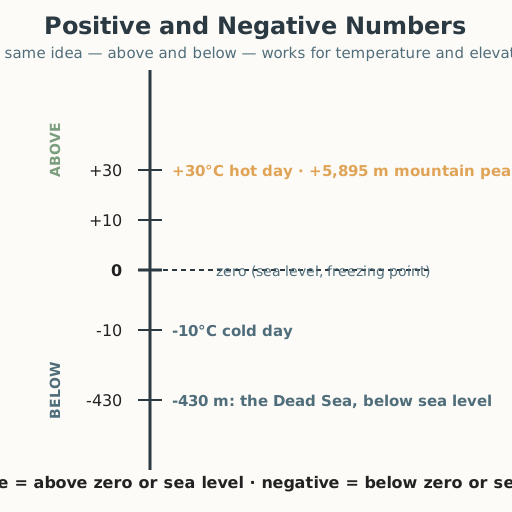
A winter morning in a high mountain town reads −10°C — ten degrees below zero — while a hot afternoon in the lowlands reads +30°C, thirty degrees above zero. The same “above and below” idea works for the land itself: a mountaintop is thousands of meters above sea level, while the shore of the Dead Sea is −430 m, hundreds of meters below sea level. Zero is not “nothing” here — it is the reference line we measure from, and positive and negative numbers tell us which side of it we stand on.
Materials
- Vertical number line
- Situation cards
- Recording page
Preparation
- Copy vertical number lines for pairs and situation cards for groups.
- Copy the recording page.
- Have examples ready: +30°C, −10°C, a peak at +5,895 m, the Dead Sea at −430 m.
Facilitator note
This lesson is written to the learner (“you”). The ideas to land: (1) positive numbers are above
the reference point and negative numbers are below it; (2) the reference point (0°C, sea level) is
a chosen starting line, not “nothing”; and (3) the sign (+ or −) carries the meaning of “above or
below.” Model one example aloud, then guide a second before independent work (Kirschner, Sweller &
Clark, 2006). Watch for the slip of treating “−10” as “ten” without its sign — the sign is the whole
point. Retrieval: ask learners to recall the number line and whole numbers from earlier grades; today
the line grows downward too. The environment lens is live here (docs/philosophy.md §4): elevations
and temperatures describe real, varied landscapes, and knowing them matters for farming, building, and
travel. Note the global and historical point: negative numbers were used in ancient China (red and
black counting rods for owing and having) and were given rules by Brahmagupta in India — the idea of
“below zero” is a human discovery, not one culture’s property. Distinguish evidence (the measured
temperatures and elevations are facts) from values (that all places and peoples are worthy of study).
Procedure
- Gather (5 min). Think of the coldest and hottest places you know. How would you write a number for “ten degrees below zero”? Today you learn the sign that says “below.”
- Meet above and below (10 min). Look at the vertical number line. Zero is the middle — the reference. Numbers above zero are positive (+30, +5,895). Numbers below zero are negative (−10, −430). The sign tells the direction.
- Worked example (10 min). Place −10°C on the line: it sits below zero, because it is ten degrees colder than freezing. Place +30°C: it sits above zero. Same line, opposite sides of zero.
- Worked example — elevation (10 min). Sea level is zero. A mountain peak at +5,895 m is above sea level (positive). The shore of the Dead Sea at −430 m is below sea level (negative). Write each with its sign and its meaning.
- Practice with a partner (10 min). Take your situation cards — a hot day, a cold night, a deep lake, a tall peak. Place each on the line and write its number with a sign. Check each other: is it above or below zero?
- Close (5 min). Positive and negative numbers tell which side of a reference line you are on — above or below zero, above or below sea level. The sign is the meaning.
Differentiation
- Support: Use only one context at a time (temperature first), with a large tactile line and the words “above/below” written on each side. Read each number aloud so learners with low vision can follow by listening.
- Extension: Compare two elevations or temperatures with signs (which is lower: −430 m or −200 m?) and explain that a more negative number is farther below zero.
Assessment
- Formative (observation/self): Can the learner place a real temperature or elevation above or below zero and write it with the correct sign?
- Self-check: The learner asks, “Did I put the number on the right side of zero, and did I write the sign that says above or below?”
Home connection
Find one “above zero” and one “below zero” example in your life or place — a high hill and a low valley, a hot day and a cold night — and write each as a signed number.
Resources
- Positive and negative numbers are standard in middle-grades mathematics; see John A. Van de Walle,
Elementary and Middle School Mathematics (10th ed., 2019). The measured elevations (e.g., the Dead
Sea shore near −430 m) and temperatures are factual; the historical note that negative numbers were
used in ancient China and systematized by Brahmagupta in India (7th century CE) is documented. The
claim that all places and peoples are worthy of study is a value (
docs/philosophy.md§4).