Lesson 08 — Which Quantity Depends on the Other
Learners decide which of two related quantities depends on the other. They name the independent quantity (the input, the one you choose) and the dependent quantity (the output, the one that follows), using pairs such as portions and cooking time, and water and plant growth — and they learn that not every pair is cause and effect.
Objectives
Objectives
- D05.S2.06.02 Represent the relationship between two quantities with a table and graph, and tell when one quantity depends on the other.
Essential question
How do I tell which of two related quantities depends on the other?
Key vocabulary
Materials
Standard materials
- Dependency cards · 1 set per group Cards naming pairs of related quantities (portions and cooking time, rain and puddle size) to sort into input and output
- Dependency recording page · 1 per learner A page to identify the independent and dependent quantity in each pair and explain the direction
- Arrow diagram template · 1 per pair A blank input → output arrow diagram to fill in for each situation
Low-tech / no-cost
- Role-play Two learners act a pair (one chooses, the other follows) and announce which of them "depends on" the other
- Voice questions Ask aloud "which do I choose, and which follows from it?" for each pair; answer without any paper
Enriched / lab & device
- A sorting game · 1 per group A game sorting pairs into "one depends on the other" vs "neither causes the other," for repeated play
- A real experiment · 1 per group Measure a real pair (water given vs plant growth over days) and name the independent and dependent quantity
Works in different contexts
- large-group Sort pairs together at the front with a big arrow, then have pairs sort cards and share one tricky case
- multi-age Younger learners match "you choose" to "follows from it" while older learners explain the direction and edge cases
- self-directed A learner works the recording page alone, naming each input and output, and checks against the worked example
- level-grouped Learners ready to extend distinguish true cause-and-effect from pairs that both follow a third thing
- outdoor-only Observe two quantities outdoors (sun and shadow length, rain and puddles) and name which depends on which
Lesson 8 — Which Quantity Depends on the Other
Summary
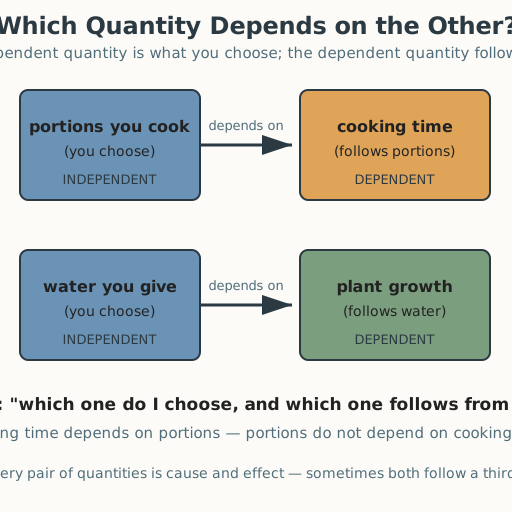
Learners decide which of two related quantities depends on the other. They name the independent quantity (the input — the one you choose) and the dependent quantity (the output — the one that follows), using pairs such as portions and cooking time, and water and plant growth. They learn that not every pair of quantities is cause and effect.
Objectives
- Tell when one of two related quantities depends on the other, naming the independent and dependent quantity. (D05.S2.06.02)
Connection
If you cook for more people, the cooking time grows — but the number of people does not grow because the cooking time grew. Cooking time depends on the number of portions; the portions are what you choose. Spotting this direction — what I choose, and what follows from it — is how a doctor reads “how much medicine depends on a child’s weight,” how a gardener knows a plant’s growth follows the water it gets, and how a shopper reasons that the total price follows the number of items. Naming the direction of a relationship is the first step toward understanding it anywhere.
Materials
- Dependency cards
- Dependency recording page
- Arrow diagram template
Preparation
- Copy dependency cards for groups, the recording page, and arrow diagram templates.
- Have examples ready: portions → cooking time (time depends on portions); water → growth (growth depends on water).
Facilitator note
This lesson is written to the learner (“you”). The ideas to land: (1) the independent quantity is the
one you choose or control (the input); the dependent quantity is the one that follows from it (the
output); (2) the test is “which do I choose, and which follows?”; and (3) correlation is not the same as
causation — two quantities may rise together because a third thing drives both. Model a worked example
first, then guide a second before independent work (Kirschner, Sweller & Clark, 2006). A common slip is
assuming the first-mentioned quantity is always the cause; keep returning to the “which do I choose?”
test. Retrieval: ask learners to recall yesterday’s table and graph (buckets → liters) — buckets are
independent, liters depend on them. The critical-thinking lens is central (docs/philosophy.md §7):
saying “one depends on the other” is a claim that needs a reason, and the honest habit of asking
“or do they both follow something else?” is the beginning of scientific skepticism. Note the global
point: farmers, fishers, and healers in every tradition have reasoned about dependence — “if the rains
come, the crops follow” — long before graphs had axes.
Procedure
- Gather (5 min). Last time you graphed two quantities growing together. Today you ask which one leads and which one follows.
- Meet input and output (10 min). In a pair of related quantities, the independent quantity is the one you choose (the input). The dependent quantity is the one that follows from it (the output). Ask: “which do I choose, and which follows?”
- Worked example (10 min). Portions and cooking time. Do you choose the portions? Yes. Does cooking time follow? Yes. So portions are independent and cooking time is dependent — time depends on portions, not the other way around.
- Worked example — a caution (10 min). Rain and puddle size: puddle size depends on rain (rain is independent). But consider “umbrellas sold and rain”: umbrellas do not cause rain — both follow the weather. Not every pair is cause and effect; sometimes both follow a third thing.
- Practice with a partner (10 min). Take your dependency cards. For each pair, draw the arrow (input → output), name the independent and dependent quantity, and say why the direction goes that way. Check each other’s reasoning.
- Close (5 min). To read a relationship, name its direction: what I choose, and what follows from it. And remember — two things moving together are not always one causing the other.
Differentiation
- Support: Use only clear cause-and-effect pairs (water → growth, items → total price) with the arrow template; describe each direction aloud so learners with low vision can follow by listening.
- Extension: Given a pair that rises together (ice-cream sales and sunburns), explain that neither causes the other — a third thing (hot weather) drives both; write a sentence justifying each dependency.
Assessment
- Formative (observation/self): Can the learner identify the independent and dependent quantity in a real pair and explain the direction?
- Self-check: The learner asks, “Which do I choose, and which follows? Did I give a reason, and did I check whether both might follow a third thing?”
Home connection
Find a pair of related quantities at home (water and a plant, days and money saved, guests and rice cooked) and tell someone which one depends on the other and why.
Resources
- Distinguishing independent and dependent quantities is standard in middle-grades mathematics; see John
A. Van de Walle, Elementary and Middle School Mathematics (10th ed., 2019). The caution that
correlation is not causation is a core scientific idea; the habit of asking “or do both follow a third
thing?” is a critical-thinking value (
docs/philosophy.md§7).