Lesson 09 — Area and Volume of Common Figures
Learners find the area of a rectangle (length × width, in square units) and the volume of a rectangular prism (length × width × height, in cubic units). They build both with square tiles and unit cubes, count the units, and see that the formula simply counts layers fast.
Objectives
Objectives
- D05.S3.06.01 Find area, surface area, and volume of common figures and use nets to build and analyze three-dimensional shapes.
Essential question
How do I find the area of a rectangle and the volume of a rectangular prism?
Key vocabulary
Materials
Standard materials
- Square tiles and unit cubes · 20 tiles and 30 cubes per group To build a rectangle and a prism and count square and cubic units
- Area and volume recording page · 1 per learner A page to record dimensions, count units, and apply formulas
- Ruler or measuring strip · 1 per pair To measure real objects (a book cover, a box) and compute area and volume
Low-tech / no-cost
- Grid drawn on paper or ground Count squares inside a rectangle drawn on a grid; stack leaves or stones in layers to feel volume
- Fold and stack Fold paper into squares for area, then stack layers of squares to show the third dimension
Enriched / lab & device
- A geometry app · 1 per group A tool that builds and measures rectangles and prisms and shows area and volume, where devices allow
- Real box and cloth task · 1 per group Measure a real box to find its volume (how much it holds) and a tabletop for its area (how much cloth covers it)
Works in different contexts
- large-group Build one rectangle and one prism together at the front, then have pairs build and record their own
- multi-age Younger learners count squares and cubes while older learners apply the formulas and compare
- self-directed A learner builds and counts units alone, records dimensions, and checks the formula against the counting
- level-grouped Learners ready to extend find a missing dimension from a given area or volume and explain the inverse
- outdoor-only Measure a real rectangle outdoors (a garden bed) and build a prism with stones or soil, counting layers
Lesson 9 — Area and Volume of Common Figures
Summary
Learners find the area of a rectangle (length × width, in square units) and the volume of a rectangular prism (length × width × height, in cubic units). They build both with square tiles and unit cubes, count the units, and see that the formula simply counts layers fast.
Objectives
- Find the area of a rectangle and the volume of a rectangular prism and explain what each measures. (D05.S3.06.01)
Connection
A farmer must know how much ground a garden bed covers (area) to know how much seed to sow, and a potter must know how much a vessel holds (volume) to know how much grain it carries. Area answers “how much flat space?”; volume answers “how much space inside?” The same two questions — cover and fill — are asked by thatchers, box-makers, builders, and cooks in every part of the world, from a courtyard in Marrakesh to a rice field in the Mekong delta.
Materials
- Square tiles and unit cubes
- Area and volume recording page
- Ruler or measuring strip
Preparation
- Gather square tiles (about 20 per group) and unit cubes (about 30 per group).
- Copy the recording page.
- Have a worked example ready: a 4 × 3 rectangle → 12 square units; a 4 × 3 × 2 prism → 24 cubic units.
Facilitator note
This lesson is written to the learner (“you”). The ideas to land: (1) area counts how many square
units cover a flat shape — for a rectangle, length × width; (2) volume counts how many cubic
units fill a solid — for a rectangular prism, length × width × height; and (3) the formula is just
fast counting: area counts one layer, volume counts the layers stacked. Model a worked example first, then
guide a second before independent work (Kirschner, Sweller & Clark, 2006). Two common slips: confusing
square units with cubic units (the dimension of the answer must match the question), and multiplying only
two of the three numbers for volume. Retrieval: ask learners to recall perimeter and area from earlier
grades — perimeter is the fence (edge), area is the field (surface), and now volume is the box (inside).
The critical-thinking lens: always ask “what does this number measure — length, surface, or space?” so the
unit and the story match (docs/philosophy.md §7). Note the global point: area and volume formulas were
worked out in ancient Egypt and Mesopotamia (for fields and granaries), in China, and in India — measuring
cover and fill is a human universal, not one culture’s invention.
Procedure
- Gather (5 min). Think of a garden bed and a grain jar. One is a flat space, the other a space you fill. Today you measure both.
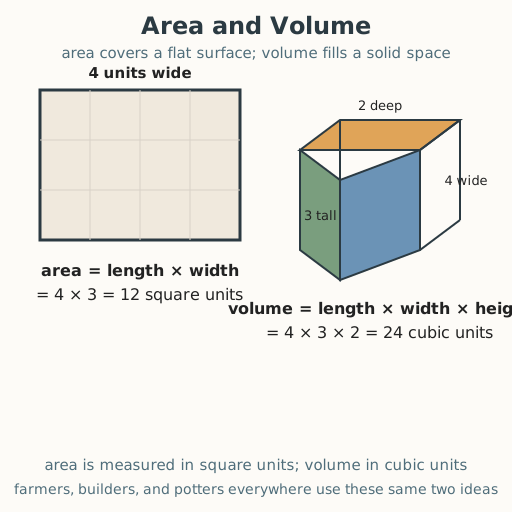
- Meet area (10 min). Area is how much flat surface a shape covers, counted in square units. Build a 4-by-3 rectangle with tiles: 4 across and 3 down makes 12 squares. So area = 4 × 3 = 12 square units.
- Worked example — area (10 min). A tabletop is 5 units long and 2 units wide. Area = length × width = 5 × 2 = 10 square units. Check by counting the 10 squares.
- Meet volume (10 min). Volume is how much space a solid fills, counted in cubic units. Stack the 12 squares into a layer, then stack 2 layers deep: a 4-by-3-by-2 prism. Count the cubes: 24. So volume = length × width × height = 4 × 3 × 2 = 24 cubic units.
- Practice with a partner (10 min). Build your own rectangle and prism, count the units, and write the formula for each. Check each other: does the answer’s unit (square or cubic) match the question?
- Close (5 min). Area covers, volume fills. Length × width counts one layer; times height counts all the layers. Always match the unit to what you are measuring.
Differentiation
- Support: Use only small dimensions (2 × 3, 2 × 2 × 3) and count aloud every square and cube; use tactile tiles and cubes so learners with low vision can count by touch.
- Extension: Find a missing dimension from a given area or volume (area 24, length 6 → width ?), and find the area and volume of a real object with a ruler.
Assessment
- Formative (observation/self): Can the learner build a rectangle and a prism, count the units, and apply the correct formula with the correct unit?
- Self-check: The learner asks, “Did I multiply the right dimensions, and did I label my answer in square units for area and cubic units for volume?”
Home connection
Measure a flat surface at home (a table, a door) to find its area, and a box to find its volume; tell someone what each number measures.
Resources
- Area of rectangles and volume of rectangular prisms are standard in middle-grades mathematics; see John
A. Van de Walle, Elementary and Middle School Mathematics (10th ed., 2019). The note that area and
volume formulas appear in ancient Egyptian, Mesopotamian, Chinese, and Indian mathematical records is
documented history; matching units to what is measured is a critical-thinking habit (
docs/philosophy.md§7).