Lesson 10 — Surface Area and Nets of 3-D Shapes
Learners find the surface area of a rectangular prism by unfolding it into a net of six faces, computing the area of each face, and summing them. They see the formula 2(lw) + 2(lh) + 2(wh) as a fast way to count the same six faces, and connect surface area to how much wrapping or paint a box needs.
Objectives
Objectives
- D05.S3.06.01 Find area, surface area, and volume of common figures and use nets to build and analyze three-dimensional shapes.
Essential question
How do I find the surface area of a three-dimensional shape using a net?
Key vocabulary
Materials
Standard materials
- Paper box templates · 1 per learner A printable net of a rectangular prism to cut, fold, and unfold
- Surface-area recording page · 1 per learner A page to count and sum the faces of a net and apply the surface-area formula
- Scissors and tape · 1 per pair To cut and fold the nets, where available
Low-tech / no-cost
- A real box, unfolded Carefully unfold a paper or thin-card box and count its six faces; refold it to see the box return
- Drawn net in the dirt Draw the six faces of a box flat in the dirt, label each face, and count the total surface
Enriched / lab & device
- A 3-D geometry app · 1 per group A tool that unfolds and folds prisms on screen and shows the surface area, where devices allow
- A wrapping task · 1 per group Measure a real box and find how much paper or cloth is needed to wrap all six faces
Works in different contexts
- large-group Unfold one large box together at the front, then have pairs cut and fold nets and sum their faces
- multi-age Younger learners count and match the six faces while older learners compute each face's area and the total
- self-directed A learner cuts and folds the net alone, counts the faces, and checks the formula against the counting
- level-grouped Learners ready to extend find surface area from dimensions only (no net) and design a net for a given box
- outdoor-only Unfold a found box outdoors and lay its faces flat on the ground; count and sum the faces
Lesson 10 — Surface Area and Nets of 3-D Shapes
Summary
Learners find the surface area of a rectangular prism by unfolding it into a net of six faces, computing the area of each face, and summing them. They see the formula 2(lw) + 2(lh) + 2(wh) as a fast way to count the same six faces, and connect surface area to how much wrapping, paint, or cloth a box needs.
Objectives
- Find the surface area of a rectangular prism using a net, and explain what surface area measures. (D05.S3.06.01)
Connection
A gift needs wrapping, a wall needs paint, a clay pot needs glaze. Each asks the same question: how much material covers the outside of a three-dimensional shape? Unfold the shape flat and you see its net — all its faces laid out like a cut-open box. Count and measure those faces, add them up, and you know the surface area. Package-makers, tent-makers, and painters in every country reason exactly this way, from a market stall folding boxes in Cairo to a cooper measuring staves for a barrel.
Materials
- Paper box templates
- Surface-area recording page
- Scissors and tape (where available)
Preparation
- Print or draw a net template for each learner (a 4 × 2 × 3 prism).
- Copy the surface-area recording page.
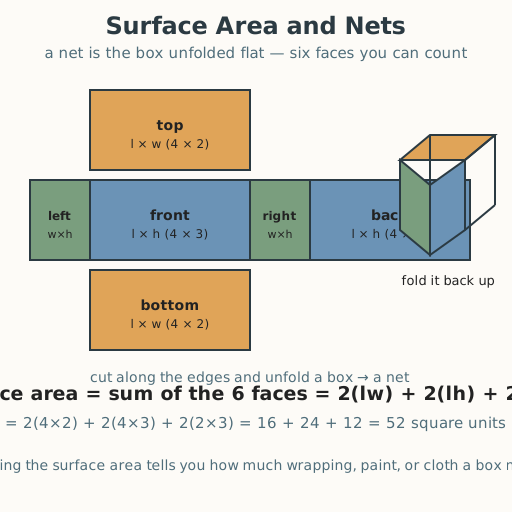
- Have a worked example ready: faces of 4×2, 4×3, 2×3 each appear twice → 2(8) + 2(12) + 2(6) = 52.
Facilitator note
This lesson is written to the learner (“you”). The ideas to land: (1) a net is a three-dimensional
shape unfolded into flat faces; (2) surface area is the total area of all the faces — for a
rectangular prism, the six faces come in three matching pairs; and (3) the formula 2(lw) + 2(lh) +
2(wh) is just fast counting of those six faces. Model a worked example first, then guide a second before
independent work (Kirschner, Sweller & Clark, 2006). Two common slips: counting a face twice or missing
one (the top and bottom are easy to forget), and confusing surface area (the outside) with volume (the
inside). Retrieval: ask learners to recall yesterday’s area and volume — surface area is area applied to
each face of a solid. The environment lens is live here (docs/philosophy.md §4): knowing surface area
matters for not wasting paint, cloth, or wrapping — measuring honestly saves materials, which is a care
for the Earth as well as for the pocket. Note the global point: nets and unfolding are used in packaging
and craft traditions worldwide — from paper lanterns in East Asia to folded baskets in many cultures —
geometry in the hands of makers.
Procedure
- Gather (5 min). Last time you measured the space inside a box. Today you measure its outside — the part you paint or wrap.
- Meet the net (10 min). Cut out your box template and fold it into a box. Now unfold it flat. That flat shape — six faces — is a net. A box has a top and bottom, a front and back, a left and right.
- Worked example — count the faces (10 min). Label the six faces with their sizes: top and bottom are each 4 × 2, front and back are each 4 × 3, left and right are each 2 × 3.
- Worked example — sum them (10 min). Find each face’s area and add all six: top 8, bottom 8, front 12, back 12, left 6, right 6. Total = 8 + 8 + 12 + 12 + 6 + 6 = 52 square units. That is the surface area. The formula 2(4×2) + 2(4×3) + 2(2×3) counts the same six faces.
- Practice with a partner (10 min). Cut and fold your own net, unfold it, and find its surface area by counting and summing the faces. Check each other: did you count all six faces exactly once?
- Close (5 min). A net shows a box’s six faces flat. Surface area is their total — how much paint, cloth, or paper the outside needs. The formula is fast counting, nothing more.
Differentiation
- Support: Use a pre-drawn net with each face’s area already written; count the six faces aloud and use a real box so learners with low vision can feel each face.
- Extension: Find surface area from dimensions alone (no net), and design a net for a box with a given surface area; explain the three matching pairs.
Assessment
- Formative (observation/self): Can the learner unfold a prism into a net, compute each face’s area, and sum them to find surface area?
- Self-check: The learner asks, “Did I find all six faces, count each exactly once, and add their areas — and does my answer tell how much covers the outside?”
Home connection
Unfold a small box at home, count its six faces, and find its surface area; then fold it back up and show someone the net.
Resources
- Surface area and nets are standard in middle-grades mathematics; see John A. Van de Walle, Elementary
and Middle School Mathematics (10th ed., 2019). The note that unfolding and folding (nets) appear in
packaging and craft traditions worldwide is a general observation; the value that measuring honestly
saves materials is an environmental and egalitarian commitment (
docs/philosophy.md§4).