Lesson 03 — A Day of Food and Drink: Let's Look
Learners begin the nutrition half of the unit by doing what scientists do first: collecting data with curiosity instead of judgment. They record a typical day of food and drink — morning, midday, afternoon, evening, and drinks — from their own real life, meeting worked examples from several regions, and set the stage for choosing one change that better fuels the body in the next lesson. Every way of eating is honored.
Objectives
Objectives
- D03.S3.06.01 Analyze a typical day of food and drink and identify one change that would better fuel the body.
Essential question
What do I actually eat and drink in a typical day, and how do I look at it with curiosity instead of judgment?
Key vocabulary
Materials
Standard materials
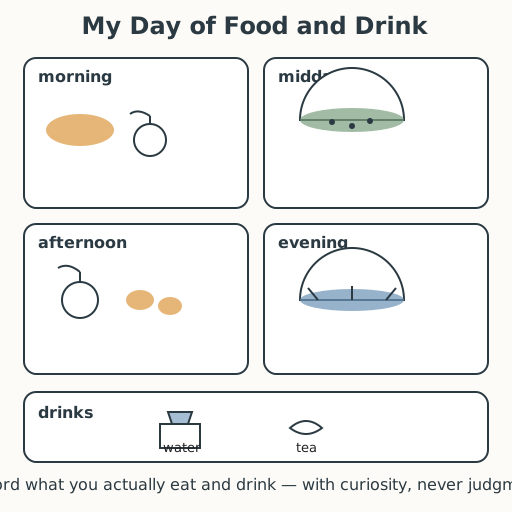
- A day of food and drink poster · 1 A poster showing a day in four sections — morning, midday, afternoon, evening — each with example foods and drinks from several regions, to model a recorded day
- My day page · 1 per learner A page with four time boxes and a drinks row, where the learner records what they actually ate and drank in a recent day — a portfolio artifact
- Pencils · per learner
Low-tech / no-cost
- Memory round Learners close their eyes and recall their last full day of food and drink, naming each item aloud in turn; no page needed
- Ground chart Draw four time boxes in the dirt or sand and place a stone or a drawn mark for each food or drink in its box
Enriched / lab & device
- A simple food-and-drink tally sheet (paper or digital) · 1 per learner A tally or list to record a real day over the coming week for the next lesson
- A class 'many tables' wall · 1 A shared wall where learners post one anonymous day, showing the wide variety of healthy ways people eat
Works in different contexts
- large-group Model one day on the board together, then have learners record their own day privately; share only examples learners choose to offer
- multi-age Younger learners draw their foods while older learners label and sort them, then pair to compare how similar and different the days are
- self-directed A learner recalls their last full day, records it in the four boxes, and reads it back to check it is complete and truthful
- level-grouped Learners ready to extend notice patterns across their day (when they eat, what they drink most) and name one pattern in a sentence
- outdoor-only Draw the four boxes on the ground and place stones or marks for each food and drink, then describe the day aloud to a partner
Lesson 3 — A Day of Food and Drink: Let’s Look
Summary
Learners begin the nutrition half of the unit by doing what scientists do first: collecting data with curiosity instead of judgment. They record a typical day of food and drink — morning, midday, afternoon, evening, and drinks — from their own real life, meeting worked examples from several regions, and set the stage for choosing one change that better fuels the body in the next lesson. Every way of eating is honored; no food, body, or family is judged.
Objectives
- Analyze a typical day of food and drink and identify one change that would better fuel the body. (D03.S3.06.01)
Connection
A mapmaker does not change a landscape until they have first looked at it carefully. Before you decide anything about how you eat, you first look at what you actually eat and drink — with curiosity, the way a scientist records what they see. Your day of food might look very different from a friend’s: yours might hold rice, beans, and fruit; a friend’s might hold flatbread, lentils, and tea; another’s might hold maize, fish, and water. There is no one “right” plate. The first step is simply to see your own day clearly — because you can only care for what you notice.
Materials
- A day of food and drink poster
- My day page
- Pencils
Preparation
- Print or draw the “day of food and drink” poster (four time sections plus a drinks row, with example foods from several regions).
- Copy a “my day” page for each learner.
- Recall Grade 5: learners learned the six nutrients and their jobs; today they apply that by recording what they actually eat and drink.
Facilitator note
This lesson is written to the learner (“you”). The one idea to land is that analyzing
starts with honestly noticing — recording a real day, not an idealized one. Guard the
no-shame rule at every step: there are no “good” or “bad” foods in this activity,
only information. A learner’s day reflects what their family has, can afford, and eats
by culture and habit — never a personal failing. Use food examples from many regions
(rice, maize, cassava, plantain, bread, beans, lentils, chickpeas, tofu, fish, eggs,
milk, fruit, vegetables, nuts, tea, water) so every home’s table belongs. Model one day
as a worked example before learners record their own, and never require anyone to
share their day aloud if they do not wish to. See docs/facilitation.md and
docs/contexts.md.
Procedure
- Gather (5 min). You know the nutrients — carbohydrates for fuel, proteins to build, fats to store and build, plus vitamins, minerals, and water. Today you use that knowledge by first looking at a real day of food and drink.
- Meet the poster (10 min). Look at the poster — a worked example of one recorded day. It has four time sections — morning, midday, afternoon, evening — and a drinks row. Notice the foods come from many places: rice and beans, flatbread and vegetables, fruit, soup, nuts, a cup of water. Your day does not need to match this one; it needs to be yours, recorded truly.
- Record your day (20 min). Think of a typical recent day — not a special feast day, just an ordinary one. In each box on your page, write or draw what you ate and drank. Include the little things: the fruit you grabbed, the water or tea you drank, the snack between meals. Be honest — this is data about you, not a test to pass.
- Look for a pattern (5 min). Read your day back to yourself. What do you notice? Do you drink much water? Do fruits and vegetables show up? When do you feel most hungry? Just notice — no judgment. This noticing is the analysis.
- Close (5 min). You have looked at your day clearly and kindly. Next time you will choose one change that better fuels your body — a small, real step that is yours.
Differentiation
- Support: Provide pre-drawn boxes with food pictures to circle, and scribe as needed; allow drawing instead of writing.
- Extension: Notice a pattern across the day — when you eat, what you drink most, or which food groups appear often — and write one sentence naming that pattern.
Assessment
- Formative (observation): Can the learner record a typical day of food and drink in the four time sections plus drinks, without judgment?
- Portfolio (artifact): The completed “my day” page, kept to guide the next lesson’s one change.
- Self-check: The learner asks, “Is this day recorded truthfully and completely — and did I notice it with curiosity, not criticism?”
Home connection
At home, ask someone what a typical day of food looks like for them, and share one thing you noticed about your own day.
Resources
- Recording and reflecting on what one actually eats and drinks is the descriptive first step in nutrition education, distinct from judging; the World Health Organization’s “Healthy diet” fact sheet (https://www.who.int/news-room/fact-sheets/detail/healthy-diet) and the FAO’s food-based dietary guidelines (https://www.fao.org/nutrition/education/food-dietary-guidelines/en/) describe the wide variety of healthy ways people eat around the world. These describe what food does and what healthy patterns look like across cultures — never a judgment about any body or family.