Lesson 07 — Signs of Stress and One Self-Care Action
Learners learn to notice signs of stress or distress in themselves — in the body, the feelings, and the behavior — and choose one simple self-care action from a menu, framed as information, never weakness, and never stigmatizing mental health. They record one sign and one action as a portfolio artifact, setting up the capstone's trusted-person plan.
Objectives
Objectives
- D03.S4.06.02 Identify signs of stress or distress in themselves and name one self-care action and one person to talk to.
Essential question
How do I recognize signs of stress or distress in myself — and what one self-care action can I take?
Key vocabulary
Materials
Standard materials
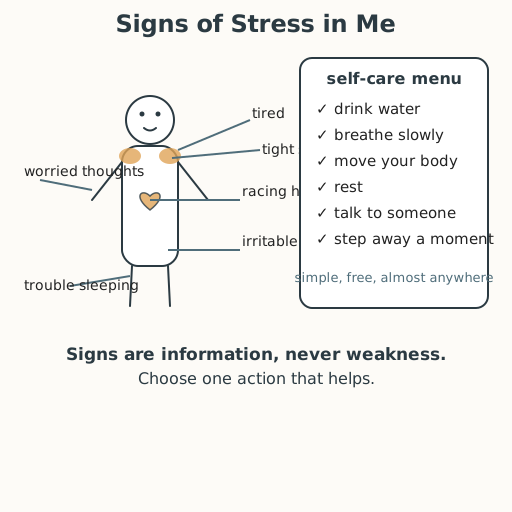
- Signs of stress poster · 1 A poster showing common signs of stress in the body, feelings, and behavior — tired, tight shoulders, racing heart, worry, irritability, trouble sleeping — with the caption "signs are information, never weakness"
- Self-care menu · 1 per learner A one-page menu of simple self-care actions — drink water, breathe slowly, move, rest, talk to someone, step away — to choose from
- My self-care page · 1 per learner A page where the learner records one sign they notice in themselves and one self-care action — a portfolio artifact
Low-tech / no-cost
- Body and voice Name a sign aloud and show where it lives in the body, then demonstrate one self-care action; no page needed
- Ground chart Draw two circles — "signs I notice" and "actions that help" — and place stones or marks in each
Enriched / lab & device
- A calming corner or quiet space · 1 A designated spot with a soft object or a picture where a learner can practice one self-care action
- A guided breathing audio (short) · 1 A one-to-two-minute slow-breathing audio to practice a self-care action together
Works in different contexts
- large-group Go through the signs poster as a class, then have learners choose one sign and one action privately, sharing only if they wish
- multi-age Younger learners point to a sign and an action; older learners explain why the action helps and model it for a partner
- self-directed A learner reads the signs and the menu, records one sign and one action, and practices the action once to check it helps
- level-grouped Learners ready to extend distinguish stress (everyday pressure that passes) from distress (heavier, longer-lasting) and note that both deserve care and, when big, a trusted adult
- outdoor-only Notice signs in the body while moving or sitting outside, then practice one action (slow breaths, a walk, a drink of water) in the open air
Lesson 7 — Signs of Stress and One Self-Care Action
Summary
Learners learn to notice signs of stress or distress in themselves — in the body, the feelings, and the behavior — and choose one simple self-care action from a menu, framed as information, never weakness, and never stigmatizing mental health. They record one sign and one action as a portfolio artifact, setting up the capstone’s trusted-person plan.
Objectives
- Identify signs of stress or distress in themselves and name one self-care action and one person to talk to. (D03.S4.06.02)
Connection
A fire needs a smoke signal to warn you there is smoke; your body and feelings send you signals too. When life gets heavy — a test, a change, a worry, too many things at once — your body might feel tired, your shoulders might tighten, your heart might race, and you might feel worried or irritable or find it hard to sleep. These are not flaws and not failures; they are signals — your own early warning system, telling you it is time to care for yourself. Noticing the signal is the first step. Choosing one small self-care action is the second.
Materials
- Signs of stress poster
- Self-care menu
- My self-care page
Preparation
- Print or draw the “signs of stress” poster (body, feeling, and behavior signs, with the caption “signs are information, never weakness”).
- Copy a self-care menu and a “my self-care” page for each learner.
- Recall Lesson 1 of this grade’s movement unit: stress shows up as tension in the body, and there are ways to release it; today learners name the signs and choose one self-care action.
Facilitator note
This lesson is written to the learner (“you”). The one idea to land is that signs of
stress are information, not weakness — and a small self-care action helps. Keep it
empowering and non-stigmatizing: never label a learner “stressed,” “anxious,” or
“depressed,” and never suggest that struggling is a defect. Use ordinary language — “a lot
on your mind,” “feeling heavy,” “worried,” “tired” — and treat stress as something every
person feels, at every age, in every culture. Frame distress gently as heavier,
longer-lasting stress that deserves extra care — and, crucially, that when feelings feel
too big to carry alone, telling a trusted adult is itself self-care (the capstone’s
focus). Invite only safe, ordinary examples; a learner may carry heavy or ongoing stress,
so never require disclosure and always leave room to step away. The self-care actions must
be simple, free, and universal — water, slow breathing, movement, rest, talking to
someone, stepping away — never luxuries some learners cannot access. See
docs/facilitation.md on holding difficult topics safely.
Procedure
- Gather (5 min). Your body and feelings send you signals when life gets heavy. Today you learn to notice the signs — and choose one self-care action that helps.
- Meet the signs (10 min). Look at the poster — a worked example of the three
kinds of signs:
- In the body: feeling tired, tight shoulders, a racing heart, a churning stomach.
- In the feelings: worry, irritability, feeling overwhelmed.
- In the behavior: trouble sleeping, snapping at people, wanting to hide away. Notice the caption: these signs are information, never weakness. Everyone has them; they mean the body and mind are asking for care.
- Meet the menu (10 min). Now the self-care menu — simple, free actions you can do almost anywhere: drink water, breathe slowly, move your body, rest, talk to someone, step away for a moment. These are not cures; they are small, kind steps that help your body and mind settle.
- Choose and try yours (15 min). Think of one sign you sometimes notice in yourself. Write it on your page. Then choose one action from the menu and actually try it once right now — slow breaths, a stretch, a sip of water, a moment of quiet. Notice: does anything soften, even a little? That is self-care working.
- Close (5 min). You are not broken when you feel stress — you are human. Noticing the sign and choosing one kind action is a skill you now own. Next time: the capstone — your trusted person and your whole self-care plan.
Differentiation
- Support: Provide a picture menu of signs and actions to circle; scribe as needed; practice one action together slowly.
- Extension: Distinguish everyday stress (pressure that passes) from distress (heavier, longer-lasting) and write one sentence about why big feelings deserve both self-care and a trusted adult.
Assessment
- Formative (observation): Can the learner name one sign of stress they notice in themselves and choose one self-care action?
- Portfolio (artifact): The “my self-care” page (one sign + one action), kept to feed the capstone plan.
- Self-check: The learner asks, “Can I name a sign I actually notice in myself, and does my chosen action help — even a little?”
Home connection
At home, notice one sign of stress in yourself this week and try your self-care action, then share with someone what you noticed and what helped.
Resources
- That stress shows up as body sensations, feelings, and changes in behavior, and that simple self-care actions (slow breathing, movement, rest, water, and social support) help the body and mind settle, is well-established in stress and self-regulation research and in the CASEL self-awareness and self-management competencies (https://casel.org/fundamentals-of-sel/). The lesson holds “signs are information, never weakness” as both a factual framing and a value, and deliberately uses non-stigmatizing, everyday language for mental wellbeing.