Lesson 08 — My Self-Care Plan and My Person to Talk To (Capstone)
The unit capstone brings self-care home: learners name one trusted person to talk to and build a one-page self-care plan that also reviews the whole unit — the changes of puberty and that every pace is normal, one change to fuel the body, the food journey and its effects, and safer choices in play, travel, and online life. This is retrieval and synthesis: the unit's learning, carried forward into a growing, caring life.
Objectives
Objectives
- D03.S4.06.02 Identify signs of stress or distress in themselves and name one self-care action and one person to talk to.
- D03.S1.06.01 Describe the basic changes of puberty and that they happen at different times for different people.
- D03.S3.06.01 Analyze a typical day of food and drink and identify one change that would better fuel the body.
- D03.S3.06.02 Explain how food is produced and transported and how this affects people and the environment.
- D03.S4.06.01 Assess everyday risks in play, travel, and online life and choose safer actions.
Essential question
Who is my person to talk to, what is my self-care plan, and how does everything I learned this unit fit together?
Key vocabulary
Materials
Standard materials
- My self-care plan poster · 1 A poster showing a one-page plan — my trusted person, my self-care action, and the unit's big ideas — as a worked example to copy from
- My self-care plan page · 1 per learner A one-page plan with sections for the trusted person, the self-care action, and a unit review — a capstone portfolio artifact
- Earlier pages · 1 set per learner The learner's own pages from Lessons 1–7 (what I notice, my day, my one change, my food's journey, my safer choice, my self-care)
Low-tech / no-cost
- Round-table recall In a circle, each learner recalls one thing from the unit — a puberty change, a fuel change, a food journey, a safer choice, a stress sign — building the review aloud
- Plan in the dirt Draw the plan's boxes on the ground and fill each with a word or a mark — the trusted person and the self-care action — stepping to each in turn
Enriched / lab & device
- A class 'our plans' gallery · 1 A shared wall where completed plans are posted (with permission), showing the many valid ways to care for a growing self
- A digital plan (slides or a voice note) · 1 per learner or group An optional digital version of the plan, with a short voice note naming the trusted person and the self-care action
Works in different contexts
- large-group Model one completed plan on the board, then have learners build their own and share one section each in a go-around
- multi-age Younger learners fill each section with a picture or a single word; older learners write full sentences connecting the parts and coach a partner
- self-directed A learner completes the plan alone, reads it back as a self-check, and teaches one part of it to someone else
- level-grouped Learners ready to extend connect the five big ideas into one paragraph about how knowing, fueling, choosing, and caring keep a body healthy, safe, and strong
- outdoor-only Draw the plan's boxes on the ground, step to each in turn, and say the trusted person and the self-care action aloud
Lesson 8 — My Self-Care Plan and My Person to Talk To (Capstone)
Summary
The unit capstone brings self-care home: learners name one trusted person to talk to and build a one-page self-care plan that also reviews the whole unit — the changes of puberty and that every pace is normal, one change to fuel the body, the food journey and its effects, and safer choices in play, travel, and online life. This is retrieval and synthesis: the unit’s learning, carried forward into a growing, caring life.
Objectives
- Identify signs of stress or distress in themselves and name one self-care action and one person to talk to. (D03.S4.06.02)
- Describe the basic changes of puberty and that they happen at different times for different people. (D03.S1.06.01)
- Analyze a typical day of food and drink and identify one change that would better fuel the body. (D03.S3.06.01)
- Explain how food is produced and transported and how this affects people and the environment. (D03.S3.06.02)
- Assess everyday risks in play, travel, and online life and choose safer actions. (D03.S4.06.01)
Connection
A traveler does not walk a long road without a small map and a friend to call when the way is hard. This unit has been building your map and your friend. The map is your self-care plan: one trusted person to talk to, and one self-care action to take when you notice stress. The friend is the plan itself — something you can carry with you, out of this classroom and into your life. You do not need the plan to be perfect; you only need to know it is yours, and where to reach for it.
Materials
- My self-care plan poster
- My self-care plan page
- Earlier pages (Lessons 1–7)
Preparation
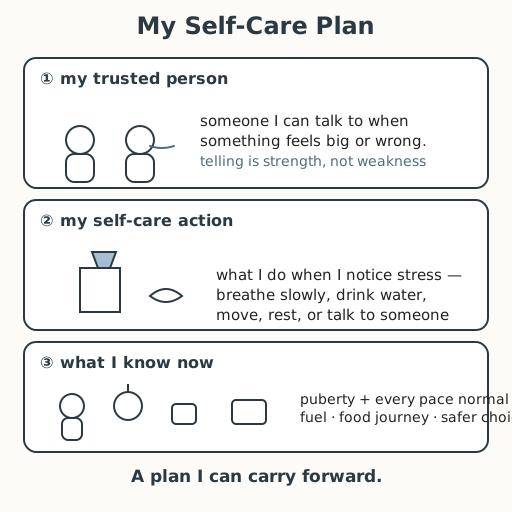
- Print or draw the “my self-care plan” poster (three sections: my trusted person, my self-care action, and what I know now).
- Copy a “my self-care plan” page for each learner.
- Have learners gather their own earlier pages from Lessons 1–7.
- Arrange a quiet space for individual writing and a circle for sharing.
Facilitator note
This lesson is written to the learner (“you”). It has two jobs: (1) land the trusted
person + self-care action (D03.S4.06.02) and (2) review the whole unit into one
portfolio artifact. Treat the trusted person with care: it may be a parent, grandparent,
aunt or uncle, teacher, coach, health worker, or neighbor — whoever the learner genuinely
trusts and can reach. Normalize that telling is strength, not weakness, and reassure
learners that if a first trusted person does not help, they can tell a second. This is
summative retrieval — the learner recalls each idea rather than re-reading; if someone
struggles, point them to their own earlier pages, not the answer. Keep the review
dignified and joyful: no two plans will match, and that is the point — every body and
every life is honored. See docs/facilitation.md and the retrieval-practice evidence in
docs/contexts.md.
Procedure
- Gather (5 min). You have traveled the whole unit: the changes of puberty and every pace being normal; a day of food and one change to fuel you; the journey food makes and its effects; safer choices in play, travel, and online life; and the signs of stress. Today you tie it all together into a self-care plan you can carry forward.
- Meet the plan (5 min). Look at the poster — a worked example of the one-page plan, with three sections: ① my trusted person (someone I can talk to); ② my self-care action (what I do when I notice stress); ③ what I know now (the unit’s big ideas). Your plan will be your own.
- Build your plan (30 min). Fill each section, recalling before you check your
notes:
- My trusted person: name one person you can talk to when something feels big or wrong. Write who they are and why you trust them.
- My self-care action: name the action you chose last lesson, and add one sentence about when you would use it.
- What I know now: write or draw one thing from each part of the unit — a puberty change and that every pace is normal; one change that fuels your body; one step of the food journey and one effect on people or the environment; and one safer choice in play, travel, or online life.
- Share one section (10 min). In a small circle, each person shares one section and listens to the others. Notice how different — and how complete — the plans are.
- Close (5 min). Healthy, safe, and strong. You know your growing body, you know how to fuel it, you know the journey behind your food, you know how to choose safely, and you know a person to talk to and an action that helps. That is a self in good care — carry it with you.
Differentiation
- Support: Provide a partially filled plan with picture prompts and a word bank for each section; scribe as needed; allow one picture per section.
- Extension: Connect the five big ideas in one paragraph about how knowing, fueling, choosing, and caring work together — and name one new situation where your plan will help.
Assessment
- Summative (portfolio): Does the plan name a trusted person and a self-care action, and does the review cover the unit’s five big ideas (puberty and pace, one fuel change, the food journey, a safer choice, and stress signs) in the learner’s own words or drawings?
- Self-check: The learner reads the plan back and asks, “If stress or something wrong arrives tonight, would I know who to tell and what to do — and could I teach one part of this to a friend?”
Home connection
Show your self-care plan to a trusted adult at home, and tell them why you chose them — and share one thing you now know about your growing body, your food, or your safety.
Resources
- Naming a trusted adult to talk to is both a self-care skill and a child’s right to protection under the UN Convention on the Rights of the Child, Article 19 (https://www.ohchr.org/en/instruments-mechanisms/instruments/convention-rights-child). Gathering the unit into one plan is retrieval practice, which strengthens long-term memory (see the testing-effect literature and Dunlosky et al., Improving Students’ Learning With Effective Learning Techniques, https://doi.org/10.1177/1529100612453266), and supports the synthesis and identity work of ages 11–14. For SEL framing of self-awareness and self-management, see CASEL: https://casel.org/fundamentals-of-sel/.