Lesson 03 — News, Opinion, or Ad? Reading the Difference
Learners distinguish news, opinion, and advertisement by the clues each leaves. A worked example takes one event — a new park opening — and writes it three ways: news reports checkable facts, opinion voices a view with words like "best," and an ad tries to sell with words like "buy" and "free offer." Learners then sort mixed messages about a bus route, a fruit snack, and a library into the three kinds, reading critically without cynicism — the goal is clarity, not distrust.
Objectives
Objectives
- D10.S2.06.01 Distinguish between news, opinion, and advertisement, and identify clues for each.
Essential question
How do I tell news from opinion from advertisement, and what clues does each leave?
Key vocabulary
Materials
Standard materials
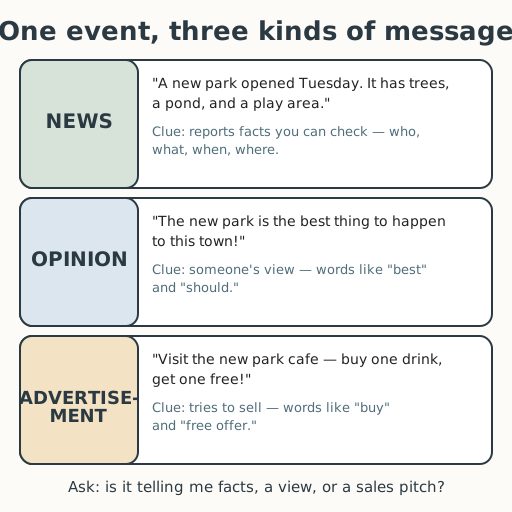
- Three-message poster · 1 A poster showing the same event — a new park opening — written three ways (news, opinion, advertisement), with the clue for each labeled
- Message-sort cards · 1 set per pair Cards with short messages about a new bus route, a fruit snack, and a library, mixed so learners sort each as news, opinion, or advertisement
- Message-sort page · 1 per learner A three-column page (news | opinion | advertisement) with a space for the clue that gave it away
Low-tech / no-cost
- A spoken message sort The facilitator reads a message aloud and learners call out news, opinion, or ad, plus the clue; voice only
- A message sort in the dirt Draw three columns in the dirt and write or point messages into them with a stick; no paper needed
Enriched / lab & device
- Real media samples · 1 set A newspaper page, a letter to the editor, and a printed ad, to sort with the same three-column tool
- A device to view one news story, one review, and one ad · 1 per group To practice sorting real online messages, where devices are available
Works in different contexts
- large-group Sort the park example together on the poster, then have pairs sort a card set and report "this is ___, and the clue is ___" in one sentence
- multi-age Younger learners spot the ad ("it is trying to sell"); older learners name all three kinds and explain the clue for each
- self-directed A learner sorts a card set alone, fills the three-column page, and writes the clue that revealed each message's kind
- level-grouped Learners ready to extend write a fourth message of their own for one event and ask a partner to classify it
- outdoor-only Look at a real sign, poster, or package outdoors and decide news, opinion, or ad, and the clue; no paper needed
Lesson 3 — News, Opinion, or Ad? Reading the Difference
Summary
Learners distinguish news, opinion, and advertisement by the clues each leaves. A worked example takes one event — a new park opening — and writes it three ways: news reports checkable facts, opinion voices a view with words like “best,” and an advertisement tries to sell with words like “buy” and “free offer.” Learners then sort mixed messages about a bus route, a fruit snack, and a library into the three kinds, reading critically without cynicism — the goal is clarity, not distrust.
Objectives
- Distinguish between news, opinion, and advertisement, and identify clues for each. (D10.S2.06.01)
Connection
Scroll any screen, open any paper, walk past any wall, and you meet three kinds of messages: one is telling you what happened, one is telling you what someone thinks, and one is trying to sell you something. They mix together on purpose, and telling them apart is a skill — like learning to hear three different voices in a crowd. Today you learn the clues each voice leaves behind.
Materials
- Three-message poster
- Message-sort cards
- Message-sort page
- Pencils
Preparation
- Print or draw the three-message poster.
- Copy message-sort cards for each pair and a message-sort page for each learner.
Facilitator note
This lesson is written to the learner (“you”). The skill to land is the three-way sort:
read a message, name its kind (news, opinion, or advertisement), and point to the clue. Model
the park example fully as a worked example before independent sorting (Kirschner, Sweller &
Clark, 2006). Teach without cynicism: the tone is “be clear-eyed, not suspicious” — news
is still worth reading, opinions still worth hearing, and ads are honest when they say they
are selling. Distinguish evidence from values: which words and structures mark each kind is
observable; that we should know which is which is a value this curriculum holds. See
docs/philosophy.md §5, §7 and docs/facilitation.md.
Procedure
- Gather (5 min). Ask: when you see a message, how do you know if it is telling you what happened, what someone thinks, or what to buy? Today you learn the three voices and their clues.
- Meet the three messages (12 min). Look at the poster — one event, the new park, written three ways. News: “A new park opened Tuesday. It has trees, a pond, and a play area.” Clue: it reports facts you can check — who, what, when, where. Opinion: “The new park is the best thing to happen to this town!” Clue: it is someone’s view, with words like “best” and “should.” Advertisement: “Visit the new park café — buy one drink, get one free!” Clue: it tries to sell, with words like “buy” and “free offer.” One event, three purposes.
- Sort your own messages (18 min). Take a card set about a new bus route, a fruit snack, and a library. For each message, decide — news, opinion, or advertisement — and write it in the right column with the clue that gave it away. Remember the clues: news = checkable facts; opinion = a view, “best,” “should”; ad = a sale, “buy,” “offer.”
- Check with a partner (10 min). Swap pages. Say: “this is ___, because ___.” Ask: does the clue really match the kind? Fix any that do not.
- Close (5 min). Three voices speak in your feed every day. Now you can tell them apart — not to shut them out, but to know exactly what each one is doing.
Differentiation
- Support: Provide a message-sort page with the clue hints printed at the top, and work one message aloud first.
- Extension: Write a fourth message of your own about the same event, then have a partner classify it and name the clue.
Assessment
- Formative (observation): Can the learner classify a message as news, opinion, or advertisement and point to the clue?
- Self-check: The learner asks, “Did I name the kind and the clue — and would someone else see the same clue I saw?”
Home connection
Find three messages at home or nearby — one news, one opinion, one ad — and say what clue told you which was which.
Resources
- The distinction between news (reporting), opinion (editorial/commentary), and advertising is
standard media-literacy content; the clues used here (checkable facts vs. judgment words vs.
selling words) follow widely used frameworks such as the Center for News Literacy and
Common Sense Media’s media-literacy materials. The “clarity, not cynicism” framing follows
docs/philosophy.md§7 anddocs/facilitation.md. On modeling before practice, see Kirschner, Sweller & Clark (2006), https://doi.org/10.1207/s15326985ep4102_1.