Lesson 04 — Loaded Words and Emotional Images
Learners identify a persuasive technique — a loaded word and an emotional image — and explain how each tries to shape a view. A worked example dissects one drink advertisement: the word "PURE!" makes the drink feel clean and safe, and the image of a happy, healthy child makes you feel good about buying it. Learners then spot the loaded word and emotional image in a snack ad, a candidate poster, and a toy ad, reading persuasion with awareness rather than fear.
Objectives
Objectives
- D10.S2.06.02 Identify a persuasive technique, such as a loaded word or an emotional image, and explain how it tries to shape a view.
Essential question
How do loaded words and emotional images try to shape the way I see something?
Key vocabulary
Materials
Standard materials
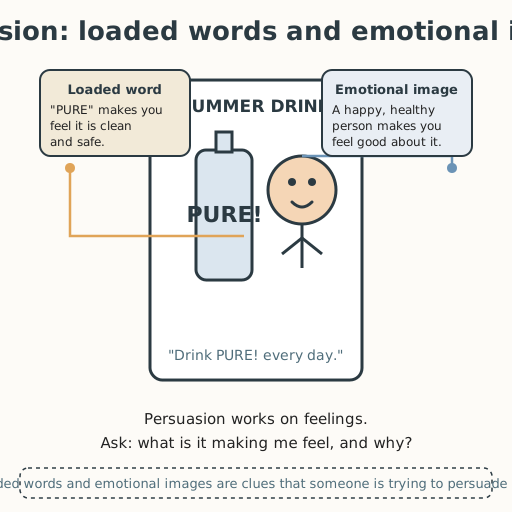
- Persuasion-spotter poster · 1 A poster of one drink advertisement with the loaded word ("PURE!") and the emotional image (a happy, healthy child) each labeled, plus the question "what is it making me feel, and why?"
- Persuasion-spotter cards · 1 set per pair Cards with a snack ad, a candidate poster, and a toy ad, each with one loaded word and one emotional image to spot
- Persuasion-spotter page · 1 per learner A page with boxes to name the loaded word, the emotional image, and how each tries to shape a view
Low-tech / no-cost
- A spoken persuasion spot The facilitator says an ad-like sentence and learners call out the loaded word and the feeling it stirs; voice only
- Act out a feeling Mime the feeling an ad is trying to create (excitement, calm, hunger), then name the word or image doing it; no paper needed
Enriched / lab & device
- A short set of real print or video ads · 1 set Age-appropriate advertisements to spot loaded words and emotional images in real persuasion
- A device to view one ad and pause it · 1 per group To freeze an ad and circle its loaded words and emotional images, where devices are available
Works in different contexts
- large-group Spot the loaded word and emotional image together on the poster, then have pairs work a card and report "the word ___ and the image ___ make me feel ___" in one sentence
- multi-age Younger learners name the feeling an ad stirs; older learners name the loaded word, the emotional image, and how each shapes the view
- self-directed A learner works a card alone, fills the persuasion-spotter page, and writes how the word and the image each try to shape a view
- level-grouped Learners ready to extend rewrite an ad with neutral words and a plain image, and compare how the feeling changes
- outdoor-only Look at a real poster or package outdoors, spot its loaded word and emotional image, and say what feeling each aims for; no paper needed
Lesson 4 — Loaded Words and Emotional Images
Summary
Learners identify a persuasive technique — a loaded word and an emotional image — and explain how each tries to shape a view. A worked example dissects one drink advertisement: the word “PURE!” makes the drink feel clean and safe, and the image of a happy, healthy child makes you feel good about buying it. Learners then spot the loaded word and emotional image in a snack ad, a candidate poster, and a toy ad, reading persuasion with awareness rather than fear.
Objectives
- Identify a persuasive technique, such as a loaded word or an emotional image, and explain how it tries to shape a view. (D10.S2.06.02)
Connection
Have you ever wanted something the moment you saw it — before you even thought about whether it was good or worth the price? Often that wanting is not your own idea; a picture or a single word planted it. A loaded word makes you feel a thing is clean, strong, or safe; an emotional image makes you feel happy, proud, or included. Today you learn to notice those feelings — and to ask where they came from.
Materials
- Persuasion-spotter poster
- Persuasion-spotter cards
- Persuasion-spotter page
- Pencils
Preparation
- Print or draw the persuasion-spotter poster.
- Copy persuasion-spotter cards for each pair and a persuasion-spotter page for each learner.
Facilitator note
This lesson is written to the learner (“you”). The skill to land is the persuasion spot:
name the loaded word, name the emotional image, and say how each tries to shape a view. Model
the drink ad fully as a worked example. Teach awareness, not fear or cynicism: persuasion
is everywhere, some of it honest and useful; the goal is to feel the pull and still think
clearly — to be moved but not tricked. Keep all examples age-safe (snacks, toys, a school
candidate) and free of frightening content. Distinguish evidence from values: which words and
images carry feeling is observable; that we should notice how we are persuaded is a value
this curriculum holds. See docs/philosophy.md §5, §7 and docs/facilitation.md.
Procedure
- Gather (5 min). Last lesson: news, opinion, and ad. Today, a closer look at how an ad — or any message — tries to shape your view, using two tools: loaded words and emotional images.
- Meet the drink ad (12 min). Look at the poster. The word “PURE!” is a loaded word — it carries a feeling, making the drink seem clean and safe. The image of a happy, healthy child is an emotional image — it makes you feel good about the drink, as if buying it would bring that happiness. Neither proves the drink is good for you; both make you feel it is. Ask the question aloud: “what is it making me feel, and why?”
- Spot your own (18 min). Take a card. The snack ad (“MEGA-CRUNCH! the snack that makes you a champion”) — loaded word: “champion”; emotional image: an athlete grinning with the snack; it makes you feel strong and cool. The candidate poster (“Vote for Ama — she will SAVE our school!”) — loaded word: “save”; emotional image: Ama smiling with students; it makes you feel safe and hopeful. The toy ad (“the toy every friend will BEG to share”) — loaded word: “beg”; emotional image: laughing children crowded around one toy; it makes you feel left out if you do not have it. On your page, name the loaded word, the emotional image, and how each tries to shape the view.
- Check with a partner (10 min). Say: “the word ___ makes me feel ___, and the image ___ makes me feel ___.” Ask: did your partner name the feeling and the technique that caused it?
- Close (5 min). Persuasion is not magic; it is a craft of feelings. When you can name the word and the image at work, you can feel the pull — and still decide for yourself.
Differentiation
- Support: Provide a card with the loaded word already underlined and a sentence starter for the feeling; work one ad aloud first.
- Extension: Rewrite an ad using neutral words and a plain image, and explain how the feeling — and the pull — changes.
Assessment
- Formative (observation): Can the learner name a loaded word and an emotional image and explain how each tries to shape a view?
- Peer check: Partners ask each other, “Did you name the word, the image, and the feeling each one is trying to create?”
Home connection
Next ad you see, name its loaded word and its emotional image, and say what feeling each is trying to give you.
Resources
- Loaded words (words chosen for emotional effect) and emotional images (imagery chosen to
stir feeling) are standard concepts in media-literacy education, taught by Common Sense
Media and the Center for News Literacy; the “awareness, not fear” framing follows
docs/philosophy.md§7. Advertising’s use of emotional appeals is documented in age-appropriate references (Britannica Kids, Common Sense Media). On modeling before practice, see Kirschner, Sweller & Clark (2006), https://doi.org/10.1207/s15326985ep4102_1.