Lesson 05 — Populations, Communities, and Predator and Prey
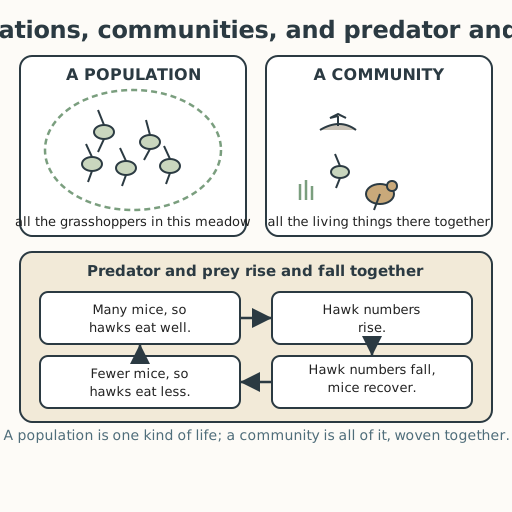
Learners explain the difference between a population and a community, and describe the predator-prey relationship as a rise-and-fall cycle. A worked example follows a meadow: the population is all the grasshoppers (one kind); the community is the grass, grasshoppers, mice, and hawk together (many kinds); and hawks and mice rise and fall together in a repeating cycle. Learners then order the cycle for a pond heron and fish, a reef grouper and small fish, or a savanna lion and gazelle.
Objectives
Objectives
- D10.S3.06.01 Explain the difference between a population and a community, and describe one relationship among organisms, such as predator and prey.
Essential question
What is the difference between a population and a community, and how do predator and prey rise and fall together?
Key vocabulary
Materials
Standard materials
- Population-and-community poster · 1 A poster showing a population (all the grasshoppers in a meadow) beside a community (the grass, grasshoppers, mice, and hawk together), with a four-step predator-prey cycle beneath
- Predator-prey cards · 1 set per pair Cards for a pond (fish and heron), a reef (small fish and grouper), and a savanna (gazelle and lion), each with a four-step rise-and-fall cycle to order
- Cycle page · 1 per learner A page with four boxes to arrange one predator-prey cycle and a line for the population vs. community difference
Low-tech / no-cost
- A spoken population and community Name a place and have learners call out one population (one kind) and the community (all kinds together); voice only
- A living predator-prey cycle Learners stand in a circle as prey and predator, rising (stand) and falling (crouch) in turn to feel the cycle; no paper needed
Enriched / lab & device
- A short photo set of real predator-prey pairs · 1 set Images of a heron and fish, a grouper and small fish, a lion and gazelle, to ground the cycle cards in real places
- A device with a short predator-prey video · 1 per group To watch one real rise-and-fall cycle, where devices are available
Works in different contexts
- large-group Build the meadow population vs. community together on the poster, then have pairs order one cycle and report "when prey ___, predators ___, then ___" in one sentence
- multi-age Younger learners say who eats whom; older learners arrange the full four-step cycle and explain population vs. community
- self-directed A learner orders a cycle card alone, fills the cycle page, and writes one sentence each for population and community
- level-grouped Learners ready to extend explain what happens if a second predator joins, and how the cycle changes
- outdoor-only Find one real population (one kind of insect or plant) and the wider community around it, then say who eats whom; no paper needed
Lesson 5 — Populations, Communities, and Predator and Prey
Summary
Learners explain the difference between a population and a community, and describe the predator–prey relationship as a rise-and-fall cycle. A worked example follows a meadow: the population is all the grasshoppers (one kind); the community is the grass, grasshoppers, mice, and hawk together (many kinds); and hawks and mice rise and fall together in a repeating cycle. Learners then order the cycle for a pond heron and fish, a reef grouper and small fish, or a savanna lion and gazelle.
Objectives
- Explain the difference between a population and a community, and describe one relationship among organisms, such as predator and prey. (D10.S3.06.01)
Connection
Stand in any place where life is — a garden, a field, a shore, a tree. Look at one kind of living thing: those are a population, all the same kind together. Now look at everything at once — the plants, the insects, the birds, the worms: that is the community. And watch the community long enough and you will see a rhythm: the hunters and the hunted rising and falling together, like a dance neither one can stop alone.
Materials
- Population-and-community poster
- Predator-prey cards
- Cycle page
- Pencils
Preparation
- Print or draw the population-and-community poster.
- Copy predator-prey cards for each pair and a cycle page for each learner.
Facilitator note
This lesson is written to the learner (“you”). The skill to land is the population-vs-
community distinction plus the predator-prey cycle trace. Model the meadow fully as a
worked example before learners order their own cycle (Kirschner, Sweller & Clark, 2006). Build
on Grade 4 (producers, consumers, decomposers) and Grade 5 (food webs and interdependence).
Present predation factually and without blood or fear: it is one of many relationships in a
community, and the cycle keeps both sides in balance. Distinguish evidence from values: how
populations rise and fall together is observable ecology; that we should understand and care
for communities of life is a value this curriculum holds. See docs/philosophy.md §5 and
docs/facilitation.md.
Procedure
- Gather (5 min). Recall the food web: energy flows from what is eaten to what eats it. Today you sharpen two words — population and community — and trace the rise-and-fall dance of predator and prey.
- Meet the meadow (12 min). Look at the poster. A population is all of one kind of living thing in a place — all the grasshoppers in the meadow. A community is all the living things there together — the grass, the grasshoppers, the mice, and the hawk. Now the cycle: many mice → hawks eat well → hawk numbers rise → fewer mice → hawks eat less → hawk numbers fall → mice recover → the cycle repeats. Predator and prey do not just interact; they rise and fall together.
- Order your own cycle (18 min). Take a card. The pond (fish and heron): many fish → herons eat well → heron numbers rise → fewer fish → herons eat less → heron numbers fall → fish recover. The reef (small fish and grouper): many small fish → groupers eat well → grouper numbers rise → fewer small fish → groupers eat less → grouper numbers fall → small fish recover. The savanna (gazelle and lion): many gazelles → lions eat well → lion numbers rise → fewer gazelles → lions eat less → lion numbers fall → gazelles recover. On your cycle page, put the four steps in order, then write one sentence for population and one for community.
- Check with a partner (10 min). Say the cycle in one breath: “when prey is many, predators rise; when prey is few, predators fall; then prey recovers.” Ask: does the order loop back to the start?
- Close (5 min). A population is one thread; a community is the whole woven cloth. The predator-prey dance is one of the threads that keeps the cloth moving.
Differentiation
- Support: Provide a cycle page with the first box filled in and a sentence starter for the population/community difference; work one cycle aloud first.
- Extension: Add a second predator to the cycle and explain how the rise-and-fall pattern changes.
Assessment
- Formative (observation): Can the learner distinguish a population from a community and order a four-step predator-prey cycle so it loops?
- Self-check: The learner asks, “Did I name one kind for the population and many kinds for the community — and does my cycle rise, fall, and loop back?”
Home connection
Pick a nearby place with life. Name one population there, then the whole community, and ask who hunts whom.
Resources
- Population (all individuals of one species in an area) vs. community (all species in an area)
and the predator-prey cycle are core ecology concepts documented in children’s science
references (BBC Bitesize, Britannica Kids, National Geographic Kids); the classic
predator-prey oscillation is described from field studies of lynx and snowshoe hare and is
summarized in age-appropriate form by those sources. The “dance, not drama” framing follows
docs/facilitation.mdanddocs/philosophy.md§5.