Lesson 06 — Biodiversity: Why Variety Keeps Ecosystems Strong
Learners explain what biodiversity means and why variety helps an ecosystem stay healthy. A worked example contrasts a garden with many kinds of life against a field with one crop: when one kind fails in the many-kinds garden, others still grow, but when a single crop is hit by disease, everything fails at once. Learners then trace the same safety-net idea through a coral reef, a forest, and a farm field, seeing variety as resilience — not decoration.
Objectives
Objectives
- D10.S3.06.02 Explain what biodiversity means and why a variety of living things can help an ecosystem stay healthy.
Essential question
What is biodiversity, and why does a variety of living things help an ecosystem stay healthy?
Key vocabulary
Materials
Standard materials
- Variety safety-net poster · 1 A poster contrasting a garden with many kinds of life against a field with one crop, with captions on what happens when one part fails
- Biodiversity cards · 1 set per pair Cards for a coral reef, a forest, and a farm field, each listing many kinds vs. few kinds and one "what if" change to trace
- Biodiversity page · 1 per learner A page to name one ecosystem, list its variety, and write why that variety is a safety net
Low-tech / no-cost
- A spoken safety net Name an ecosystem and have learners call out the many kinds in it and what would happen if one kind vanished; voice only
- A safety-net in the dirt Draw many different plants and creatures, then erase one and ask what still holds; no paper needed
Enriched / lab & device
- A short photo set of biodiverse places · 1 set Images of a coral reef, a rainforest, a mangrove, and a mixed farm, to ground the cards in real places
- A device with a short video on biodiversity · 1 per group To watch one real ecosystem and its variety, where devices are available
Works in different contexts
- large-group Compare the many-kinds garden and the one-kind field together on the poster, then have pairs work a card and report "variety helps because ___" in one sentence
- multi-age Younger learners name the many kinds in a place; older learners explain the safety net and why variety builds resilience
- self-directed A learner works a card alone, fills the biodiversity page, and writes why variety helps an ecosystem stay healthy
- level-grouped Learners ready to extend compare two ecosystems — one rich, one poor in variety — and argue which can better survive a shock, with reasons
- outdoor-only Count the different kinds of life in one small patch outdoors, then ask what would happen if one kind disappeared; no paper needed
Lesson 6 — Biodiversity: Why Variety Keeps Ecosystems Strong
Summary
Learners explain what biodiversity means and why variety helps an ecosystem stay healthy. A worked example contrasts a garden with many kinds of life against a field with one crop: when one kind fails in the many-kinds garden, others still grow, but when a single crop is hit by disease, everything fails at once. Learners then trace the same safety-net idea through a coral reef, a forest, and a farm field, seeing variety as resilience — not decoration.
Objectives
- Explain what biodiversity means and why a variety of living things can help an ecosystem stay healthy. (D10.S3.06.02)
Connection
Imagine a rope made of many strands. Cut one strand and the rope still holds. Now imagine a rope of a single strand — cut it and it snaps. An ecosystem with many kinds of living things is the many-stranded rope: if one kind is harmed, the others still hold the system up. That variety of life is called biodiversity, and it is a living thing’s safety net.
Materials
- Variety safety-net poster
- Biodiversity cards
- Biodiversity page
- Pencils
Preparation
- Print or draw the variety safety-net poster.
- Copy biodiversity cards for each pair and a biodiversity page for each learner.
Facilitator note
This lesson is written to the learner (“you”). The idea to land is the safety-net metaphor:
more kinds of life means more ways for an ecosystem to survive a shock. Model the garden-vs-
field contrast fully as a worked example. Build on the previous lesson’s communities and on
Grade 5’s interdependence. Present variety factually and hopefully: biodiversity is strength,
and people everywhere — farmers who mix crops, communities who protect reefs and forests — are
already building that strength. Distinguish evidence from values: that variety aids
resilience is observable ecology; that we should protect the variety of life is a value this
curriculum holds. See docs/philosophy.md §4–5 and docs/facilitation.md.
Procedure
- Gather (5 min). Last lesson: populations and communities. Today, a quality of the whole community — how many kinds of life it holds — and why that number matters.
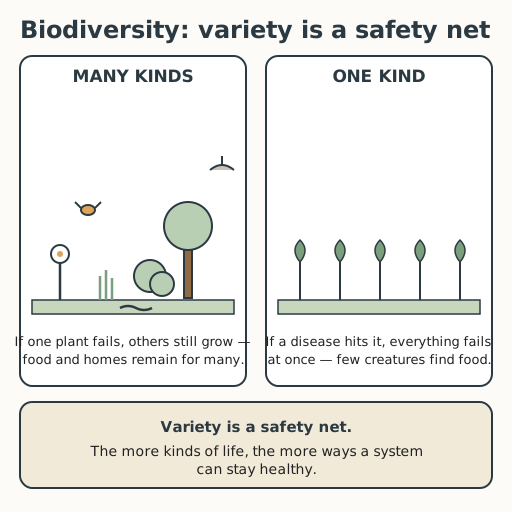
- Meet the two gardens (12 min). Look at the poster. In the many-kinds garden — flowers, grass, a bush, a tree, a bee, a bird, a worm — if one plant fails, others still grow, and food and homes remain for many creatures. In the one-kind field — a single crop repeated — if a disease hits it, everything fails at once, and few creatures find food. That is biodiversity: the variety of living things, and the reason variety is a safety net.
- Trace your own safety net (18 min). Take a card. The coral reef (many kinds: coral, fish, crabs, algae, turtles; if one kind of coral suffers, other corals and algae still shelter the fish — but a reef with only one coral can collapse at once). The forest (many kinds: tall trees, shrubs, birds, fungi, insects; if one tree species is diseased, others still shade and shelter — but a single-species plantation falls together). The farm field (many kinds: mixed crops, hedges, bees, birds, soil worms; if one crop fails, others still feed the family and the soil — but one crop alone is one point of failure). On your page, name the ecosystem, list its variety, and write one sentence on why that variety is a safety net.
- Check with a partner (10 min). Say: “variety helps ___ because if one kind ___, the others still ___.” Ask: did your partner show why variety, not just that variety?
- Close (5 min). Variety is not extra; it is the system’s strength. The more strands in the rope, the harder it is to break.
Differentiation
- Support: Provide a card with the many kinds already listed and a sentence starter for the safety-net reason; work one card aloud first.
- Extension: Compare two real ecosystems — one rich and one poor in variety — and argue, with reasons, which could better survive a shock such as a drought or a disease.
Assessment
- Formative (observation): Can the learner explain biodiversity and give the safety-net reason variety helps an ecosystem stay healthy?
- Peer check: Partners ask each other, “Did you say why variety helps — what happens when one kind fails?”
Home connection
Find one patch of life near home. Count its different kinds, then ask: if one kind disappeared, what would still hold?
Resources
- Biodiversity — the variety of living things — and its link to ecosystem resilience are core
ecology concepts documented by the UN Convention on Biological Diversity and in children’s
references (BBC Bitesize, Britannica Kids, National Geographic Kids); the single-crop risk
(e.g., the Irish potato famine and crop-disease risk) is a standard, age-appropriate example.
The safety-net metaphor and hopeful framing follow
docs/facilitation.mdanddocs/philosophy.md§12.