Lesson 03 — How Reproduction Works: Cycle, Conception & Pregnancy
Learners explain how the **menstrual cycle** works and how **conception and pregnancy** happen: an egg is released, can be met by sperm, and if fertilization and implantation occur, a pregnancy can grow in the uterus. They order the steps and read the cycle as a normal, variable rhythm — not a mystery and not a source of shame.
Objectives
Objectives
- D03.S4.09.01 Explain the basics of sexual and reproductive health, including anatomy, consent, and how to access accurate information and care.
Essential question
How does the menstrual cycle work, and how does conception and pregnancy happen?
Key vocabulary
Materials
Standard materials
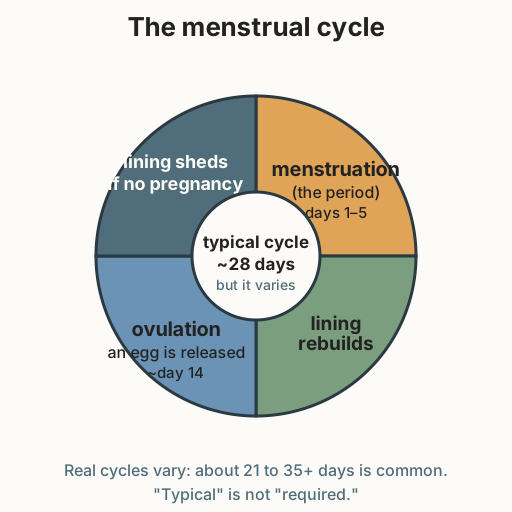
- Menstrual-cycle wheel · 1 per learner A circular diagram of a typical cycle with the phases labeled, to annotate
- Conception sequence cards · 1 set per group Cards for the steps (egg released → sperm meets egg → fertilization → implantation → pregnancy) to order
Low-tech / no-cost
- A shared board or large paper Draw the cycle wheel and the conception sequence together; no printed cards needed
- Voice and a partner Say the steps of conception aloud in order and explain the cycle together; a learner who cannot see the wheel can follow the whole cycle by ear
- Found-object tactile cycle Make the wheel from a loop of string or rope and mark each phase with a different texture (stones, leaves, seeds, or knots), so a learner who is blind or low-vision can trace the cycle by touch as each phase is named aloud
Enriched / lab & device
- A short accurate animation of the menstrual cycle or conception · 1 for the group Optional; a reputable animated explainer to watch once
- Colored markers · 1 set To mark the phases of the cycle on the wheel
Works in different contexts
- large-group Teach the cycle wheel to the whole group once, then small groups order the conception cards and report their sequence
- multi-age Younger learners name the main events (period, egg release, pregnancy can begin); older learners explain timing and the fertile window
- self-directed A learner labels the wheel, orders the cards, and writes a one-paragraph explanation of the cycle and conception
- level-grouped Learners ready to extend explain why the timing of ovulation matters for both conceiving and avoiding pregnancy
- outdoor-only Draw the cycle as a circle in the dirt or sand and mark the phases with stones or leaves as you explain them aloud
Lesson 3 — How Reproduction Works: Cycle, Conception & Pregnancy
Summary
Learners explain how the menstrual cycle works and how conception and pregnancy happen: an egg is released, can be met by sperm, and if fertilization and implantation occur, a pregnancy can grow in the uterus. They order the steps and read the cycle as a normal, variable rhythm — not a mystery and not a source of shame.
Objectives
- Explain the basics of sexual and reproductive health, including how reproduction works. (D03.S4.09.01)
Connection
You have probably heard fragments — a “period,” a “fertile window,” a “nine months” — without ever seeing how they fit into one story. Put together, they form a single, orderly process that has been happening in human bodies for as long as there have been humans, in every culture on Earth. It is not magic and it is not shameful; it is biology you can understand in about one lesson. Knowing how it actually works — not the rumor version — is what lets you understand your own body, plan your life, and sort accurate information from myth.
Materials
- Menstrual-cycle wheel
- Conception sequence cards
Preparation
- Copy the cycle wheel and sequence cards.
- Retrieval: from Lesson 2, recall the accurate names of the parts; from Grade 6, recall the changes of puberty.
Facilitator note
This lesson is written to the learner (“you”). The concept to land: the menstrual cycle is a normal, recurring rhythm in bodies with a uterus — roughly a month long but widely variable — and pregnancy can begin when a released egg is fertilized by sperm and implants in the uterus. This is foundational biology, so use explicit instruction and worked examples: model the cycle wheel and the conception sequence once, in order, before learners work (S-011). Accurate, appropriately hedged facts to teach: a typical cycle averages about 28 days but ranges widely (about 21 to 35 days is common, and more variation is normal); ovulation (an egg’s release) usually happens around the middle of the cycle; the uterine lining thickens to prepare for a possible pregnancy and is shed as menstruation (a period) if none occurs; if sperm meets the egg in the fallopian tube, fertilization can occur, and the fertilized egg can implant in the uterus and grow — a pregnancy, which typically lasts about 40 weeks (about nine months). Sperm can survive in the body for several days, and an egg lives about a day after release, which is why timing matters for both conceiving and avoiding pregnancy (WHO, S-261; UNESCO CSE, S-412). The egalitarian lens: the cycle is a normal, healthy function, not an illness or a curse, and it varies — some bodies do not have a cycle, and that does not make them any less whole; some people cannot become pregnant, and that is a fact of biology, not a failing. The ethics lens: accurate knowledge about reproduction is what lets a person make their own informed choices; no one else’s shame or silence should decide for them. The global lens: cultures worldwide have named and made sense of menstruation in many ways — some celebrate it, some keep it quiet, some attach rules to it — and all deserve respectful curiosity, while the biology is the same everywhere. And where accurate information and services are missing, unplanned and adolescent pregnancy is more common — which is why this knowledge matters (WHO, S-455). The technology lens: medical technology — from the ultrasound that watches a pregnancy grow to assisted-reproduction techniques that help people conceive when they could not otherwise — has changed what people can know and choose about reproduction, and it is spread very unevenly across the world, which is itself a matter of justice. Keep it factual, calm, and free of fear; cite the sources; and hold the door open for questions without ever requiring a learner to share anything personal.
Procedure
- Recall (5 min). From Lesson 2: name the organs where eggs are stored and where a pregnancy grows. Today we watch the process those organs carry out.
- Meet the cycle (15 min). Worked example, guided on the wheel: a typical cycle runs about a month. Menstruation (the period, roughly days 1–5) sheds the lining built the month before. The lining then rebuilds; around the middle, ovulation releases an egg from an ovary; and if no pregnancy occurs, the lining sheds again and the cycle repeats. Mark the phases. Real cycles vary — 21 to 35 days is common, and “typical” is not “required.”
- Meet conception (10 min). The sequence, in order: (1) an egg is released at ovulation; (2) if sperm are present in the fallopian tube, one may meet and fertilize the egg; (3) the fertilized egg travels to the uterus and implants in the lining; (4) a pregnancy grows there for about 40 weeks (about nine months). No sperm, no fertilization — no pregnancy. That one fact is the hinge for the next two lessons.
- Order the cards (10 min). In pairs, order the conception steps and, on the wheel, point to the part of the cycle when pregnancy is possible. Self-check against the worked example.
- Close (10 min). Write one accurate sentence connecting the cycle, ovulation, and pregnancy — e.g., “Pregnancy can begin when a released egg is fertilized by sperm and implants in the uterus.” You now hold the real story, not the rumor version.
Differentiation
- Support: Use three steps instead of four — period, egg release, pregnancy can begin — and match each to a picture.
- Extension: Explain, using the wheel, why a person who does not want to become pregnant would want to know when ovulation happens — and why cycle-timing alone is not a reliable method.
Assessment
- Formative (observation/peer): Can the learner order the conception steps and locate the fertile part of the cycle on the wheel?
- Portfolio artifact: The labeled cycle wheel and the ordered sequence, kept in the portfolio (or, for a learner who does not see the wheel: the sequence spoken or dictated in order, or a tactile model of the cycle built from found objects and described aloud).
Home connection
The next time the topic comes up in media or conversation, notice whether the account matches what you learned today. Correct one misunderstanding — kindly — if the chance arises, and notice how much calmer the real story is than the rumor.
Resources
- On reproductive health and the menstrual cycle: WHO, “Adolescent health” (S-261).
- On reproductive biology within comprehensive sexuality education: UNESCO, International Technical Guidance on Sexuality Education (2018) (S-412).
- On adolescent pregnancy and the value of accurate reproductive education: WHO, “Adolescent pregnancy” (S-455).
- On explicit instruction and worked examples: Kirschner, Sweller & Clark (2006) (S-011).