Lesson 04 — Consent: Freely Given, Reversible & Informed
Learners explain **consent** — an agreement that is **freely given, reversible, and informed**, never assumed from silence or a previous yes — and practice asking, giving, and refusing with clarity in everyday and intimate situations. Consent is framed as respect for a person's **autonomy** over their own body, not as a hurdle or a game.
Objectives
Objectives
- D03.S4.09.01 Explain the basics of sexual and reproductive health, including anatomy, consent, and how to access accurate information and care.
Essential question
What is consent, and how do I give it, ask for it, recognize it, and respect a no?
Key vocabulary
Materials
Standard materials
- Consent-principles card · 1 per learner A card listing the principles of consent with a one-line check for each
- Scenario slips · 1 set per group Short everyday scenarios (not only sexual) where consent matters, to read and judge
Low-tech / no-cost
- A shared board or large paper Build the consent principles together; role-play the scenarios aloud with no printed slips
- Voice and a partner Practice asking, giving, and refusing clearly, in pairs
Enriched / lab & device
- A short accurate video or article on consent · 1 for the group Optional; a reputable explainer on consent and boundaries
- A messaging or note app · 1 per learner To draft a "how I ask" and "how I say no" script and keep it
Works in different contexts
- large-group Teach the principles to the whole group once, then pairs role-play one scenario each and the group reflects together
- multi-age Younger learners practice everyday consent (borrowing, hugging, sharing); older learners apply the principles to intimate situations too
- self-directed A learner studies the principles, judges the scenarios, and writes their own ask-and-refuse scripts
- level-grouped Learners ready to extend analyze the difference between a real yes and a pressured yes, using one scenario
- outdoor-only Use voice and role-play only; the principles can be practiced as a spoken circle with no materials
Lesson 4 — Consent: Freely Given, Reversible & Informed
Summary
Learners explain consent — an agreement that is freely given, reversible, and informed, never assumed from silence or a previous yes — and practice asking, giving, and refusing with clarity in everyday and intimate situations. Consent is framed as respect for a person’s autonomy over their own body, not as a hurdle or a game.
Objectives
- Explain the basics of sexual and reproductive health, including consent. (D03.S4.09.01)
Connection
You already practice a form of consent every day. When a friend asks “can I borrow your jacket?” and you say “sure,” that is consent; when you say “not today,” and they accept it without pushing, that is consent being respected. Consent is not a special rule invented for one situation; it is the everyday practice of asking before acting on someone else’s body or things, and honoring the answer — yes or no. What changes in intimate situations is only how much the stakes rise. The principle never changes: your body is yours, and so is everyone else’s.
Materials
- Consent-principles card
- Scenario slips
Preparation
- Copy the principles card and scenario slips.
- Retrieval: from Grade 5, recall the idea of consent for one’s own body; from Grade 9 Relationships (Unit 5), recall healthy relationship skills including consent and trust.
Facilitator note
This lesson is written to the learner (“you”). The concept to land: consent is an agreement that is freely given, reversible, and informed — a real, unpressured “yes” — and it is never assumed from silence, from a past yes, from what someone wears, or from a relationship. This is a skills lesson with a strong values core, so use explicit instruction for the principles (worked example) and role-play for the practice (S-011). Teach the principles plainly: freely given (not pressured, coerced, or guilted — a yes under pressure is not a yes); reversible (a person can change their mind at any moment, even mid-way, and the new answer stands); informed (a person needs the real facts to agree); not assumed (silence, sleep, intoxication, or an earlier yes do not equal yes — only a clear, ongoing yes does). The ethics lens: consent is how we honor another person’s autonomy — their right to decide what happens to their own body — and autonomy is the floor of all dignity. The egalitarian lens: consent belongs to everyone equally — every gender, every body, every relationship — and no one’s “no” matters less because of who they are. The global lens: cultures express agreement and refusal differently — some are direct, some indirect, some rely on gesture — but the underlying standard is the same: a real, unforced agreement (UNESCO CSE, S-412). The technology lens: phones and social media add new consent questions — a photo or message shared without consent is a violation of consent, and digital spaces follow the same freely-given, reversible, informed standard as every other space. Hold the room safely: role-play is voluntary; a learner may always observe instead; and if anything a learner shares suggests coercion or harm, follow your safeguarding path — believe, do not promise secrecy, get help (WHO, S-051). Keep the language clear and calm, and never frame consent as a burden — it is the opposite: it is what makes closeness safe and mutual.
Procedure
- Recall (5 min). From Unit 5: what did we learn about consent in healthy relationships? Today we make the principle precise and practice it.
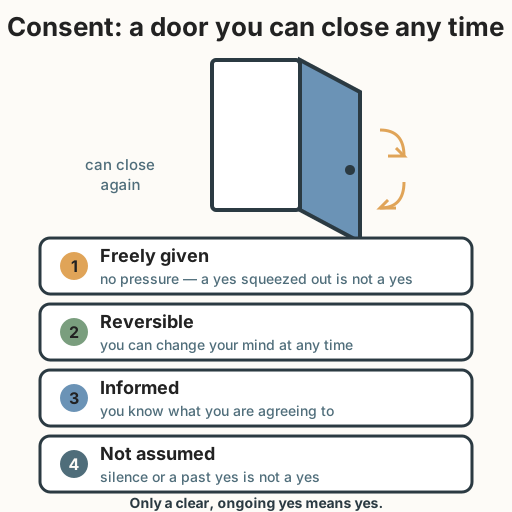
- Meet the principles (12 min). Worked example, guided: consent is an agreement that is freely given (no pressure — a yes squeezed out is not a yes), reversible (a person can change their mind at any time), and informed (they know what they are agreeing to). And it is never assumed: silence, sleep, intoxication, or a yes given last week are not a yes now. Only a clear, ongoing yes means yes.
- Read the scenarios (10 min). For each scenario, ask: Is there real consent here? How do you know? Some are everyday (borrowing, hugging, sharing a seat), some are intimate. Notice that the same test applies to both.
- Practice asking and refusing (15 min). In pairs, role-play, with the chance to pass: (a) ask for something clearly and accept either answer; (b) give a clear yes; (c) give a clear no and have it respected; (d) change your mind and have the change honored. Model one round first.
- Close (8 min). Write two lines: one way you can ask clearly, and one way you can say no clearly, that you would actually use. Consent is not a hurdle — it is what makes “yes” real.
Differentiation
- Support: Practice only everyday consent (borrowing, hugging, sharing) and use the single-sentence frames “Can I ___?” and “No, not right now — thanks for asking.”
- Extension: Analyze the difference between a genuine yes and a pressured yes in one intimate scenario, and write what “checking in” during the moment would look like.
Assessment
- Formative (observation/performance): Can the learner apply the principles to a scenario and give, ask for, or refuse consent clearly and respectfully?
- Self-assessment: The learner writes one reflection sentence on why a pressured yes is not a yes, kept with their scripts.
Home connection
Practice clear asking and clear no in low-stakes moments this week — “Can I borrow this?” and “No, thank you,” said plainly. Notice how much easier real agreements are when both people are honest.
Resources
- On consent within comprehensive sexuality education: UNESCO, International Technical Guidance on Sexuality Education (2018) (S-412).
- On preventing violence and protecting young people: WHO, “Preventing violence against children” (S-051).
- On explicit instruction and worked examples: Kirschner, Sweller & Clark (2006) (S-011).