Lesson 05 — Contraception & Preventing Infections
Learners explain how the main **methods of contraception** work — barrier, hormonal, IUD, and emergency — and how **condoms also reduce the risk of many sexually transmitted infections**, the idea of **dual protection**, and the value of **testing**. They practice matching accurate information to a person's needs without judgment.
Objectives
Objectives
- D03.S4.09.01 Explain the basics of sexual and reproductive health, including anatomy, consent, and how to access accurate information and care.
Essential question
How do the main methods of contraception and infection prevention work, and how does a person choose what is right for them?
Key vocabulary
Materials
Standard materials
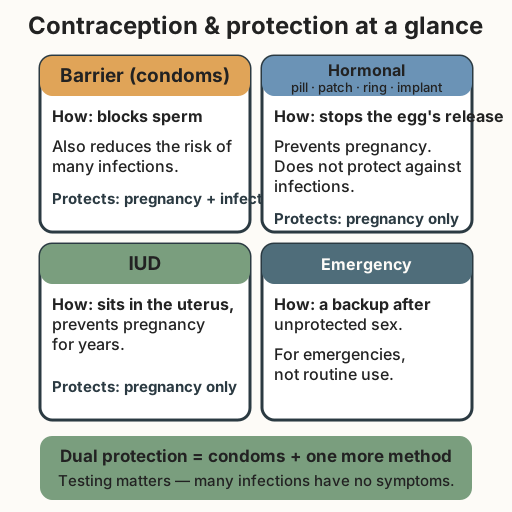
- Method-comparison chart · 1 per learner A table of main methods — barrier, hormonal, IUD, emergency — with how each works, its protection, and notes
- Scenario cards · 1 set per group Short situations to practice matching a person's needs and values to accurate information about methods
Low-tech / no-cost
- A shared board or large paper Build the method-comparison chart together as a class; discuss scenarios aloud
- Voice and a partner Explain each method's basic idea aloud and match scenarios by discussion
Enriched / lab & device
- Accurate health-service or WHO fact sheets on methods · 1 set To read how each method works from an authoritative source
- A short reputable video on contraception and STI prevention · 1 for the group Optional; to see a clear, accurate explainer once
Works in different contexts
- large-group Build the comparison chart with the whole group, then small groups work one scenario each and report the accurate answer
- multi-age Younger learners learn what a condom is and why testing matters; older learners compare methods and dual protection in depth
- self-directed A learner completes the chart from accurate sources and matches each scenario to the right information
- level-grouped Learners ready to extend explain dual protection and why no single method covers everything
- outdoor-only Discuss aloud in a circle, using the chart drawn in the dirt or simply spoken and remembered
Lesson 5 — Contraception & Preventing Infections
Summary
Learners explain how the main methods of contraception work — barrier, hormonal, IUD, and emergency — and how condoms also reduce the risk of many sexually transmitted infections, the idea of dual protection, and the value of testing. They practice matching accurate information to a person’s needs without judgment.
Objectives
- Explain the basics of sexual and reproductive health, including how to access accurate information and care. (D03.S4.09.01)
Connection
Knowing how pregnancy begins — from Lesson 3 — is the key to knowing how to prevent it or plan for it when and if you choose to. And just as there are ways to prevent pregnancy, there are ways to reduce the risk of infections that can pass between partners. None of this is about judging anyone’s choices; it is about making sure that when a person does choose, they choose with accurate information rather than rumor. Today you learn the tools and how they actually work — so that decisions about your own body are yours, and informed.
Materials
- Method-comparison chart
- Scenario cards
Preparation
- Copy the comparison chart and scenario cards.
- Retrieval: from Lesson 3, recall that no sperm meeting the egg means no pregnancy; from Lesson 4, recall that consent is the floor of every sexual choice.
Facilitator note
This lesson is written to the learner (“you”). The concept to land: the main approaches to contraception are barrier methods (like condoms), hormonal methods (pill, patch, ring, injection, implant), the IUD, and emergency contraception — and condoms are the only method that also helps protect against many sexually transmitted infections (STIs), which is why “dual protection” (condoms plus another method) is the standard advice for anyone wanting both pregnancy prevention and infection protection. This is foundational knowledge, so use explicit instruction with the worked example of the comparison chart (S-011). Accurate, appropriately hedged facts to teach: condoms (external and internal) are barriers that also reduce the risk of many STIs; hormonal methods prevent ovulation and are highly effective for pregnancy but do not protect against infections; the IUD (copper or hormonal) is a long-acting, very effective method; emergency contraception can reduce the chance of pregnancy after unprotected sex but is for emergencies, not routine use; STIs are infections caused by bacteria, viruses, or parasites that can pass during sex — some are curable with medicine (like chlamydia, gonorrhea, and syphilis), some are manageable with treatment (like HIV), and many can be present without symptoms, which is why testing matters and why vaccines (for HPV and hepatitis B) are part of prevention (WHO family planning, S-453; WHO STIs, S-454). The ethics lens: accurate information is what makes a person’s consent and choices truly free — withholding or distorting it is a form of harm. The egalitarian lens: contraception and infection prevention are for everyone, every gender and orientation; there is no shame in using them and no hierarchy among people who do or do not. The global lens: access to contraception is deeply unequal around the world — many people cannot get the methods others take for granted — and widening that access is a matter of health and justice (WHO, S-453). The technology lens: methods are a technology of care, developed by science and now unevenly distributed — a fact worth noticing, not a reason to distrust them. Teach factually and without fear; a learner may always pass; and never pressure anyone to share personal choices. Distinguish the facts (what methods do) from the values (that everyone deserves access and no one deserves shame).
Procedure
- Recall (5 min). From Lesson 3: what single fact decides whether pregnancy can begin? (Sperm meeting an egg.) Contraception works by interrupting that meeting — or by preventing the egg.
- Meet the methods (15 min). Worked example, guided on the chart. Barrier (condoms) block sperm — and also reduce the risk of many infections. Hormonal methods (pill, patch, ring, injection, implant) stop the release of an egg. The IUD sits in the uterus and prevents pregnancy for years. Emergency contraception is a backup after unprotected sex, not a routine. Mark on the chart which methods also protect against infections — only the barrier ones do.
- Meet infections and testing (10 min). Sexually transmitted infections can pass during sex and often cause no symptoms, so a person can have one and not know it. Some are curable with medicine; some are manageable with treatment. That is why testing matters, and why condoms and vaccines (HPV, hepatitis B) are part of prevention.
- Match the scenarios (12 min). For each scenario, name the accurate information the person needs: What protects against both pregnancy and infections? What is long-acting? What if a condom fails? Answer with the chart, not with guesses.
- Close (8 min). Write one accurate sentence you now know that you did not know last week — about a method, an infection, or testing. Accurate information is a right, not a privilege.
Differentiation
- Support: Focus on two ideas — condoms protect against pregnancy and many infections, and testing matters because infections can be silent.
- Extension: Explain dual protection in your own words and why “condoms plus one more method” is the standard advice for people who want both kinds of protection.
Assessment
- Formative (observation/peer): Can the learner correctly match a method to its protection and state that only barrier methods also reduce infection risk?
- Portfolio artifact: The completed method-comparison chart, kept in the portfolio.
Home connection
Notice how contraception and sexual health are talked about — or avoided — in media and at home. Practice naming one accurate fact calmly; the goal is comfort with truth, not shock.
Resources
- On contraception and family planning: WHO, “Family planning/contraception” (S-453).
- On sexually transmitted infections: WHO, “Sexually transmitted infections (STIs)” (S-454).
- On comprehensive sexuality education: UNESCO, International Technical Guidance on Sexuality Education (2018) (S-412).
- On explicit instruction and worked examples: Kirschner, Sweller & Clark (2006) (S-011).