Lesson 06 — Accessing Accurate Information & Care
Learners explain **where and how to access accurate information and care** for sexual and reproductive health — trusted adults, health workers, clinics, and official services — and the **rights** a young person holds when they seek it: to accurate information, to privacy and confidentiality (with safety limits), and to make their own choices with consent.
Objectives
Objectives
- D03.S4.09.01 Explain the basics of sexual and reproductive health, including anatomy, consent, and how to access accurate information and care.
Essential question
Where do I go for accurate information and care about my sexual and reproductive health, and what are my rights when I seek it?
Key vocabulary
Materials
Standard materials
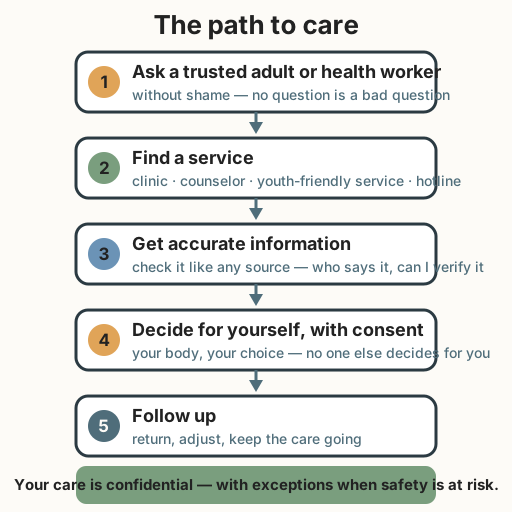
- Care-pathway map · 1 per learner A simple flowchart of where a person can seek accurate information and care, and what to expect at each step
- Rights card · 1 per learner A short list of a young person's rights when seeking health care (accurate info, privacy, consent, no judgment)
Low-tech / no-cost
- A shared board or large paper Draw the care-pathway map together; discuss rights aloud
- Voice and a partner Role-play asking a health worker a question, practicing calm, clear wording
Enriched / lab & device
- Accurate national or local health-service directory · 1 set To find the real services available where the learner lives
- A device to explore an official health site or hotline · 1 per pair Optional; to practice finding a real service and reading what it offers
Works in different contexts
- large-group Draw the pathway once to the whole group, then pairs role-play one step and report what they learned
- multi-age Younger learners name one trusted adult and one place to go; older learners map the full pathway and their rights
- self-directed A learner builds their own care-pathway map and lists the real services and trusted adults available to them
- level-grouped Learners ready to extend research one real local service and add it to the map with what it offers and how to reach it
- outdoor-only Draw the pathway in the dirt or sand and walk it step by step as a group, speaking each step aloud
Lesson 6 — Accessing Accurate Information & Care
Summary
Learners explain where and how to access accurate information and care for sexual and reproductive health — trusted adults, health workers, clinics, and official services — and the rights a young person holds when they seek it: to accurate information, to privacy and confidentiality (with safety limits), and to make their own choices with consent.
Objectives
- Explain the basics of sexual and reproductive health, including how to access accurate information and care. (D03.S4.09.01)
Connection
Knowing the facts is only half the skill; the other half is knowing where to go when you need more than a lesson can give — a real question answered by a real person, a test, a method, a vaccine, a check-up. In every community on Earth there are people whose job is exactly this: health workers, clinics, counselors. And in most places a young person who seeks care has rights — to accurate information, to privacy, and to decide what happens to their own body. Today you learn the pathway from “I have a question” to “I got the care I needed,” and the rights that protect you along the way.
Materials
- Care-pathway map
- Rights card
Preparation
- Copy the pathway map and rights card.
- Retrieval: from Lesson 1, recall the three source-check questions; from Lesson 4, recall consent and autonomy.
Facilitator note
This lesson is written to the learner (“you”). The concept to land: access to accurate information and care is a right, and the pathway is knowable — a trusted adult, a health worker, or a clinic can answer questions, provide methods, testing, vaccines, and referrals, and a young person’s care is generally confidential, with important exceptions where safety is at risk. This is a knowledge-and-skills lesson, so use explicit instruction (the worked-example pathway) and role-play for asking (S-011). Teach the steps plainly: (1) start with a trusted adult or a health worker you can ask without shame; (2) find a service — a clinic, a school counselor, a youth-friendly service, a pharmacist, a hotline — depending on what is available where you live; (3) get accurate information; (4) decide for yourself, with consent, what you want; (5) follow up. Teach the rights: to accurate information, to privacy and confidentiality, to be treated without judgment, and to give or withhold consent over your own body — grounded in the right to health and to decide freely over one’s own body (UNESCO CSE, S-412; WHO, S-261). Be honest about confidentiality: in most settings a young person’s health matters are private, but privacy has limits when a person’s safety is at risk — then a trusted adult or service must act to protect them. The ethics lens: seeking care and honoring a person’s rights — to accurate information, to privacy, and to decide over their own body — is how we uphold their dignity and autonomy; access to care is a moral matter, not merely a practical one. The egalitarian lens: access is not equal — cost, distance, stigma, and law differ wildly around the world, and the same care that is easy for one person is out of reach for another; that is an injustice to name, not a reason anyone is less deserving. The global lens: services take many forms — a community health worker under a tree, a mobile clinic, a hospital, a phone hotline — and all are real parts of the pathway. The technology lens: official websites and hotlines can reach people far from any clinic, but they must be checked like any source. Keep it practical and hopeful; a learner may always pass; and if a learner names a specific unmet need or risk, connect them to real local help rather than leaving it abstract.
Procedure
- Recall (5 min). From Lesson 1: what are the three questions to ask of any health claim? Today we learn where to go when a claim needs a person, not just a check.
- Meet the pathway (15 min). Worked example, guided on the map: (1) a trusted adult or health worker; (2) a service — clinic, counselor, youth-friendly service, pharmacist, hotline; (3) accurate information; (4) your own choice, with consent; (5) follow-up. For each step, name what actually happens and who is there to help.
- Meet your rights (8 min). You have a right to accurate information, to privacy and confidentiality, to be treated without judgment, and to decide what happens to your own body. One honest limit: confidentiality is not absolute — if your safety is at risk, a trusted adult or service must act to protect you.
- Practice asking (12 min). In pairs, role-play (you may pass): ask a health worker a question calmly and clearly — “I have a question about ___; can you help me find accurate information?” — and hear how a good service answers.
- Close (10 min). Write your own three-line pathway: one trusted adult, one kind of service you could reach, and one right you now know you have. You are not alone in this; the path is real.
Differentiation
- Support: Use three steps — trusted adult, service, your choice — and name one real adult and one real place.
- Extension: Research one actual local or national service (by name) and add it to your map with what it offers and how to reach it.
Assessment
- Formative (observation/performance): Can the learner describe the pathway and at least two rights, and ask for help clearly in role-play?
- Portfolio artifact: The learner’s three-line pathway (trusted adult, service, right), kept in the portfolio.
Home connection
Find out — from a trusted adult or an official source — one real place near you where a young person can get accurate sexual-health information or care. Write its name down; knowing the name is half the journey.
Resources
- On the right to health information and care: UNESCO, International Technical Guidance on Sexuality Education (2018) (S-412).
- On adolescent health services: WHO, “Adolescent health” (S-261).
- On explicit instruction and worked examples: Kirschner, Sweller & Clark (2006) (S-011).