Lesson 03 — Duties: What We Owe
Learners read the same everyday moral question through the duties lens — the traditions that judge an act by what we owe, not by its results. They distinguish duties owed to every person from duties that grow out of relationships and roles, and they name what this lens captures and what it misses.
Objectives
Objectives
- D09.S1.09.01 Analyze a moral question using more than one ethical framework (such as consequences, duties, and virtues) and compare what each shows.
Essential question
What does the duties lens show about a moral question — and where does duty come from?
Key vocabulary
Materials
Standard materials
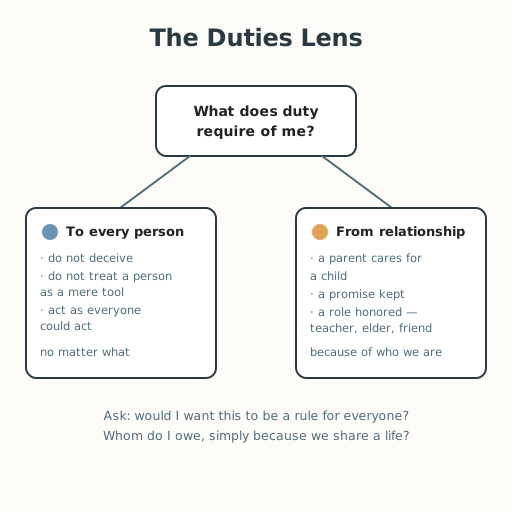
- Duties branches sheet · 1 per learner A diagram of duty split into what we owe every person and what we owe from relationships and roles
- Worked-example dilemma card · 1 per pair The same dilemma as last lesson, now read through the duties lens
Low-tech / no-cost
- A shared board or large paper Draw the two branches of duty together instead of using printed sheets
- Voice Discuss the dilemma aloud in a circle, each learner naming one duty
Enriched / lab & device
- A digital whiteboard · 1 Co-build the duties branches, adding examples from learners' own roles and traditions
- A short excerpt from a rights document · 1 A line or two from the Universal Declaration of Human Rights to connect duty and dignity
Works in different contexts
- large-group Model the worked example whole-group, then pairs read the dilemma through the duties lens and report one duty each
- multi-age Younger learners name a duty from a relationship (to a sibling, friend, pet); older learners add a universal duty to every person
- self-directed A learner fills the two branches for one dilemma and writes the "would I want this to be a rule for everyone?" test
- level-grouped Learners ready to extend compare Kant's universal rule with a relationship-based account of duty and argue what each captures
- outdoor-only Use a shared outdoor obligation — tending a common path or water source — and ask what we owe the next user simply because they are a person
Lesson 3 — Duties: What We Owe
Summary
Learners read the same everyday moral question through the duties lens — the traditions that judge an act by what we owe, not by its results. They distinguish duties owed to every person from duties that grow out of relationships and roles, and they name what this lens captures and what it misses.
Objectives
- Analyze a moral question through the duties lens, distinguishing universal duties from relationship-based duties, and compare what this lens shows with the consequences lens. (D09.S1.09.01)
Connection
A promise you made, a confidence a friend shared with you, a stranger who needs help and no one is watching — some things feel like they are required of you no matter what the result is. The duties lens asks: what do I owe, simply because we share a life? It is a second, very different way people everywhere have reasoned about right and wrong.
Materials
- Duties branches sheet
- Worked-example dilemma card
Preparation
- Copy the branches sheet and dilemma card (use the same dilemma as Lesson 2, so learners can feel the difference between the lenses).
- Prepare to model: “Would I want this to be a rule for everyone?” as the universal-duty test.
Facilitator note
This lesson is written to the learner (“you”). Its goals: (1) introduce the duties lens honestly — its modern form is deontology, most associated with Immanuel Kant (the idea of a universal rule and treating persons as ends, never merely as means), but duty-based reasoning appears in many traditions, including Confucian role ethics, Hindu and Buddhist accounts of dharma, and Indigenous traditions that ground duty in relationship, role, and reciprocity (S-468; S-469; S-427); (2) model once, then guide: work the same dilemma as Lesson 2 but ask the duty question — what do I owe, no matter what the result? — and test it with “would I want everyone to act this way?”; (3) name the lens’s limits — duty can seem rigid when consequences are severe, and it can conflict with care for specific people. The ethics lens: some things are owed regardless of outcome. The egalitarian lens: a universal rule protects everyone equally — that is its power, and we must check that it does not ignore real inequality. The global lens: duty is grounded differently across traditions — in law, in kinship, in faith, in reciprocity — and none is the default. Keep the lens as one way of seeing; virtues arrive next (philosophy §11). Distinguish evidence from values: that people feel bound by duty is a fact; that a particular duty is binding is a value claim we argue about.
Procedure
- Recall (5 min). Without looking: what did the consequences lens ask, and what did it miss?
- Meet the lens (10 min). Read the duties branches sheet. The lens asks: what do I owe? One branch is duties to every person (do not deceive; do not treat a person as a mere tool); the other is duties from relationship and role (a parent to a child, a promise kept, a role honored).
- Worked example (15 min). Take the same dilemma as last lesson. Step by step: (a) name the act; (b) ask — would I want this to be a rule for everyone? (c) list duties to every person; (d) list duties from relationships and roles. Notice how the answer differs from the consequences lens.
- Guided practice (15 min). In pairs, read a second dilemma through the duties lens and fill your own branches. Then say aloud: what do I owe, no matter what the result?
- Compare the two lenses (5 min). Side by side — consequences asked “what happens?”, duties ask “what do I owe?”. Where do the two answers disagree? What does each see that the other misses?
- Close (5 min). Two lenses down, one to go. Next: the virtues lens — what kind of person do I want to become?
Differentiation
- Support: Provide the two branches pre-labeled and one worked duty in each.
- Extension: Argue which account of duty — universal rule or relationship — better captures a duty to care for a distant stranger.
Assessment
- Formative (observation): Can the learner state a universal duty and a relationship-based duty for a new dilemma, and contrast the duties lens with the consequences lens?
- Artifact: The completed branches sheet (or written duties), kept in the portfolio.
Home connection
Ask someone at home: is there a promise or duty you keep even when it costs you? What does it come from — a rule, a relationship, or a role? Bring one sentence next time.
Resources
- On deontological ethics and Kant: Stanford Encyclopedia of Philosophy, “Deontological Ethics,” https://plato.stanford.edu/entries/ethics-deontological/ (S-457).
- On duty from relationship and role (Confucian role ethics): Stanford Encyclopedia of Philosophy, “Confucius,” https://plato.stanford.edu/entries/confucius/ (S-468).
- On dharma as duty in Hindu and Buddhist traditions: Encyclopaedia Britannica, “dharma,” https://www.britannica.com/topic/dharma-religious-concept (S-469).
- On Indigenous duty grounded in relationship and reciprocity: Kimmerer (2013), Braiding Sweetgrass (S-427).
- On explicit instruction and worked examples: Kirschner, Sweller & Clark (2006), https://doi.org/10.1207/s15326985ep4102_1 (S-011).