Lesson 04 — Virtues: Who We Become
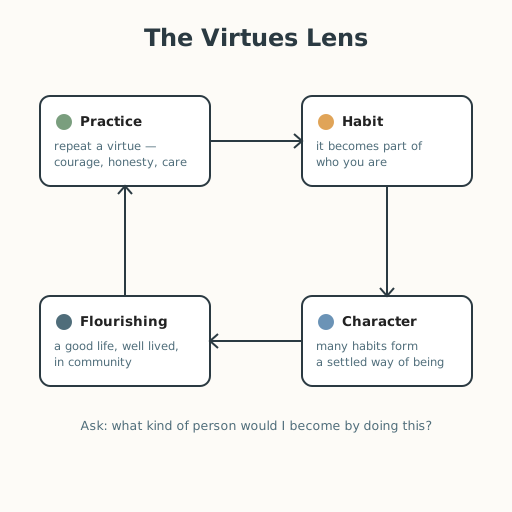
Learners read the same moral question through the virtues lens — the traditions that judge an act by the kind of person it builds. They trace how practice becomes habit, habit becomes character, and character becomes a flourishing life, and they compare virtues named across cultures without ranking them.
Objectives
Objectives
- D09.S1.09.01 Analyze a moral question using more than one ethical framework (such as consequences, duties, and virtues) and compare what each shows.
Essential question
What does the virtues lens show about a moral question — and how do virtues differ across cultures?
Key vocabulary
Materials
Standard materials
- Virtue loop sheet · 1 per learner A four-step loop — practice, habit, character, flourishing — for reading a moral question
- Virtue cards · 1 set per group Cards naming virtues from more than one tradition (e.g., courage, honesty, care, generosity, ubuntu, hózhó) with a one-line meaning
Low-tech / no-cost
- A shared board or large paper Draw the loop and write virtues from learners' own cultures together
- Voice and memory Learners name a virtue their family or culture prizes and say what it looks like in action
Enriched / lab & device
- A digital whiteboard · 1 Co-build the loop and add virtues from across the group's languages
- Short quotations from more than one tradition · 1 set A few lines on a good life or a good person from different cultures, to compare
Works in different contexts
- large-group Collect virtues whole-group on the board, then small groups trace the loop for one virtue
- multi-age Younger learners act out a virtue in one small scene; older learners explain what a lifetime of that virtue would build
- self-directed A learner chooses one virtue, traces the loop, and writes what kind of person a lifetime of it would make them
- level-grouped Learners ready to extend compare a virtue named in two different traditions and say how each shades its meaning
- outdoor-only Observe a place outdoors kept or harmed by habit — a clean path, a littered bank — and ask what habits of character would keep it well
Lesson 4 — Virtues: Who We Become
Summary
Learners read the same moral question through the virtues lens — the traditions that judge an act by the kind of person it builds. They trace how practice becomes habit, habit becomes character, and character becomes a flourishing life, and they compare virtues named across cultures without ranking them.
Objectives
- Analyze a moral question through the virtues lens — what kind of person the act builds — and compare virtues named across more than one culture. (D09.S1.09.01)
Connection
Every repeated choice shapes you. A person who practices honesty becomes honest; a person who practices care becomes caring; a person who practices courage becomes the kind of person who can stand up when it costs something. The virtues lens asks: what kind of person would I become by doing this? Cultures everywhere have named the traits of a life well lived — courage, honesty, care, generosity — though they name and shade them differently.
Materials
- Virtue loop sheet
- Virtue cards
Preparation
- Copy the loop sheet and virtue cards.
- Prepare a few one-line meanings for virtues from more than one tradition (e.g., the Southern African ubuntu — “I am because we are”; the Diné hózhó — balance, harmony, beauty) — offered respectfully as living ideas, not specimens.
Facilitator note
This lesson is written to the learner (“you”). Its goals: (1) introduce the virtues lens honestly — virtue ethics is most associated with Aristotle (a virtue is a settled habit of character, built by practice, aimed at flourishing, eudaimonia), but the idea of character and a good life runs through many traditions, including Confucian, Buddhist, Islamic, and Indigenous frameworks; (2) model once, then guide: trace the loop — practice → habit → character → flourishing — for one virtue, then let learners trace another; (3) name the lens’s limits — it says less about which specific act to choose right now, and “virtue” can be used to judge others harshly or to privilege one culture’s list over another’s. The ethics lens: who we become matters as much as what we do. The egalitarian lens: ask whose list of virtues gets treated as normal, and whether the virtues named include care for the least powerful. The global lens: virtues are named and shaded differently across cultures — hold them side by side, never ranked (philosophy §11). Distinguish evidence from values: that cultures name virtues is a fact; that a particular virtue is good is a value we argue about, and there is room for more than one answer.
Procedure
- Recall (5 min). Name the two lenses so far (consequences, duties) and one thing each misses.
- Meet the lens (10 min). Read the virtue loop sheet. The lens asks: what kind of person would I become by doing this? Practice a virtue; it becomes a habit; habits form character; character makes a flourishing life.
- Worked example (15 min). Take the same dilemma as the last two lessons. Step by step: (a) name the act; (b) ask — which virtue would this practice, and which would it erode? (c) what kind of person does a lifetime of this build? Notice how the answer differs from the other two lenses.
- Virtues across cultures (10 min). Look at the virtue cards. Which virtues appear in more than one tradition? How is each shaded differently by its own culture? Treat each as a living idea — ask before you assume, and rank none above another.
- Guided practice (10 min). In pairs, choose one virtue and trace its loop in your own life: one small practice → the habit it forms → the character it builds → the life it makes possible.
- Close (5 min). Three lenses, three answers. Next: we put them side by side on one question and compare what each shows.
Differentiation
- Support: Provide the loop pre-labeled and one worked virtue (honesty) filled in.
- Extension: Compare one virtue across two traditions in writing, and say what each shading teaches that the other does not.
Assessment
- Formative (observation): Can the learner trace a virtue through the loop and name one virtue that appears in more than one culture?
- Artifact: The completed loop sheet (or written virtue trace), kept in the portfolio.
Home connection
Ask someone at home: what trait does our family or culture most try to teach a child, and how is it practiced in daily life? Bring one sentence next time.
Resources
- On virtue ethics and Aristotle: Stanford Encyclopedia of Philosophy, “Virtue Ethics,” https://plato.stanford.edu/entries/ethics-virtue/ (S-458).
- On respectful engagement across cultural difference: UNESCO, “Universal Declaration on Cultural Diversity,” https://www.unesco.org/en/legal-affairs/unesco-universal-declaration-cultural-diversity (S-389).
- On explicit instruction and worked examples: Kirschner, Sweller & Clark (2006), https://doi.org/10.1207/s15326985ep4102_1 (S-011).