Lesson 05 — One Question, Three Answers
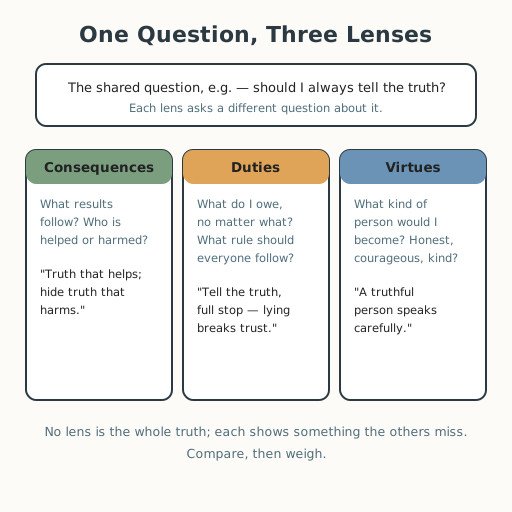
Learners put the three lenses side by side on one moral question, producing the unit's first portfolio artifact: a multi-framework analysis. They analyze the same question through consequences, duties, and virtues, then compare what each shows and what each misses, and they weigh the answers without being required to collapse them into one.
Objectives
Objectives
- D09.S1.09.01 Analyze a moral question using more than one ethical framework (such as consequences, duties, and virtues) and compare what each shows.
Essential question
How do I reason about one moral question across more than one ethical framework, and compare what each shows?
Key vocabulary
Materials
Standard materials
- Three-lens comparison sheet · 1 per learner One question with three columns — consequences, duties, virtues — for a side-by-side analysis
- A moral question of the learner's choice · 1 A real, age-appropriate dilemma chosen from the unit's question bank or the learner's own life
Low-tech / no-cost
- Paper folded into three columns No printed sheet needed — fold a page into three columns and label them
- Voice Discuss the three readings aloud before writing
Enriched / lab & device
- A digital document or whiteboard · 1 Build the three-column comparison collaboratively, then each learner saves their own
- A peer-review checklist · 1 per pair A short list — did each lens get a real answer? did they compare, not just list?
Works in different contexts
- large-group Do one question whole-group first, then learners choose their own and work in pairs with the checklist
- multi-age Younger learners fill one column; older learners fill all three and write the comparison
- self-directed A learner chooses a question, fills all three columns, and writes one paragraph comparing what each lens shows
- level-grouped Learners ready to extend weigh the three answers and defend a reasoned judgment, naming what each framework contributes
- outdoor-only Choose a question from a real shared space — how to divide limited water, shade, or path space — and run it through all three lenses
Lesson 5 — One Question, Three Answers
Summary
Learners put the three lenses side by side on one moral question, producing the unit’s first portfolio artifact: a multi-framework analysis. They analyze the same question through consequences, duties, and virtues, then compare what each shows and what each misses, and they weigh the answers without being required to collapse them into one.
Objectives
- Analyze a moral question using more than one ethical framework (consequences, duties, and virtues) and compare what each shows. (D09.S1.09.01)
Connection
When a real decision matters, one lens is rarely enough. The friend who needs the truth, the promise that must be kept, the scarce resource that must be shared — read any of these through one lens and you see part of the picture; read it through three and the picture sharpens. Today you do what thoughtful people everywhere do: reason across more than one framework and compare what each shows.
Materials
- Three-lens comparison sheet
- A moral question of the learner’s choice
Preparation
- Copy the comparison sheet and peer-review checklist.
- Prepare one question to model whole-group, drawn from the unit’s question bank or from real shared life (a scarce resource, a hard truth, a promise).
Facilitator note
This lesson is written to the learner (“you”). Its goals: (1) consolidate the three lenses into a single skill — analyze one question three ways, then compare; (2) model once, then guide: work one question whole-group across all three columns, then let each learner choose their own question and work it (Kirschner, Sweller & Clark 2006, S-011); (3) hold the outcome open — the goal is a reasoned comparison, not a single “right” answer, and learners may legitimately weigh the three answers differently (philosophy §11). The ethics lens: more than one framework, held together, is what honest moral reasoning looks like. The egalitarian lens: in every column, keep asking who benefits and who is left out. The global lens: the frameworks themselves travel across cultures and are argued about within each — present them as tools, not as one tradition’s property. Distinguish evidence from values: what a framework shows is a matter of careful reasoning; what we value more is a choice we defend, not prove. This is the first portfolio artifact — keep it.
Procedure
- Retrieval (5 min). From memory, write one sentence each for what the consequences, duties, and virtues lenses ask. Check against a partner.
- Model the comparison (15 min). As a group, take one question. Fill the three columns together: consequences (“what happens, to whom?”), duties (“what do I owe?”), virtues (“what kind of person would I become?”). Then compare aloud: where do the answers agree? Where do they pull in different directions? What does each lens see that the others miss?
- Choose your own question (5 min). Pick a moral question from the bank or your own life — one you genuinely find hard, and that is fair to discuss in this space.
- Analyze it three ways (20 min). Fill all three columns for your question. Then write one short paragraph: what does each framework show, and where do they differ?
- Peer check (5 min). Trade with a partner. Did each lens get a real answer? Was there an actual comparison, not just a list? Give one specific suggestion, kindly.
- Close (5 min). Next we turn inward — to conscience and self-criticism, and how our own values stay honest.
Differentiation
- Support: Provide sentence starters for each column (“The consequences lens shows…”, “The duties lens shows…”, “The virtues lens shows…”).
- Extension: Weigh the three answers and defend a reasoned judgment, naming what each framework contributes and what you would want to know to decide better.
Assessment
- Formative (observation): Does the learner give each lens a genuine, distinct answer and then compare them, rather than merely listing?
- Artifact (portfolio): The completed three-lens comparison — the unit’s multi-framework moral analysis.
Home connection
Show someone at home your three columns and ask: which lens would you reach for first, and why? Bring their answer next time.
Resources
- On the three frameworks as distinct traditions: Stanford Encyclopedia of Philosophy, “Consequentialism” (S-456); “Deontological Ethics” (S-457); “Virtue Ethics” (S-458).
- On explicit instruction and worked examples: Kirschner, Sweller & Clark (2006), https://doi.org/10.1207/s15326985ep4102_1 (S-011).