Lesson 03 — The Mirror in My Pocket
Learners evaluate how online comparison shapes emotional life. They learn that comparison is a normal human tendency that curated feeds can skew, name their own comparison moments, and choose a considered response.
Objectives
Objectives
- D01.S1.10.02 Evaluate how technology and media influence emotional life, such as online comparison, empathy, and emotional contagion.
Essential question
How does online comparison shape my emotional life, and how do I respond?
Key vocabulary
Materials
Standard materials
- Comparison-notice log · 1 per learner A simple table — the moment, what I compared, how I felt, and a response I could choose next time
- Screenshots or printed examples of a feed (optional) · as available Real, anonymized examples of curated posts to examine together
Low-tech / no-cost
- Paper and pencil The log can be a folded sheet with four boxes
- Memory of a real feed Learners recall and describe posts they have compared themselves to; no device needed
Enriched / lab & device
- Device with a feed or photo app · 1 per group To examine a real feed together with the comparison lens on
- Screen-time or digital-wellbeing app · 1 per learner To notice when comparison moments tend to happen in the day
Works in different contexts
- large-group Examine one example feed together on a projector, then learners keep their own logs individually
- multi-age Younger learners name one thing they compared and how it felt; older learners add the response they would choose next time
- self-directed A learner keeps the comparison log alone for a day and writes a short reflection
- level-grouped Learners ready to extend distinguish upward, downward, and lateral comparison and weigh which is most common online
- outdoor-only Discuss comparison without any device — compare how two people might feel seeing the same "perfect" photo, using the log on paper
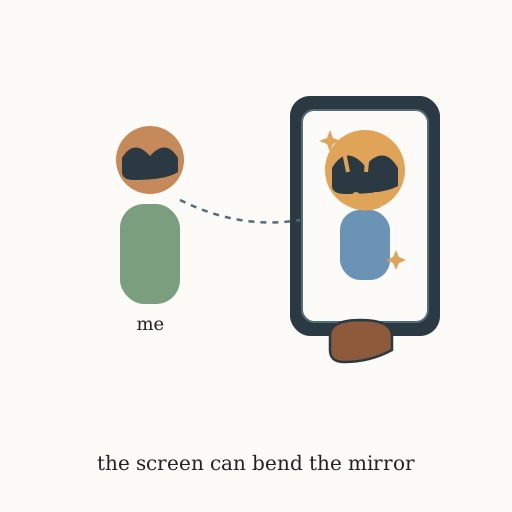
Lesson 3 — The Mirror in My Pocket
Summary
Learners evaluate how online comparison shapes emotional life. They learn that social comparison is a normal human tendency (S-221) that curated, edited feeds can skew — turning other people’s highlight reels into a warped mirror. They keep a comparison-notice log, name how comparison makes them feel, and choose a considered response rather than a reactive one.
Objectives
- Evaluate how technology and media influence emotional life, such as online comparison. (D01.S1.10.02)
Connection
Every time you open a feed, you are handed a mirror — but a bent one. It shows the polished, filtered, carefully chosen moments of other people’s lives, next to the unedited, ordinary, behind-the-scenes view you have of your own. No wonder a quick scroll can leave a person feeling smaller. Comparison itself is not the problem — humans have always looked sideways to understand themselves. The question is what we compare, and what we do with the feeling afterward.
Materials
- Comparison-notice log (the moment, what I compared, how I felt, a response I could choose)
- Screenshots or printed examples of a feed (optional)
Preparation
- Copy or draw the comparison-notice log.
- Retrieval: from Lessons 1–2, recall that history and culture shape feeling. Today we add a third shaper: technology — specifically the curated feeds that invite constant comparison.
Facilitator note
This lesson is written to the learner (“you”). The ideas to land: (1) social comparison is a normal, universal human tendency, not a personal defect; (2) online feeds are curated and edited, so they skew comparison — typically toward “upward” comparison with polished versions of others; (3) the healthy move is not to stop feeling but to notice the comparison and choose a response. The first comes from Festinger’s social-comparison theory (S-221); the second from the body of research on media, technology, and adolescent development (S-226) and from WHO’s balanced account of social media’s effects on adolescent mental health (S-311). Hold the causal claims with care: the evidence says curated content can distort self-image and that comparison can shape mood — not that screens simply “cause” illness (S-226, S-311). This is a balanced, non-alarmist treatment (philosophy §11, §12).
Model the skill once, then let learners practice (S-011). The technology lens is the heart: name the mechanism — feeds rank and reward polished, high-engagement content (S-481), and filter bubbles show a narrow slice of others’ lives (S-482). The egalitarian lens: whose lives are shown as “successful” in a feed is not neutral; the same platform can lift some images and hide others. The ethics lens: honesty about the gap between a person’s feed and their real life is a kindness — to oneself and to others, who are also showing only their highlights. The global lens: the pressure to curate a perfect life is not the same everywhere; different cultures value different kinds of “showing,” and no single idea of success is universal. The social-emotional lens: this topic can touch real sore spots — invite, never force; learners choose what to share, and “pass” is always allowed. The critical-thinking lens: this is practice in distinguishing the image from the evidence — a feed is a chosen story, not a measurement.
Procedure
- Recall (5 min). Think of one time you scrolled and felt a little smaller afterward. You do not have to share — just notice that the feeling arrived through a comparison you did not consciously choose.
- Meet comparison (10 min). Learn the word: social comparison is the human habit of measuring ourselves against others (S-221). It is normal — even useful. The problem online is that the feed is curated: people post their best, edited moments, so we compare our whole, unedited life to their highlight reel. Watch a worked example: a photo of a friend’s “perfect” day, and the quiet, messy ordinary reality behind it.
- Notice your own (15 min). Use the comparison-notice log. List two or three real moments from a recent day: what you compared, how it made you feel, and — for each — one honest fact the feed left out (the bad day, the filters, the years of practice, the luck).
- Choose a response (12 min). For each moment, write one response you could choose next time — for example, closing the app, saying “that is a highlight, not a whole life,” or messaging the person to ask how they really are. Notice: the goal is not to stop feeling; it is to stop letting the mirror decide your worth.
- Draft (10 min). Write or record two or three sentences: comparison is normal, but the feed is bent. Here is how I will hold it next time.
- Close (3 min). Remember: the screen shows a story, not a measurement. You are allowed to be an unedited, ordinary, growing person.
Differentiation
- Support: Offer a one-column log (the moment, the feeling) and a single sentence starter (“That post is a highlight, not ___.”).
- Extension: Distinguish upward, downward, and lateral comparison, and explain which the feed most often triggers and why.
Assessment
- Formative (self): Can the learner name one comparison moment, the feeling it produced, and one considered response they would choose next time?
- Portfolio artifact (summative for the unit): The comparison-notice log and the drafted reflection, added to the unit portfolio.
Home connection
Ask someone at home: have you ever felt worse after scrolling? What do you tell yourself when that happens? Trade one response that works for each of you.
Resources
- On social comparison: Festinger (1954), “A Theory of Social Comparison Processes,” Human Relations 7(2), 117–140 (S-221).
- On media/technology effects on adolescent development: Common Sense Media Research, https://www.commonsensemedia.org/research (S-226).
- On adolescent mental health and social media (balanced): WHO fact sheet, Mental health of adolescents, https://www.who.int/news-room/fact-sheets/detail/adolescent-mental-health (S-311).
- On feeds and filter bubbles: Pariser, The Filter Bubble (2011) (S-482); Britannica, “Social media,” https://www.britannica.com/topic/social-media (S-481).
- On modeling + guided practice: Kirschner, Sweller & Clark (2006), https://doi.org/10.1207/s15326985ep4102_1 (S-011).