Lesson 04 — Feeling With Others, Through a Screen
Learners evaluate how technology shapes empathy. They distinguish empathic concern ("feeling with") from distanced concern and personal distress ("feeling for"), examine how screens can help and hinder each, and choose how to keep empathy alive online.
Objectives
Objectives
- D01.S1.10.02 Evaluate how technology and media influence emotional life, such as online comparison, empathy, and emotional contagion.
Essential question
How does technology shape empathy — and what is the difference between feeling with and feeling for?
Key vocabulary
Materials
Standard materials
- With vs. for cards · 1 set per group Short scenarios; learners sort each as feeling "with" (empathic concern) or "for" (distanced concern), and some as neither
- Writing journal · 1 per learner
Low-tech / no-cost
- Spoken scenarios and a two-sided sign Read scenarios aloud and have learners step to one side of the room for "with" and the other for "for"
- Voice and body Act out the two stances — leaning in versus standing back
Enriched / lab & device
- Device with a messaging or social app · 1 per group To examine a real online exchange and identify where empathy or distance showed up
- Video clip of a real story of distant suffering · 1 per class A short, age-appropriate documentary or news segment to practice the with/for lens together
Works in different contexts
- large-group Sort the scenarios whole-class by moving to two sides of the room, then discuss the close calls
- multi-age Younger learners sort simple scenarios; older learners explain why a case is "with," "for," or a mix
- self-directed A learner reads the scenarios alone, sorts them, and writes one paragraph explaining two of their choices
- level-grouped Learners ready to extend connect "with vs. for" to Batson's empathic-concern/personal-distress distinction and to compassion fatigue
- outdoor-only Use the two-sided sign and spoken scenarios while standing in a circle outdoors
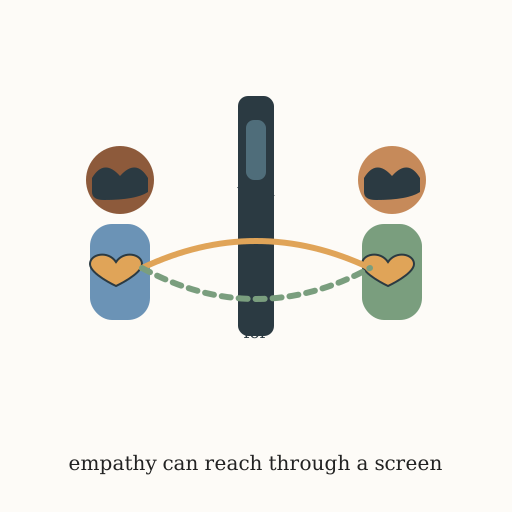
Lesson 4 — Feeling With Others, Through a Screen
Summary
Learners evaluate how technology shapes empathy. They distinguish empathic concern — feeling with someone, other-oriented and motivating of help — from personal distress and distanced concern — feeling for someone from the outside (S-230). They examine how screens can carry empathy across distance, and how they can also flatten it into a quick “react” or a numb scroll, and they choose one way to keep empathy alive online.
Objectives
- Evaluate how technology and media influence emotional life, such as empathy. (D01.S1.10.02)
Connection
A friend far away sends a message that they are hurting, and in a heartbeat you are leaning toward them — even through a screen. That is empathy: feeling with someone, not just about them. But a screen can also let a person scroll past a hundred small sorrows until they stop landing, turning other people’s pain into background noise. Technology can carry our empathy a long way, or let it slip away — the difference is in how we hold it.
Materials
- With vs. for cards (short scenarios to sort)
- Writing journal
Preparation
- Copy or draw the with/for scenario cards.
- Retrieval: from Lesson 3, recall that feeds skew comparison. Today we ask how technology shapes empathy — the capacity to feel with others — for better and worse.
Facilitator note
This lesson is written to the learner (“you”). The ideas to land: (1) empathy is not one thing — “feeling with” (empathic concern) is other-oriented and moves us toward help, while “feeling for” from a distance (and its overwhelmed cousin, personal distress) is self-oriented and can lead to avoidance or burnout; (2) technology can carry both — it extends empathy across distance but also risks flattening it into a quick react or numbing it into compassion fatigue. The with/for distinction draws on Batson’s empathic-concern vs. personal-distress work (S-230); the technology side draws on the research on digital platforms, empathy, and echo chambers (S-226, S-481). Present both as descriptive, not moralistic: a quick “react” is not a sin, and neither is stepping back to protect your own heart — the point is awareness and choice, not guilt (philosophy §8, §11).
Model the skill once, then let learners practice (S-011). The technology lens: explain the mechanism — a feed shows many people’s pain at once, at a distance, with a one-tap response, which can flatten empathy; algorithms may also show us mostly people like us, shrinking the range of whom we imagine ourselves with (S-481, S-482). The global lens: empathy reaches further than ever before — a person in one country can feel with someone in another — yet that same reach can overwhelm; different cultures have different norms for how feeling is shown, and none is the “right” amount. The egalitarian lens: whose suffering is shown, and whose is left out, shapes whom we are invited to feel with — ask that question out loud. The ethics lens: feeling with someone carries a small obligation — to listen, to respond, to act when we can; empathy without action can curdle into a performance. The social-emotional lens: this topic can bring up real pain, including our own — invite, never force; “pass” is always allowed, and the facilitator should watch for learners who may be carrying their own heavy story.
Procedure
- Recall (5 min). Think of a time a message from someone far away made you feel with them. Notice: the feeling reached you through a screen.
- Meet “with” and “for” (10 min). Learn the difference. Feeling with (empathic concern): you take the other person’s side, feel their feeling as theirs, and want to help (S-230). Feeling for (distanced concern) and its overwhelmed cousin personal distress: you feel about them from outside, often tangled with your own discomfort, and you may pull back. Watch a worked example: a friend’s bad news — leaning in (“with”) versus wincing and changing the subject (“for”).
- Sort the cards (15 min). In a small group, sort the scenario cards into “with,” “for,” and “it depends.” Discuss the close calls: when does a screen help you feel with someone, and when does it push you toward “for” — a quick react, a numb scroll?
- Name what the screen does (12 min). Talk together: the screen can carry empathy far (a friend in another town, a stranger’s story in another country) — and it can also flatten it (too many pains at once, one-tap responses, feeds full of people like us). Write down one thing the screen helps and one thing it hurts.
- Choose your practice (10 min). Choose one small way to keep empathy with you online — for example, reply with a real sentence instead of a react, or pause on one person’s story instead of scrolling ten. Write it down.
- Close (3 min). Remember: empathy is not a limited resource you can run out of — but attention is. Choosing where to feel with someone is part of caring for them and for yourself.
Differentiation
- Support: Offer two starter scenarios with clear answers, and a sentence starter (“Feeling with means ___, while feeling for means ___.”).
- Extension: Connect the with/for distinction to compassion fatigue — the exhaustion that comes from feeling for too many, too often — and name one boundary that protects empathy without turning it off.
Assessment
- Formative (peer): Can each learner sort the scenarios and explain, for one close call, why it is “with,” “for,” or a mix?
- Portfolio artifact (summative for the unit): The sorted cards or a written note on one screen-help and one screen-hurt, plus the chosen practice, added to the unit portfolio.
Home connection
Ask someone at home: when has a screen let you feel with someone far away? Then share one way you will keep your empathy awake online, and ask what they do.
Resources
- On empathic concern vs. personal distress: Batson, Fultz & Schoenrade (1987), “Distress and Empathy,” Journal of Personality 55(1), 19–39 (S-230).
- On digital platforms and empathy/echo chambers: Britannica, “Social media,” https://www.britannica.com/topic/social-media (S-481); Common Sense Media Research, https://www.commonsensemedia.org/research (S-226).
- On modeling + guided practice: Kirschner, Sweller & Clark (2006), https://doi.org/10.1207/s15326985ep4102_1 (S-011).