Lesson 05 — When Feelings Go Viral
Learners evaluate how emotional contagion shapes emotional life — how feelings spread from person to person, online and offline — and practice noticing the moment a feeling "catches," so they can choose to keep their own.
Objectives
Objectives
- D01.S1.10.02 Evaluate how technology and media influence emotional life, such as online comparison, empathy, and emotional contagion.
Essential question
How do emotions spread from person to person, online and offline — and how do I keep my own?
Key vocabulary
Materials
Standard materials
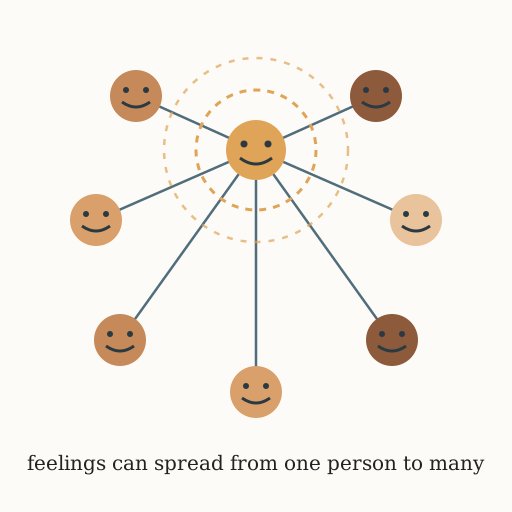
- Contagion map · 1 per pair A small network diagram of connected people; learners trace how one person's mood moves outward
- Index cards · 1 set per group Each card holds a mood or emotion; learners practice spreading and noticing it
Low-tech / no-cost
- A circle of chairs and a spoken mood One person holds up a mood, and each next person names how it shifts — tracing contagion live, no cards needed
- Paper and pencil Draw the network by hand
Enriched / lab & device
- Device showing a trending topic or comment thread · 1 per group To observe the emotional tone of a real online thread and trace its rise
- Mood-tracking app · 1 per learner To notice one's own mood shifts across a day of scrolling
Works in different contexts
- large-group Run the spoken mood-circle whole-class, then discuss in small groups where the feeling "caught"
- multi-age Younger learners trace one step of contagion; older learners trace a whole chain and name the regulation point
- self-directed A learner traces a real thread's emotional tone alone and writes a short reflection on where they would insert a pause
- level-grouped Learners ready to extend distinguish contagion from deliberate empathy, and collective mood from individual feeling
- outdoor-only Stand in a circle outdoors and pass a feeling with voice and gesture, then name where it landed in the body
Lesson 5 — When Feelings Go Viral
Summary
Learners evaluate how emotional contagion shapes emotional life. They learn that feelings spread from person to person — a smile, a panic, a burst of outrage — both face to face and through feeds, which can carry a single mood to millions at once. They trace a contagion chain, notice the moment a feeling “catches,” and practice keeping their own mood — choosing regulation over reaction (S-225).
Objectives
- Evaluate how technology and media influence emotional life, such as emotional contagion. (D01.S1.10.02)
Connection
Have you ever walked into a room and felt the mood change you before anyone said a word? Or watched a thread of comments turn from curiosity to fury in minutes — and felt your own pulse rise with it? That is emotional contagion: feelings passing from person to person like a spark. It is how a crowd becomes brave, a team becomes hopeful, or a feed becomes angry. It is not a flaw — it is a fact of being human. And once you can see it, you can begin to choose it.
Materials
- Contagion map (a small network diagram)
- Index cards (each with a mood or emotion)
Preparation
- Copy or draw the contagion map and the mood cards.
- Retrieval: from Lessons 3–4, recall that feeds skew comparison and can flatten empathy. Today we ask how feelings themselves spread through people and platforms.
Facilitator note
This lesson is written to the learner (“you”). The ideas to land: (1) emotions spread between people — emotional contagion — through face, voice, body, and now through feeds that carry a mood to many people at once; (2) contagion is neither good nor bad — it can lift (courage, hope) or weigh (panic, outrage); (3) the skill is noticing the catch and choosing — regulation over reaction. The science is real but the framing must stay honest: emotional contagion is well documented in face-to-face interaction (a widely replicated phenomenon; see the emotion-regulation field, S-225), and online emotional contagion is an active area of research with real but contested evidence (S-226, S-481) — state it as “feelings can spread, and feeds can amplify the spread,” not as settled proof that a platform simply “controls” mood (philosophy §5, §11).
Model the skill once, then let learners practice (S-011). The technology lens: name the mechanism — feeds rank high-engagement content, and strong emotion (outrage, delight, fear) is highly engaging, so platforms tend to surface the most contagious moods (S-481, S-482). The global lens: collective emotion is a real force in every society — hope, grief, and fear rise and fall in groups (this lesson sets up D01.S1.11’s “emotional climate” next year); different cultures have different rituals for carrying and releasing collective feeling. The egalitarian lens: when a mood sweeps a group, quieter or different-feeling people can be steamrolled — noticing contagion is also noticing whom the mood silences. The ethics lens: spreading a feeling is an act with consequences — before amplifying a panic or an outrage, ask whether it is true and whether it helps; you are responsible for the feeling you pass on. The social-emotional lens: learners may have been caught in real viral panics or pile-ons; hold the topic gently, invite rather than force sharing, and let “pass” stand.
Procedure
- Recall (5 min). Think of a time a room’s mood, or a thread’s mood, changed your feeling. Notice how quickly it happened.
- Meet contagion (10 min). Learn the word: emotional contagion is the way feelings spread from person to person — through face, voice, body, and now through screens. Watch a worked example on the contagion map: one person’s worry moves to two friends, then to four, then to a whole room — each person catching it, not choosing it. Notice the difference between catching a feeling and choosing one.
- Trace a chain (15 min). In a small group, use the mood cards. One person “holds” a mood; each next person names how it shifts them, tracing the spread. Then try it online: look at a short example comment thread and mark where the tone turns from neutral to hot. Where did it “catch”?
- Find the pause (12 min). Ask: where, in that chain, could someone have paused? Learn that regulation — the ability to notice and steer a feeling (S-225) — is the tool that turns a caught feeling into a chosen one. Write one pause you could take next time: a breath, a question (“is this true?”), a step away from the screen.
- Draft (10 min). Write or record two or three sentences: feelings spread — I can choose what I catch and what I pass on. Here is my pause.
- Close (3 min). Remember: you are not a leaf in the wind of every passing mood. Noticing the catch is the first step to steering your own heart.
Differentiation
- Support: Offer a single-step trace and a starter (“When everyone got ___, I noticed I ___.”).
- Extension: Distinguish emotional contagion from deliberate empathy (choosing to feel with someone) and explain when each is at work in a real online moment.
Assessment
- Formative (peer): Can each learner trace one step of a contagion chain and name a pause point where someone could choose differently?
- Portfolio artifact (summative for the unit): The contagion map with the traced chain and the drafted pause reflection, added to the unit portfolio.
Home connection
Ask someone at home: have you ever caught a feeling from a room or a screen without meaning to? Share your pause — and ask what they do to keep their own mood their own.
Resources
- On emotion regulation (the “pause”): Gross (1998), “The Emerging Field of Emotion Regulation,” Review of General Psychology 2(3), 271–299 (S-225).
- On platforms ranking high-engagement content: Britannica, “Social media,” https://www.britannica.com/topic/social-media (S-481); Pariser, The Filter Bubble (2011) (S-482).
- On media/technology effects on adolescent development: Common Sense Media Research, https://www.commonsensemedia.org/research (S-226).
- On modeling + guided practice: Kirschner, Sweller & Clark (2006), https://doi.org/10.1207/s15326985ep4102_1 (S-011).