Lesson 06 — Who Told Me Who I Am?
Learners examine how identity is socially constructed. They map the messages that family, peers, media, school, history, and place send about who they are, and meet the idea that group belonging shapes identity — often without anyone noticing.
Objectives
Objectives
- D01.S2.10.01 Examine how identity is socially and historically constructed, comparing examples across cultures.
Essential question
How is my identity shaped — socially and historically — by the people and systems around me?
Key vocabulary
Materials
Standard materials
- Who-tells-me-who-I-am map · 1 per learner A central figure surrounded by empty circles — family, peers, media, school, history, place — for learners to fill with the messages each sends
- Writing journal · 1 per learner
Low-tech / no-cost
- A large sheet of paper or drawn ground map Draw the central figure and circles together, and fill them with spoken or written messages
- Voice and memory The map can be spoken and remembered rather than written
Enriched / lab & device
- Digital mind-map or slide · 1 per learner Build the "who tells me who I am" map as an interactive diagram for the digital portfolio
- Short documentary clip on how a community names its members · 1 per class An age-appropriate look at identity roles in a specific culture, to compare with the learner's own
Works in different contexts
- large-group Model one circle together on the board, then learners fill their own maps; share in small circles of three to four
- multi-age Younger learners fill two circles (family, friends); older learners fill all circles and rank which messages carry the most weight
- self-directed A learner fills the map alone and writes one paragraph about which messages they have begun to question
- level-grouped Learners ready to extend connect the map to in-group/out-group dynamics and to social identity theory
- outdoor-only Draw the map large in soil or chalk and stand in each circle in turn, speaking the message each place sends
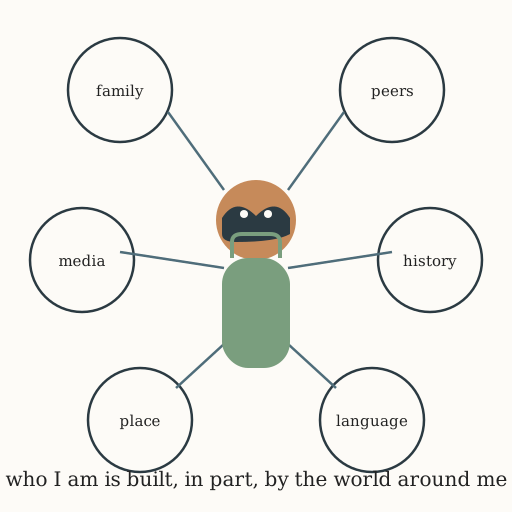
Lesson 6 — Who Told Me Who I Am?
Summary
Learners examine how identity is socially constructed. They map the messages that family, peers, media, school, history, and place send about who they are, and meet the idea that group belonging shapes identity — that even arbitrary groups can trigger in-group loyalty and out-group distance (S-232) — often without anyone noticing. They begin to ask the unit’s central question: which of these messages did I choose, and which were handed to me?
Objectives
- Examine how identity is socially and historically constructed, comparing examples across cultures. (D01.S2.10.01)
Connection
Before you ever chose a word to describe yourself, other people had already begun describing you — your family, your friends, the shows you watched, the school you sat in, the history your community carried. “You are the quiet one.” “You are so much like your mother.” “People like us don’t do that.” Some of those messages fit; some never did. None of them, on its own, is the whole truth of you — but together they helped build the person you see in the mirror. The first step to authoring your own identity is seeing which parts were written by other hands.
Materials
- “Who tells me who I am” map (central figure + surrounding circles)
- Writing journal
Preparation
- Copy or draw the map.
- Retrieval: from Lessons 1–2, recall that history and culture shape feeling. Today we turn to identity: the sense of who we are, built — in part — by the people and systems around us.
Facilitator note
This lesson is written to the learner (“you”). The idea to land: identity is socially and historically constructed — built in relation to the groups, messages, and histories around us, not simply found fully formed inside us. The scientific anchor is social identity theory and the minimal-group experiments: even arbitrary, content-free group assignment can trigger in-group favoritism (S-232). Present that as a descriptive finding about human group behavior, not a verdict on any person, and never as an excuse for exclusion — the lesson’s “open the circle” values are a commitment, not a claim from the research (philosophy §4, §11).
Model the skill once, then let learners practice (S-011). The global lens: how a culture names its members — by clan, caste, craft, faith, language, birth order, or achievement — varies enormously; there is no single “right” set of identity roles, and comparing them is the point of the next lesson. The egalitarian lens: some identity messages lift people and some limit them, and that is not distributed fairly — whose messages are narrowing, and why, is a question worth asking out loud. The ethics lens: we are all both shaped by and responsible for the messages we pass on to others — the words we use to describe a person can build or confine them. The technology & environment lens: media and feeds are now among the loudest voices telling us who we are (recall Lesson 3’s warped mirror) — include them in the map, and note that the places we grow up in are voices too. The social-emotional lens: this exercise can stir strong feeling about family or belonging; invite, never force, and let learners choose what to share. Keep the tone curious, not accusing — the goal is awareness and agency, not blame.
Procedure
- Recall (5 min). Think of one thing you “know” about yourself that you first heard from someone else. Notice: it arrived from outside, then settled inside.
- Meet the map (10 min). Look at the central figure and its surrounding circles: family, peers, media, school, history, place, language. Watch a worked example: the “family” circle filled with “the responsible one”; the “media” circle filled with “this is what a successful person looks like.” Notice that these are messages — some true, some narrow, some simply inherited.
- Fill your circles (18 min). In each circle, write two or three real messages you have received about who you are, from that source. For each, ask: does this fit me, or was it handed to me? Mark each message with a small ✓ (fits) or a small ? (handed to me, worth questioning).
- Meet in-groups and out-groups (10 min). Learn this finding: people quickly form a sense of “us” and “them” — even over arbitrary groupings — and tend to favor their own group (S-232). Talk: which of your circles feel like “us,” and which feel like “them”? Who drew those lines, and who keeps them?
- Draft (9 min). Write or record a few sentences: much of what I “know” about myself was written by other hands. Here is one message I accept, and one I am learning to question.
- Close (3 min). Remember: seeing the hands that wrote your story is not an accusation — it is the beginning of holding the pen yourself.
Differentiation
- Support: Offer a two-circle map (family, media) and a sentence starter (“I first heard ‘you are ___’ from ___, and it ___.”).
- Extension: Rank your circles by how much weight their messages carry for you now, and explain why the ranking has changed (or stayed) over time.
Assessment
- Formative (self): Can the learner name two sources of identity messages and mark one message they accept and one they are learning to question?
- Portfolio artifact (summative for the unit): The completed map, added to the unit portfolio as the “who told me who I am” reflection.
Home connection
Ask an older family member: what is one message you were given about who you were supposed to be — and did you keep it or rewrite it? Listen for their “fits” and their “?” marks.
Resources
- On social identity and in-group/out-group dynamics: Tajfel (1970), “Experiments in Intergroup Discrimination,” Scientific American 223(5), 96–102 (S-232).
- On identity formation as exploration and commitment: Marcia (1966), “Development and Validation of Ego-Identity Status,” JPSP 3(5), 551–558 (S-403).
- On modeling + guided practice: Kirschner, Sweller & Clark (2006), https://doi.org/10.1207/s15326985ep4102_1 (S-011).