Lesson 09 — My Considered Position
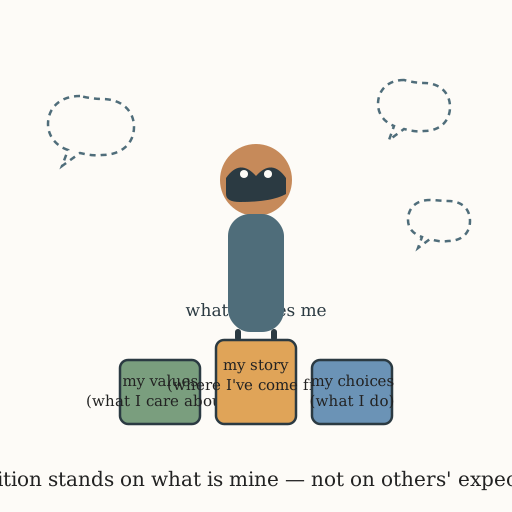
Learners complete their considered position on what defines them, independent of external labels and expectations. They build it from three pillars — their values, their story, and their choices — support it with evidence, and hold it as theirs to revise, not a finished verdict.
Objectives
Objectives
- D01.S2.10.02 Develop a considered position on what defines them, independent of external labels and expectations.
Essential question
What is my considered position on what defines me — stated in my own words, and mine to revise?
Key vocabulary
Materials
Standard materials
- Position scaffold · 1 per learner A one-page frame — what defines me (my values, my story, my choices), my evidence, and the part I am still deciding
- Writing journal · 1 per learner
Low-tech / no-cost
- Paper and pencil The scaffold can be drawn by hand
- Voice and memory The position can be spoken and recorded by memory rather than written
Enriched / lab & device
- Digital document, audio, or slide · 1 per learner Compose the considered position as a written, spoken, or visual artifact for the digital portfolio
- Peer-review prompts on a shared document · 1 per group For giving and receiving kind, useful feedback on a draft
Works in different contexts
- large-group Model a complete worked example aloud, then learners draft individually; pairs exchange one kind, useful comment each
- multi-age Younger learners state two of the three pillars (values and choices); older learners state all three with evidence and a revision
- self-directed A learner completes the scaffold alone and drafts the position, then reads it back and revises once
- level-grouped Learners ready to extend add a counter-consideration — a label or expectation they considered and why it does not define them
- outdoor-only Compose the position by walking and speaking it in three parts — my values, my story, my choices — then write the key line
Lesson 9 — My Considered Position
Summary
Learners complete their considered position on what defines them, independent of external labels and expectations. They build it from three pillars — their values, their story, and their choices — support it with evidence from their own life, and hold it as theirs to revise, not a finished verdict. This is the unit’s identity-writing artifact and a direct enactment of D01.S2.10.02.
Objectives
- Develop a considered position on what defines them, independent of external labels and expectations. (D01.S2.10.02)
Connection
Everyone lives with a version of the question “who am I, really?” — but few stop to answer it on purpose, in their own words, and keep the answer. A considered position is just that: a statement you have actually considered — looked at, tested against your life, and written down — rather than a label you inherited or a mood you happened into. It does not have to be final; in fact, the strongest positions are the ones their authors know how to revise. What matters is that it is yours.
Materials
- Position scaffold (what defines me — values, story, choices — my evidence, the part I am still deciding)
- Writing journal
Preparation
- Copy or draw the position scaffold.
- Retrieval: from Lessons 6–8, recall the messages others send, the labels they attach, and the truths you know beneath them. Today we assemble the positive answer: not what I am not, but what I am.
Facilitator note
This lesson is written to the learner (“you”). The idea to land: a considered position on what defines me is built from what is mine — my values, my story, my choices — is supported by evidence from my own life, and is held as revisable, not final. The three-pillar frame is a teaching structure, not a psychological law; it gathers the unit’s threads (values, narrative identity, agency) into one writable artifact. Narrative identity (S-404) and the exploratory, non-final nature of identity formation (S-403) are the descriptive anchors; “you are the author, and you may revise” is the value commitment (philosophy §6, §8, §11).
Model a complete worked example, then let learners practice (S-011). The ethics lens: a considered position is honest — it names real evidence, including the parts still undecided, and does not claim a certainty the learner does not yet have. The egalitarian lens: every learner’s position is worth writing and hearing; there is no “best” way to be a person, and no position outranks another. The global lens: the shape of a self is drawn differently in different cultures (recall Lesson 7) — a considered position may be told as a story, a list, a song, or a vow, and all are valid forms. The technology & environment lens: a position built to be read back and revised resists the feed’s demand for an instant, fixed, performable self — it is a slow, honest thing in a fast, polished world. The social-emotional lens: this is deeply personal work; invite, never force, let learners share only what they choose, and allow “I’m still deciding” as a complete and dignified answer. This lesson is also the unit’s summative identity artifact — gather it into the portfolio.
Procedure
- Recall (5 min). From the last three lessons: some of what you “know” about yourself was written by other hands; some of it was labels; beneath it all is what is true. Today you write that down, on purpose.
- Meet the scaffold (10 min). Look at the three pillars: my values (what I care about and how I try to live), my story (where I have come from and what it taught me), my choices (what I actually do, and choose next). Watch a worked example: a person who values fairness, whose story is being the one who stood up when no one else did, and whose choice is to keep speaking for the one left out. Notice how the three pillars hold each other up.
- Build your position (20 min). Fill the scaffold. For each pillar, write one sentence that is true of you — and, beside it, one small piece of evidence from your own life (a moment, a habit, a choice) that shows it. Then write the sentence that holds them together: what defines me is…
- Test it (10 min). Read your position back. Ask: would this still be true if everyone’s labels and expectations vanished tomorrow? If not, revise it until it stands on what is yours. Then, in a pair, trade one kind, useful comment each — a thing that rings true, and a gentle question.
- Draft (7 min). Write or record the final position in one short paragraph, ending with the part you are still deciding — because a considered position grows.
- Close (3 min). Remember: this is your answer, in your words, and you hold the pen to revise it. No one else gets the final word on who you are.
Differentiation
- Support: Offer a two-pillar version (values and choices) and a sentence starter (“What defines me is ___, and I know this because ___.”).
- Extension: Add a counter-consideration — a label or expectation you weighed and set down, with a sentence on why it does not define you.
Assessment
- Summative (portfolio): The completed position — the scaffold and the final paragraph — gathered into the unit portfolio as the “my considered position” artifact.
- Formative (peer): Can the learner’s partner name one pillar with its evidence, and one part the learner is still deciding?
Home connection
Read your position to a trusted adult, and ask: what do you see in me that my position leaves out — and should I add it? Hold their words as a question, not a verdict.
Resources
- On narrative identity: McAdams (2001), “The Psychology of Life Stories,” Review of General Psychology 5(2), 100–122 (S-404).
- On identity as exploration and commitment: Marcia (1966), “Development and Validation of Ego-Identity Status,” JPSP 3(5), 551–558 (S-403).
- On modeling + guided practice: Kirschner, Sweller & Clark (2006), https://doi.org/10.1207/s15326985ep4102_1 (S-011).