Lesson 08 — Beyond the Labels
Learners develop the first half of a considered position on what defines them by examining the labels and expectations others attach to them, distinguishing outer labels from inner worth, and naming what they know to be true of themselves beneath the labels.
Objectives
Objectives
- D01.S2.10.02 Develop a considered position on what defines them, independent of external labels and expectations.
Essential question
What defines me, independent of the labels and expectations others attach to me?
Key vocabulary
Materials
Standard materials
- Labels-and-worth worksheet · 1 per learner Two columns — labels others have attached to me (with what each claims about me), and what I know to be true of myself beneath or beside the label
- Writing journal · 1 per learner
Low-tech / no-cost
- Paper folded into two columns Write labels on one side, truths on the other
- Voice and memory The worksheet can be spoken and remembered rather than written
Enriched / lab & device
- Digital note or slide · 1 per learner Build the "labels and worth" reflection as a digital artifact for the portfolio
- Short video on stereotype threat or labeling (optional) · 1 per class An age-appropriate explainer to pair with the discussion
Works in different contexts
- large-group Model one label and its "truth beneath" on the board, then learners complete their own; share only in small circles
- multi-age Younger learners name one label and one truth; older learners add what the label *claims* about them and why it is incomplete
- self-directed A learner completes the worksheet alone and writes one paragraph about a label they are learning to hold lightly
- level-grouped Learners ready to extend connect labels to stereotype threat and to the difference between inner worth and outside approval
- outdoor-only Write labels on one side of a paper and truths on the other, then physically tear or set down the labels that no longer fit
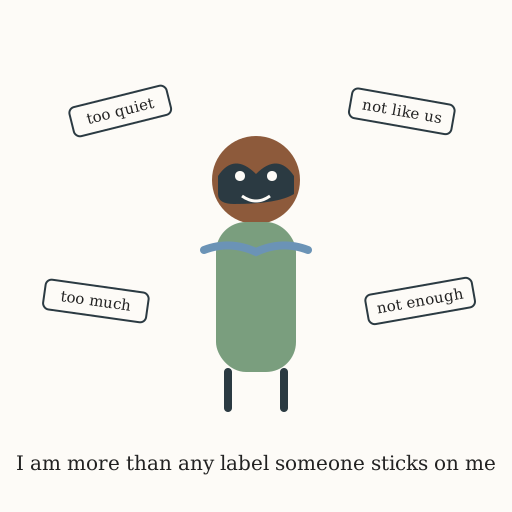
Lesson 8 — Beyond the Labels
Summary
Learners develop the first half of a considered position on what defines them by examining the labels and expectations others attach to them. They distinguish outer labels from inner worth, meet the idea of stereotype threat — how a negative label, made salient, can weigh on performance and self-image (S-284) — and name what they know to be true of themselves beneath the labels.
Objectives
- Develop a considered position on what defines them, independent of external labels and expectations. (D01.S2.10.02)
Connection
Labels are shortcuts, and people hand them out freely: “the smart one,” “the quiet one,” “the troublemaker,” “not really one of us.” Some fit, some never did, and almost all of them are too small — a person is not a single word. The strange thing is how heavy a word can become: called “not a math person” often enough, and a person may start to perform the label, even when it is false. The work of this lesson is to set the labels down and ask, quietly: what is true of me, regardless of what I have been called?
Materials
- “Labels and worth” worksheet (two columns: labels attached to me; truths I know beneath them)
- Writing journal
Preparation
- Copy or draw the worksheet.
- Retrieval: from Lessons 6–7, recall that much of identity is constructed by others. Today we begin the turn toward what is ours — the considered position independent of labels and expectations.
Facilitator note
This lesson is written to the learner (“you”). The ideas to land: (1) labels and expectations are external — they say more about who is doing the labeling than about the truth of the person labeled; (2) a negative label, made salient, can become a real weight (stereotype threat) that shapes performance and self-image, which shows that labels have consequences and are not merely “words”; (3) inner worth is not the same as outside approval — and a considered position on what defines me stands on what is true of me, not on what I have been called. The stereotype-threat claim is a well-replicated finding (S-284), presented as descriptive, not as a verdict about any learner; the worth-vs-approval distinction is a value commitment (philosophy §4, §8, §11).
Model the skill once, then let learners practice (S-011). The egalitarian lens: labels are not handed out equally — some people are labeled more, and more harmfully, than others, and the curriculum’s job is to name that honestly without ranking any learner. The ethics lens: we both receive and give labels; the words we use about another person can build or confine them, so we bear a small responsibility for the labels we pass on. The global lens: what counts as a “good” or “bad” label varies across cultures — the same trait praised in one place may be belittled in another — which shows how little a label tells you about a person’s worth. The technology & environment lens: feeds and platforms sort people into categories and show them narrow images of “who someone like me is” (recall Lesson 3) — a digital version of labeling that a considered position must see through. The social-emotional lens: this lesson can touch real wounds; invite, never force, let “pass” stand, and watch for learners who may be carrying a heavy label. Keep the tone gentle and dignifying: the point is freedom from labels, not a new ranking of who has suffered most.
Procedure
- Recall (5 min). Think of a label someone has attached to you. Notice how it arrived from outside — and how it can come to feel like the truth.
- Meet labels and worth (10 min). Learn the difference: a label is a shortcut others use to sort you; your worth is the truth of you beneath it. Learn too that a negative label, made prominent, can become a real weight — this is stereotype threat, and researchers have shown it can change how a person actually performs (S-284). A label is not “just a word” — but it is also not the truth of you.
- Sort your labels (18 min). Use the worksheet. On the left, write two or three labels others have attached to you, and note what each label claims about you. On the right, write what you know to be true of yourself beneath or beside each label — the part the label leaves out. Example: “quiet” claims I have nothing to say; the truth is I think carefully and speak when it matters.
- Distinguish worth from approval (10 min). Ask: if everyone’s approval vanished tomorrow, what would still be true of me? Write two or three things — your values, your history, your choices — that do not depend on being called anything at all.
- Draft (9 min). Write or record a few sentences: I am more than any label. Here is what I know to be true of me, regardless of what I have been called.
- Close (3 min). Remember: a label describes the labeler’s shortcut, not your worth. You are allowed to set it down.
Differentiation
- Support: Offer a two-row version with a sentence starter (“They call me ___, but I know ___.”).
- Extension: Distinguish inner worth from outside approval with a concrete example, and explain how stereotype threat works in one real setting without blaming the person labeled.
Assessment
- Formative (self): Can the learner name one label, what it claims, and one truth they know beneath it — plus one thing true of them independent of approval?
- Portfolio artifact (summative for the unit): The completed worksheet, added to the unit portfolio as the “beyond the labels” reflection.
Home connection
Ask a trusted adult: what is a label you were given that you decided wasn’t the truth of you — and how did you set it down?
Resources
- On stereotype threat: Steele & Aronson (1995), “Stereotype Threat and the Intellectual Test Performance of African Americans,” JPSP 69(5), 797–811 (S-284).
- On worth vs. approval and assertion: Alberti & Emmons, Your Perfect Right (2017) (S-405).
- On modeling + guided practice: Kirschner, Sweller & Clark (2006), https://doi.org/10.1207/s15326985ep4102_1 (S-011).