Lesson 03 — Movement Shapes Mood and Thinking
Learners explore how movement shapes mood and thinking — through brain chemicals and through attention itself — and meet the WHO picture of a balanced routine (aerobic plus muscle-strengthening activity). They feel the shift in their own bodies and begin to see movement as mental health, not just fitness.
Objectives
Objectives
- D03.S1.10.01 Analyze how chronic stress, sleep, and movement shape mood, thinking, and long-term health.
Essential question
How does moving my body shape my mood and my thinking, and what is actually happening inside?
Key vocabulary
Materials
Standard materials
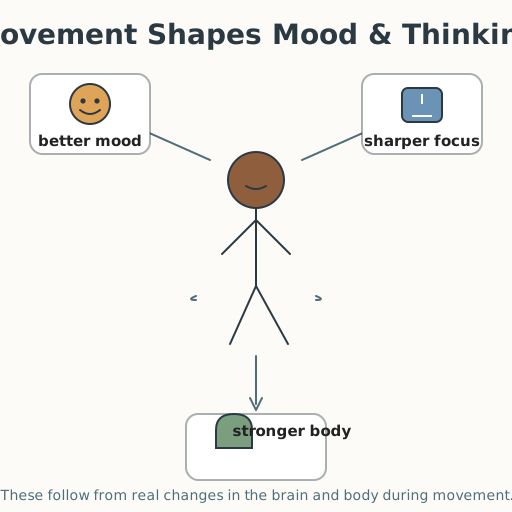
- Movement-and-brain diagram · 1 per learner or projected A figure in motion linked by arrows to three labeled outcomes — better mood, sharper focus, stronger body — with the mechanism note
- Writing journal · 1 per learner
Low-tech / no-cost
- Paper with three boxes, or three patches of ground One box for "mood," one for "thinking," one for "body" — fill each with what movement does for it
- Body and breath Do a short burst of movement, then notice the shift in energy and attention
Enriched / lab & device
- Short clip on exercise and the brain · 1 per class An age-appropriate look at how movement changes brain chemistry
- Heart-rate monitor (optional) · 1 per pair To watch the heart respond to movement and recover
Works in different contexts
- large-group Project the diagram, then learners notice the shift after a whole-class movement burst; share in pairs
- multi-age Younger learners name how movement makes them feel; older learners explain a mechanism and connect it to mental health
- self-directed A learner does a short movement burst alone and writes one paragraph on the shift in mood and focus
- level-grouped Learners ready to extend explain the endorphin/monoamine/BDNF mechanisms and distinguish evidence from hype
- outdoor-only Take the movement burst outdoors — a brisk walk or game — and notice mood and focus shift in real time
Lesson 3 — Movement Shapes Mood and Thinking
Summary
Learners explore how movement shapes mood and thinking. They meet the mechanisms behind the mood lift — endorphins, monoamines, and BDNF, among others (S-408) — and the WHO picture of a balanced routine: aerobic activity plus muscle-strengthening activity, with balance and flexibility across the lifespan (S-341). They feel the shift in their own bodies and begin to see movement as mental health, not just fitness.
Objectives
- Analyze how chronic stress, sleep, and movement shape mood, thinking, and long-term health — focusing on the movement side. (D03.S1.10.01)
Connection
Think of a time you walked, ran, danced, swam, or played hard — and afterward felt something lift: a steadier mood, a clearer head, an energy that had been missing. That is not your imagination. Movement changes the chemistry of the brain and the body, and it does it in ways that help mood and sharpens thinking. This matters everywhere — for the child who walks far to school, the elder who gardens, the dancer in a festival, the worker who cycles to a shift. The body was made to move, and when it does, the mind moves with it.
Materials
- Movement-and-brain diagram (movement → mood, focus, body)
- Writing journal
Preparation
- Copy or draw the movement-and-brain diagram.
- Retrieval: from Lessons 1–2, recall the alarm/calm branches and sleep’s night shift. Today we add the third force: movement, which is one of the body’s most reliable ways to shift from alarm toward calm and to sharpen the mind.
- Plan a short, safe movement burst that fits your space and every body (a brisk walk, marching in place, a stretch-and-reach, a chair-based or adapted version).
Facilitator note
This lesson is written to the learner (“you”). The idea to land: movement is evidence-backed medicine for the mind — it improves mood, reduces symptoms of depression and anxiety, and supports focus — through mechanisms that include endorphins, monoamines, and BDNF, among others (S-408). Hold the mechanism claims honestly and with hedging: endorphins are one piece, not the whole story; no single chemical explains the mood lift (S-408). The WHO frames a balanced routine as aerobic (endurance) activity plus muscle-strengthening activity, with balance and flexibility also mattering across life (S-341). These are descriptions, never a prescription for any particular body, and every body can move in ways that fit it.
Model once, then let learners practice (S-011). The egalitarian lens: the opportunity to move is not shared equally — safe places to play, time, money, and ability all gate access — so “move more” must never become a lecture aimed only at those with the fewest choices. The global lens: movement traditions — dance, sport, play, work — differ richly across cultures, and all of them count. The ethics lens: movement is offered as joy and care, never as punishment or a way to “fix” a body; a body is not a problem to be solved. The technology & environment lens: our environments (walkable streets, green spaces, safe parks) shape whether movement is easy or hard — that is a community question, not only a personal one. The social-emotional lens: moving with others builds connection; invite, never force, and keep the burst inclusive of every ability. Preview: Lesson 7 will turn this into a training plan.
Procedure
- Recall (5 min). From Lessons 1–2: the body has an alarm branch and a calm branch, and sleep is a deep calm. Notice that movement is a way to actively move your body from alarm toward calm — and it sharpens the mind too.
- Meet the mechanism (10 min). Look at the diagram: a figure in motion, arrows to three outcomes — better mood, sharper focus, stronger body. Learn the “why”: during movement the body and brain release chemicals — endorphins (the body’s own opioids), monoamines (serotonin, dopamine, noradrenaline), and BDNF (a growth factor that supports brain cells) — that together lift mood and support learning (S-408). Remember: endorphins are one piece, not the whole story.
- Feel it (8 min). Do the short movement burst — brisk walking or marching in place for two to three minutes, or a chair-based/adapted version that fits every body. Stop. Close your eyes for ten seconds. Notice: what changed in your energy, your breathing, your attention?
- Meet a balanced routine (10 min). Learn the WHO picture: a balanced routine includes aerobic activity (endurance — walking, cycling, swimming, dancing) and muscle-strengthening activity (carrying, climbing, lifting, resistance), with balance and flexibility also mattering across the lifespan (S-341). Note that every one of these has versions that fit different bodies and abilities.
- Link it to your life (14 min). In your journal, write: one movement you already enjoy or used to enjoy; what it does for your mood and focus; and one small way you could add a little more of it this week — in a form that fits your body and your life.
- Close (3 min). Remember: movement is not about looking a certain way. It is a gift you give your own mind — a steadier mood and a clearer head, one step at a time.
Differentiation
- Support: Offer a one-box journal prompt (“when I move, I feel ___ and my mind feels ___”) and model a seated movement option.
- Extension: Explain the endorphin/monoamine/BDNF mechanisms in your own words and state one honest limit — what the science cannot promise (no single chemical, no quick fix).
Assessment
- Formative (self): Can the learner name one mechanism by which movement helps mood and one component of a balanced routine?
- Portfolio artifact (summative for the unit): The “movement and me” journal entry, added to the unit portfolio as the “movement shapes mood and thinking” reflection.
Home connection
Ask an adult you trust: what is one way you like to move, and how does it affect your mood? Then invite them to join you in the short movement burst this week.
Resources
- On the mechanisms linking exercise and mental health (endorphins, monoamines, BDNF): Mikkelsen et al. (2017), “Exercise and mental health,” Maturitas 106, 48–56, https://doi.org/10.1016/j.maturitas.2017.09.003 (S-408).
- On balanced physical activity (aerobic + muscle-strengthening): WHO, “Physical activity” fact sheet, https://www.who.int/news-room/fact-sheets/detail/physical-activity (S-341).
- On modeling + guided practice: Kirschner, Sweller & Clark (2006), https://doi.org/10.1207/s15326985ep4102_1 (S-011).