Lesson 04 — Reading My Own Body's Signals
Learners bring the unit's first three forces together and read them in their own lives. They track stress, sleep, and movement alongside mood and focus, name a pattern, and practice the honest distinction between a correlation and a causal claim.
Objectives
Objectives
- D03.S1.10.01 Analyze how chronic stress, sleep, and movement shape mood, thinking, and long-term health.
Essential question
How do stress, sleep, and movement show up together in my own mood and thinking — and what can I learn from the pattern?
Key vocabulary
Materials
Standard materials
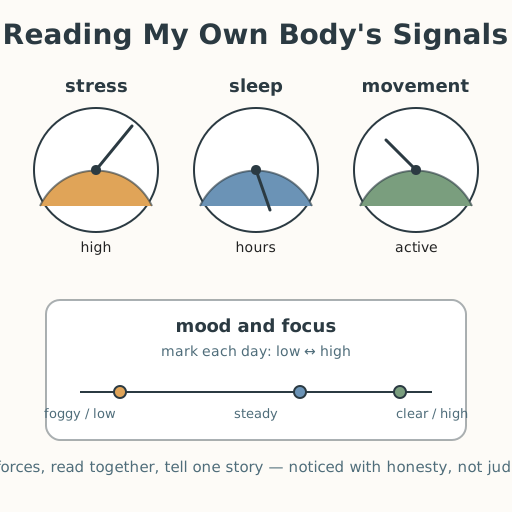
- Three-dial pattern tracker · 1 per learner A one-page organizer with three dials or scales — stress, sleep, movement — and a strip below for mood and focus over a day
- Writing journal · 1 per learner
Low-tech / no-cost
- Paper with three columns, or three marks drawn in the ground Track stress, sleep, and movement with simple marks — no tools needed
- Voice and memory Recall and speak the pattern aloud rather than writing it
Enriched / lab & device
- Spreadsheet or simple tracking app (optional) · 1 per learner A light three-column log to notice patterns across a week
- Shared class "pattern board" (optional) · 1 per class Anonymous, aggregated trends learners can discuss without singling anyone out
Works in different contexts
- large-group Model one worked example of reading a pattern, then learners track their own; discuss trends anonymously
- multi-age Younger learners notice one link ("short sleep → grumpy"); older learners distinguish correlation from cause
- self-directed A learner completes the tracker alone and writes one paragraph naming a pattern and its honest limit
- level-grouped Learners ready to extend write a cautious causal claim and identify what data they would need to test it
- outdoor-only Walk and talk through the three dials; mark each on a natural object or patch of ground as you go
Lesson 4 — Reading My Own Body’s Signals
Summary
Learners bring the unit’s first three forces together and read them in their own lives. Using a three-dial tracker, they observe stress, sleep, and movement beside mood and focus, name a pattern, and practice the honest distinction between a correlation and a causal claim. This is the “analyze” step of the objective: the learner becomes a careful observer of their own body-mind system.
Objectives
- Analyze how chronic stress, sleep, and movement shape mood, thinking, and long-term health — by reading the pattern in one’s own life. (D03.S1.10.01)
Connection
You already have more data about your own body than any tracker could buy. How you slept last night, what is pressing on you this week, whether you moved today — these things you can notice, and they tell a story about your mood and your focus. The trick is learning to read the story instead of just living it. A sailor reads the wind and the tide; a farmer reads the soil and the sky; you can learn to read the three forces that shape your own mind. No special tool is needed — only attention, honesty, and a little patience.
Materials
- Three-dial pattern tracker (stress, sleep, movement → mood and focus)
- Writing journal
Preparation
- Copy or draw the three-dial tracker.
- Retrieval: from Lessons 1–3, recall the three forces — chronic stress wears on mood and health; sleep consolidates memory and steadies mood (8–10 hours); movement lifts mood and sharpens focus. Today we read all three together.
- Prepare one worked example of reading a pattern so learners can see the skill modeled.
Facilitator note
This lesson is written to the learner (“you”). The idea to land: stress, sleep, and movement are not separate; they act together on mood and thinking, and a learner can read the pattern in their own life — while staying honest about what the pattern does and does not prove. This is the unit’s retrieval-and-application pass (spacing and retrieval practice are among the most effective learning techniques, S-039): the three lessons just learned are pulled back together and used.
The key intellectual move is correlation vs. causation. A learner might notice “short sleep goes with a foggy morning,” but a careful observer does not leap to “sleep caused the fog” without more data — many things change together (S-039 supports retrieval practice; the correlation/causation distinction is a general reasoning skill). Model it: “On days I slept under six hours, I also felt low — but those were also the days I was most stressed, so I can’t say sleep alone did it. That is a correlation, not yet a cause.”
The ethics lens: self-observation is for care and agency, never for self-punishment or a grade on oneself; a learner who finds no pattern yet has still done the work. The egalitarian lens: what a learner can observe is bounded by what life allows — work, caregiving, housing, and safety all shape the data; a “bad” pattern is often a context, not a character flaw. The global lens: people have tracked body rhythms by season, moon, and labor for thousands of years; this is an ancient human practice in modern form. The technology & environment lens: apps and wearables can help — or can turn self-observation into self-surveillance; we return to that question in Lesson 9. The social-emotional lens: noticing mood can bring up real feeling; invite, never force, and let learners share only what they choose. Keep the tone curious and kind.
Procedure
- Recall (5 min). From memory — no notes — name the three forces and one thing each does to mood or thinking: stress, sleep, movement. This is retrieval practice: pulling it back up is what makes it stick (S-039).
- Meet the tracker (8 min). Look at the three dials: stress, sleep, movement — and the strip below for mood and focus. Watch a worked example: a day with high stress, six hours of sleep, and no movement, marked with low mood and foggy focus; a day with low stress, nine hours of sleep, and a long walk, marked with steady mood and clear focus. Notice the pattern — but also notice what we cannot yet claim.
- Track your last few days (15 min). Fill the tracker for the last three or four days you can remember. For each, mark roughly: how stressed were you (low/medium/ high)? How many hours did you sleep? Did you move much? Then mark your mood and focus. Be honest, and be kind — these are observations, not grades.
- Find a pattern (10 min). Read across your rows. Ask: what travels together? Write one sentence naming a pattern you notice — for example, “on short-sleep days my focus drops” or “movement days feel steadier.”
- Name the limit (8 min). Learn the difference: a correlation is two things that travel together; a causal claim says one causes the other. Write one sentence that honestly names the limit of your pattern: “I see ___ and ___ together, but I can’t be sure one caused the other, because ___ might also be at work.”
- Close (4 min). Remember: reading your body is a skill, and every careful observer starts where you are — with attention and honesty, not with certainty.
Differentiation
- Support: Offer a two-day tracker and a sentence starter (“When I ___, my mood and focus tend to ___.”).
- Extension: Write a cautious causal claim and list the specific data you would need (more days? a comparison? a control?) to test it more fairly.
Assessment
- Formative (self): Can the learner name one pattern across stress, sleep, and movement — and state its honest limit (correlation, not proof of cause)?
- Portfolio artifact (summative for the unit): The completed tracker and pattern reflection, added to the unit portfolio as the “reading my own body’s signals” analysis.
Home connection
Ask an adult you trust: do you notice that your sleep, stress, or movement affects your mood — and which one matters most for you? Compare their pattern with yours.
Resources
- On retrieval practice and spacing as high-utility learning techniques: Dunlosky et al. (2013), “Improving Students’ Learning With Effective Learning Techniques,” https://doi.org/10.1177/1529100612453266 (S-039).
- On the three forces this lesson pulls together: stress (S-338), sleep (S-050), and movement-and-mind (S-408) — see Lessons 1–3.