Lesson 05 — The Body-Mind Connection Across Cultures and Times
Learners survey how different cultures and times have understood the body-mind connection — breath practices, meditation, movement arts, and humoral systems — and hold them side by side with respect, without ranking. They practice one tradition and note where it comes from.
Objectives
Objectives
- D03.S1.10.02 Explain how different cultures and times have understood the body-mind connection and assess what evidence supports each.
Essential question
How have different cultures and times understood the connection between body and mind?
Key vocabulary
Materials
Standard materials
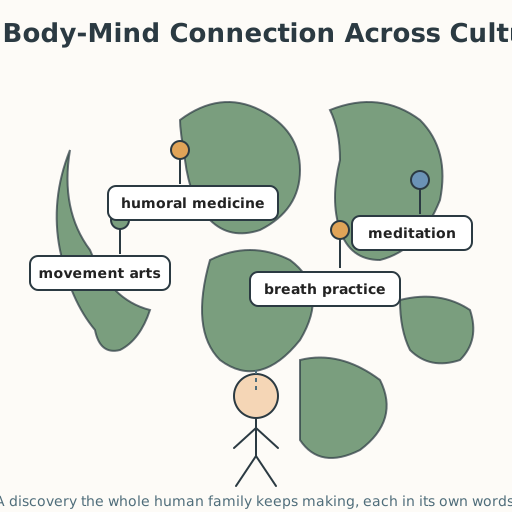
- Body-mind traditions map · 1 per learner or projected A world map or table placing mind-body traditions — breath, movement, meditation, and humoral systems — across cultures and times
- Writing journal · 1 per learner
Low-tech / no-cost
- Large paper map or drawn circles on the ground Place each tradition in a circle by region; no printing needed
- Voice and story Retell one tradition aloud from a home culture or a neighbor's
Enriched / lab & device
- Short documentary clips · 2 per class Age-appropriate clips showing two live mind-body traditions practiced today
- Digital map with pins · 1 per group A collaborative map learners add traditions to
Works in different contexts
- large-group Build the map together on the board, each group adding one tradition; share briefly
- multi-age Younger learners match a tradition to its place; older learners compare underlying ideas across traditions
- self-directed A learner researches one tradition and writes a short, respectful account of it
- level-grouped Learners ready to extend compare two traditions' *theories* of why body and mind connect
- outdoor-only Practice one breath or movement form outdoors and discuss where in the world it comes from
Lesson 5 — The Body-Mind Connection Across Cultures and Times
Summary
Learners survey how different cultures and times have understood the body-mind connection — breath practices, meditation, movement arts, and humoral systems — and hold them side by side with respect, without ranking (philosophy §11). They practice one tradition (a slow breath or gentle movement form) and note where it comes from, treating every tradition as a living practice to honor, never a specimen.
Objectives
- Explain how different cultures and times have understood the body-mind connection and assess what evidence supports each — beginning with the understandings themselves. (D03.S1.10.02)
Connection
Long before any lab measured it, people everywhere noticed the same thing: how you breathe, move, and settle your body changes how you feel and think. In one place they built a science of the breath; in another, a practice of slow movement; in another, a system of sitting still; in another, a theory of the body’s humors and seasons. No single culture invented the body-mind connection — it seems to be a discovery the whole human family keeps making, each in its own words. Today you meet a few of those words, from many places and times, and you hold them with respect.
Materials
- Body-mind traditions map (breath, meditation, movement, humoral — across cultures and times)
- Writing journal
Preparation
- Copy or draw the traditions map.
- Retrieval: from Lessons 1–3, recall that the body-mind connection is real and measurable — stress, sleep, and movement all change mood and thinking. Today we ask: who has understood this, in how many different ways, across the world and across time?
- Preview the closing practice so you can lead it (a slow breath or gentle movement form, adapted for every body).
Facilitator note
This lesson is written to the learner (“you”). The idea to land: the body-mind connection is not one culture’s idea — many peoples across time have built sophisticated understandings of it, and we hold them side by side with respect, not rank them. The lesson’s examples are offered accurately and humbly: breathing practices such as pranayama (South Asia) and qigong (China) are named, alongside meditation and movement arts, as practices the scientific literature now also studies for their calming effects (S-340 explicitly holds pranayama and qigong side by side as breathing traditions from many cultures). Humoral medicine (the ancient idea of balancing the body’s humors — in Greek, Islamic, South Asian, and other traditions) is presented as a historical theory that shaped medicine for centuries, distinct from what modern evidence supports. The UNESCO International Charter frames physical activity and sport as a fundamental right for all, inclusive of every ability — the egalitarian anchor for this lesson (S-342).
The global lens is the spine here: treat every tradition as a living practice to honor with respectful questions, never as a specimen to be dissected (philosophy §11; art-style representation note). The ethics lens: borrowing a practice from another culture calls for care — name where it comes from, and do not strip it of its context. The egalitarian lens: no tradition is “more advanced” than another; each is a real answer to a real question. The critical-thinking lens: understanding a tradition is not the same as evidence for it — we will weigh evidence next lesson, and today we simply describe honestly. The social-emotional lens: practicing a calm-down may surface feeling; go gently, and let learners opt out. The technology & environment lens: modern life often separates body from mind (desk, screen, stillness); these traditions, in their different ways, all insist they belong together.
Procedure
- Recall (5 min). From Lessons 1–3, recall the three forces: stress, sleep, movement — all of which change mood and thinking. Notice: this is the body-mind connection, and it is real. Now ask: who else has noticed this, across the world and across time?
- Meet the traditions (15 min). Look at the map. Four broad families appear again
and again across cultures and centuries:
- Breath practice — controlling the breath to settle the body (e.g., pranayama in South Asian traditions, qigong breathing in Chinese traditions) (S-340).
- Meditation — training attention by sitting still, found in many contemplative traditions across Asia and beyond.
- Movement arts — yoga, tai chi, dance, and martial arts, where the moving body becomes a way to train the mind.
- Humoral systems — ancient theories that health depends on balancing the body’s fluids or forces, found in Greek, Islamic, South Asian, and other medicines. For each, name one culture or time that practiced it, and write it on your map.
- Add your own (10 min). Think of a body-mind practice from your own home, culture, or neighborhood — a way of breathing, moving, praying, resting, or gathering that people use to settle or lift themselves. Add it to the map in your own words.
- Practice one, with respect (15 min). Choose one practice and try it for a few minutes — a slow breath with a longer exhale, or a gentle movement form. As you do, remember and name where it comes from. The point is not to master it; the point is to feel the connection it was built on.
- Draft (7 min). Write or record two sentences: one tradition I met today and where it comes from; and one practice from my own life that does the same work.
- Close (3 min). Remember: the body-mind connection is a discovery the whole human family keeps making. No one owns it — and every culture’s answer deserves respect.
Differentiation
- Support: Offer a two-item matching task (practice → place) and a single practiced breath.
- Extension: Compare two traditions’ theories — how each explains why body and mind connect — and note what they share.
Assessment
- Formative (self): Can the learner name at least two traditions from different cultures and state, respectfully, what each understood about the body-mind connection?
- Portfolio artifact (summative for the unit): The traditions map and two-sentence reflection, added to the unit portfolio as the “body-mind across cultures” entry.
Home connection
Ask an adult or elder: is there a way our family or community settles or lifts the body and mind together — a breath, a movement, a rest, a gathering? Listen, and add it to your map.
Resources
- On breath-control practices held side by side across traditions (pranayama, qigong, and others): Harvard Health, “Relaxation techniques: Breath control helps quell errant stress response,” https://www.health.harvard.edu/mind-and-mood/relaxation-techniques-breath-control-helps-quell-errant-stress-response (S-340).
- On physical activity and sport as a fundamental right for all, inclusive of every ability: UNESCO, International Charter of Physical Education, Physical Activity and Sport (2015), https://www.unesco.org/en/sport-and-anti-doping/international-charter-sport (S-342).
- On holding multiple accounts side by side without ranking: philosophy §11 (inquiry over creed) and §4 (global lens).