Lesson 06 — What Evidence Supports Each View?
Learners learn to weigh evidence for body-mind claims. They place types of evidence on a ladder — anecdote, correlation, trial, systematic review — and apply it to one mind-body practice, distinguishing what the evidence supports from what it does not, without dismissing tradition.
Objectives
Objectives
- D03.S1.10.02 Explain how different cultures and times have understood the body-mind connection and assess what evidence supports each.
Essential question
How do I weigh what evidence supports — and does not support — each way of understanding the body-mind connection?
Key vocabulary
Materials
Standard materials
- Evidence scale · 1 per learner or projected A balance or ladder ranking types of evidence from anecdote to systematic review, with a worked example placed on it
- Writing journal · 1 per learner
Low-tech / no-cost
- A drawn ladder or a row of stones Place "anecdote," "correlation," "trial," "review" from low to high on the ground
- Voice and discussion Rank a claim aloud together, with reasons
Enriched / lab & device
- Abstract or plain-language summary of a systematic review · 1 per pair A real, readable review of a mind-body practice so learners can see the strongest kind of evidence
- Access to a medical library or database (optional) · 1 per group To trace one claim to its source
Works in different contexts
- large-group Build the evidence ladder whole-class, then pairs rank one claim; share reasons briefly
- multi-age Younger learners sort anecdote from trial; older learners weigh a full evidence chain for one practice
- self-directed A learner ranks a single claim on the ladder and writes one paragraph justifying the placement
- level-grouped Learners ready to extend explain why a systematic review outweighs an anecdote and name a placebo risk
- outdoor-only Use natural objects (a pebble = anecdote, a heavy stone = review) to physically build the ladder and place a claim
Lesson 6 — What Evidence Supports Each View?
Summary
Learners learn to weigh evidence for body-mind claims. They place types of evidence on a ladder — anecdote, correlation, randomized trial, systematic review — and apply it to one mind-body practice, distinguishing what the evidence supports from what it does not, without dismissing the tradition that carried the practice.
Objectives
- Explain how different cultures and times have understood the body-mind connection and assess what evidence supports each — weighing the evidence for each view. (D03.S1.10.02)
Connection
Someone tells you a practice “really works” — a breathing exercise that “cured” a neighbor’s anxiety, a tea that “everyone knows” helps sleep. Maybe it does; maybe it does not. The difference between trusting a claim and knowing whether to believe it is evidence. This is the same skill you use when you decide whether to believe a headline, an ad, or a rumor: ask what kind of support does this claim actually have? Whether the claim is ancient or brand new, from your own culture or another, the question is the same — and it is a question of respect, not disrespect, to ask it.
Materials
- Evidence scale (ladder: anecdote → correlation → trial → systematic review)
- Writing journal
Preparation
- Copy or draw the evidence ladder.
- Retrieval: from Lesson 5, recall the traditions — breath practice, meditation, movement arts, humoral systems. Today we turn from understanding them to weighing the evidence for them.
- Prepare one worked example: a mind-body claim placed on the ladder with reasons.
Facilitator note
This lesson is written to the learner (“you”). The idea to land: we can honor a tradition and still weigh its evidence honestly — the two are not enemies. The evidence ladder is the core skill: an anecdote (one person’s story) is weak evidence; a correlation (two things travel together) is suggestive but proves no cause; a randomized controlled trial (people assigned to practice or control) is strong; a systematic review (many trials pooled and assessed) is the strongest. For mind-body practices, the honest summary is mixed and maturing: there is evidence that breath control can help the body return to calm (S-340), that physical activity improves mood and reduces symptoms of depression and anxiety through real mechanisms (S-408), and that the stress response itself is physiological (S-338) — while many specific claims (about particular teas, “detoxes,” or a single practice curing illness) rest on far weaker ground. Hold this with humility and respect: “weak evidence” describes the claim, never the people who hold it, and a tradition may carry value (community, meaning, rest) that a trial does not measure (philosophy §5, §11).
The ethics lens: asking for evidence is a form of care, not contempt — but it must never be used to sneer at another culture’s wisdom; distinguish “what the evidence supports” from “what is worthy of respect” (they are different questions). The global lens: scientific methods are themselves one cultural tradition, now shared across the world — not a superior one, but a useful tool we can all wield. The egalitarian lens: everyone deserves the same honest standard, whether the claim comes from a clinic or a market stall. The technology & environment lens: the feeds, search engines, and social platforms that spread claims reward what grabs attention, not always what is true — so the evidence ladder matters more, not less, in a connected world — and the “wellness” products many claims sell also carry environmental costs worth asking about. The critical-thinking lens: watch for the placebo effect (feeling better because you expect to) and for the leap from “anecdote” to “proof.” The social-emotional lens: weighing a practice someone loves can feel personal; keep the tone respectful and let learners choose their example. Preview: this same evidence skill returns in Lesson 10 for diets.
Procedure
- Recall (5 min). From Lesson 5: many cultures understand the body-mind connection. Now ask the harder question: how do I know which of these claims are supported? Recall too, from Lesson 4, that a correlation is not a cause.
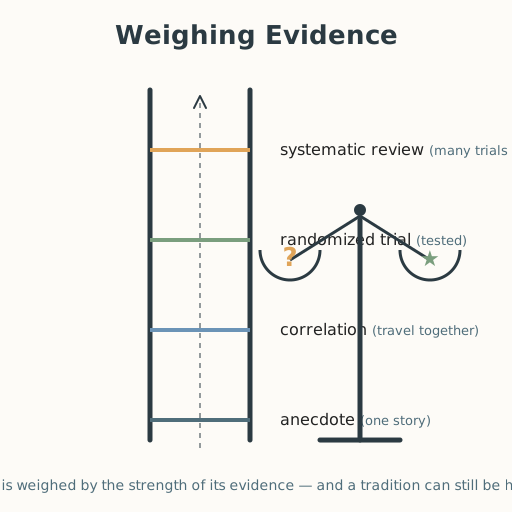
- Meet the ladder (12 min). Look at the evidence ladder, bottom to top:
- Anecdote — one person’s story (“it worked for my aunt”). Weak alone.
- Correlation — two things travel together (“people who practice report less anxiety”). Suggestive, not proof.
- Randomized trial — people are assigned to the practice or a comparison group, and outcomes are measured. Strong.
- Systematic review — many trials pooled and weighed together. Strongest. Watch a worked example: “breath control calms the body” sits high — there are physiological studies showing slow breathing engages the calming branch (S-340). “This one tea cures all illness” sits low — it is an anecdote until tested.
- Weigh one claim (15 min). Choose one mind-body claim you have heard (a breathing practice, a movement form, a remedy, a “detox”). Place it on the ladder. For each rung, ask: is there evidence of this kind for it? Write down what you find, even if the answer is “no trial exists.”
- Distinguish the two questions (12 min). Learn to separate: “what does the evidence support?” (a question of fact) from “is this worthy of respect?” (a question of values). A tradition may rest on anecdotes yet still carry meaning, community, and rest — those are real, even when a trial cannot measure them. Write one sentence of each kind about the claim you weighed.
- Draft (7 min). Write or record: the claim I weighed, where it sits on the ladder, and what I would still honor about it even if the evidence is thin.
- Close (4 min). Remember: asking for evidence is not disrespect — it is how you care for yourself and others, and it can live side by side with honoring the traditions that carried the practice to you.
Differentiation
- Support: Offer a two-rung ladder (anecdote vs. trial) and a claim chosen for them to place.
- Extension: Find or describe what a systematic review of a mind-body practice would need to include, and explain why it outweighs a single trial.
Assessment
- Formative (self): Can the learner place one claim on the evidence ladder, state why, and separate “evidence supports” from “worthy of respect”?
- Portfolio artifact (summative for the unit): The evidence ladder entry, added to the unit portfolio as the “what evidence supports each view” analysis.
Home connection
Ask an adult you trust about a remedy or practice your family uses. Then, together, ask gently: what kind of evidence does this rest on — a story, or something more? Notice that asking does not have to mean rejecting.
Resources
- On breath control and the physiology of calm: Harvard Health (S-340), see Lesson 1.
- On the mechanisms and mood effects of physical activity: Mikkelsen et al. (2017), Maturitas 106, 48–56 (S-408).
- On the physiology of stress: American Psychological Association (S-338), see Lesson 1.
- On distinguishing evidence from values: philosophy §5.