Lesson 07 — Progressive Effort and Recovery
Learners meet the two principles at the heart of training: progressive effort (small, steady increases) and recovery (the rest in which the body adapts and grows stronger). They learn why recovery is not laziness but part of progress, and spot the warning signs of overtraining.
Objectives
Objectives
- D03.S2.10.01 Apply principles of training, such as progressive effort and recovery, to build a safe and sustainable movement plan.
Essential question
How do I build strength and endurance safely — and why is recovery as important as effort?
Key vocabulary
Materials
Standard materials
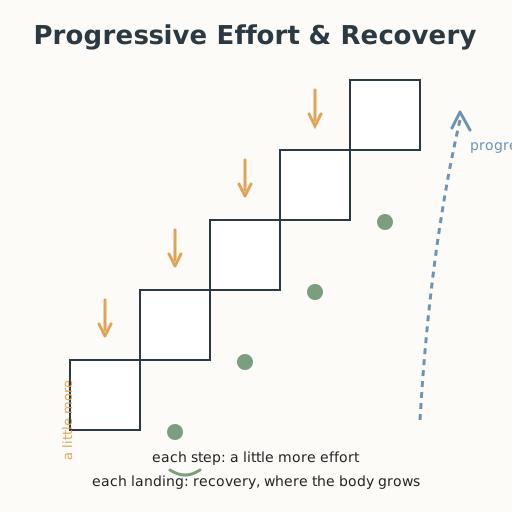
- Effort-recovery curve diagram · 1 per learner or projected A stepped curve — effort rises in small increments, then a recovery dip, then a slightly higher baseline — showing adaptation over time
- Writing journal · 1 per learner
Low-tech / no-cost
- A drawn staircase, or steps and resting spots along a path Walk the staircase of small increases with rests to feel progressive effort and recovery
- Voice and body Act out "push a little, then rest, then a little more" with a simple movement
Enriched / lab & device
- Video clip of a training plan in action · 1 per class An age-appropriate look at how athletes and everyday movers build gradually
- Simple interval timer or stopwatch (optional) · 1 per pair To practice work-and-rest cycles
Works in different contexts
- large-group Model the staircase whole-class, then learners sketch their own; share in pairs
- multi-age Younger learners grasp "push a little, then rest"; older learners explain adaptation and overtraining
- self-directed A learner draws the curve and writes one paragraph explaining why recovery is part of progress
- level-grouped Learners ready to extend explain the physiology of adaptation and the signs of overtraining
- outdoor-only Walk a real path with a slight climb and a rest stop, noticing effort and recovery in the legs
Lesson 7 — Progressive Effort and Recovery
Summary
Learners meet the two principles at the heart of training: progressive effort (small, steady increases) and recovery (the rest in which the body adapts and grows stronger). They learn why recovery is not laziness but part of progress, and spot the warning signs of overtraining. This prepares the movement plan they will build next lesson.
Objectives
- Apply principles of training, such as progressive effort and recovery, to build a safe and sustainable movement plan — beginning with the principles themselves. (D03.S2.10.01)
Connection
Ask any builder, gardener, or musician how you get strong: not by doing everything at once, but by a little more today than yesterday, and rest in between. A wall rises brick by brick; a crop grows between the sowing and the harvest; a musician learns a passage by playing it, resting, and playing it again. Your body is the same. It grows stronger between efforts, not during them — which means rest is not the opposite of progress; it is half of progress. Whether you train for a race, a harvest, a dance, or simply the strength to live well, the same two rules hold: push a little, then recover.
Materials
- Effort-recovery curve diagram (stepped staircase: effort up, then recovery, then higher)
- Writing journal
Preparation
- Copy or draw the effort-recovery curve.
- Retrieval: from Lesson 3, recall the balanced routine — aerobic plus muscle-strengthening activity. Today we learn the rules of the road: how to build that routine safely.
- Prepare a worked example of a progressive step (e.g., walk 20 minutes → 25 → 30).
Facilitator note
This lesson is written to the learner (“you”). The idea to land: progress comes from progressive effort — small, steady increases — plus recovery, the rest in which the body adapts and grows stronger. The WHO frames a balanced routine as aerobic plus muscle-strengthening activity, with balance and flexibility across life (S-341); the principle of progressive overload (increasing the load, duration, or intensity a little at a time) and the role of recovery in adaptation are foundational exercise-science ideas, presented here as the standard, well-established picture. Hold them as description, not as a demand on any body: “push a little” always means “within your own body’s safe range,” and every body has its own starting point and pace.
Model once, then let learners practice (S-011). The ethics lens: training is offered as care and joy, never as punishment, and never as a way to “fix” a body that is not broken; the goal is a body that can do the things a person wants to do. The egalitarian lens: the chance to train safely is not shared equally — time, safe space, equipment, and ability all gate access — so this principle is taught as a tool for whoever chooses to use it, with adapted and seated versions always honored. The global lens: every culture trains for something — work, dance, sport, ceremony — and the same two principles appear everywhere, in many languages. The technology & environment lens: where a body trains — a safe street, a green space, a gym, a single room — and the tools it uses (a timer, an app, a plan) shape what “progressive effort and recovery” can look like; Lesson 9 will ask how tracking tech helps or distorts that picture. The critical-thinking lens: watch for the myth that “more is always better” — overtraining is real, and the signs (persistent tiredness, worsening performance, low mood, poor sleep, frequent injury) are the body asking for rest. The social-emotional lens: rest can feel like guilt in a culture that praises hustle; name that feeling and reframe rest as part of the work. Preview: Lesson 8 turns these principles into each learner’s own plan.
Procedure
- Recall (5 min). From Lesson 3: a balanced routine has aerobic activity and muscle-strengthening activity. Now ask: how do I build it without hurting myself — and why does rest matter?
- Meet the staircase (12 min). Look at the curve. It is a staircase, not a ramp: each step is a little more effort — a slightly longer walk, one more repetition, a touch more weight — and each flat landing is recovery, where the body adapts and grows stronger. Learn the two names: progressive effort (the small increases) and recovery (the rest). Watch a worked example: walk 20 minutes this week, 25 next, 30 the week after — with rest days in between (S-341 for the balanced-routine frame; progressive overload and recovery are the standard training principles).
- Find your “a little more” (12 min). Choose one movement you do or want to do. Write down your current level. Then write the next small step — small enough to be safe, real enough to be progress. Example: “I walk 15 minutes; next I’ll walk 20.” Do not jump ahead; the staircase is climbed one step at a time.
- Meet overtraining (10 min). Learn the warning signs that you have skipped too many landings: persistent tiredness, worsening performance, low mood, poor sleep, frequent aches or injuries. These are not weakness — they are your body asking for the rest it needs to grow.
- Reframe rest (8 min). In your journal, write one sentence: rest is not the opposite of progress; it is half of progress — here is how I will build it in.
- Close (3 min). Remember: strength is not built in the pushing; it is built in the resting after. Push a little. Then rest. That is the whole secret.
Differentiation
- Support: Offer a two-step staircase with a worked example and a single “next small step” to choose.
- Extension: Explain, in your own words, why the body adapts during recovery rather than during effort, and list three overtraining signs with one honest self-check.
Assessment
- Formative (self): Can the learner name both principles (progressive effort and recovery) and give one concrete “next small step” for a movement they do?
- Portfolio artifact (summative for the unit): The effort-recovery staircase and the “rest is half of progress” reflection, added to the unit portfolio as the training principles entry.
Home connection
Ask an adult you trust: have you ever trained or built up to something — and how did you learn to rest as part of it? Listen for their staircase.
Resources
- On balanced physical activity (aerobic + muscle-strengthening) and the role of rest in adaptation: WHO, “Physical activity” fact sheet, https://www.who.int/news-room/fact-sheets/detail/physical-activity (S-341).
- On modeling + guided practice: Kirschner, Sweller & Clark (2006), https://doi.org/10.1207/s15326985ep4102_1 (S-011).