Lesson 03 — De-escalation: Cooling the Fire Down
Learners learn de-escalation as a practiced skill: notice when a conflict is heating up, regulate their own body first, then use calm voice, listening, naming the feeling without blame, and finding one point of agreement. They practice on a low-stakes scenario and reflect on their own pattern.
Objectives
Objectives
- D02.S1.10.02 Handle conflict through de-escalation and seek mediation when a conflict is too big to solve alone.
Essential question
When a conflict is heating up, how do I help it cool down instead of adding fuel?
Key vocabulary
Materials
Standard materials
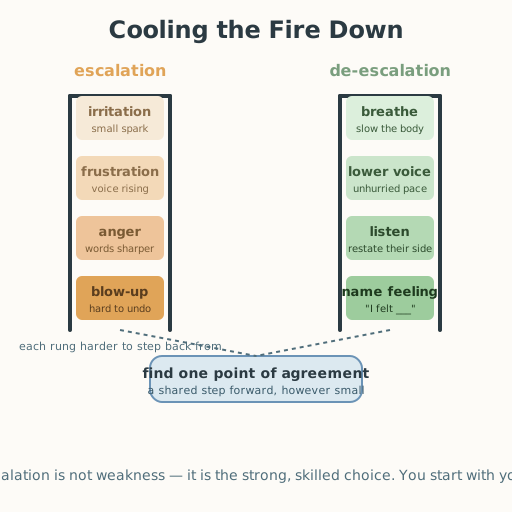
- Escalation ladder / de-escalation ramp diagram · 1 per learner or projected A ladder climbing from irritation to blow-up, with a parallel ramp down — breathe, lower voice, listen, name feeling, find common ground
- Role-play scenario cards · 1 set per pair Short, low-stakes heated moments (a group project, a borrowed item, a misheard text) to practice cooling down
Low-tech / no-cost
- Lines drawn in the ground as a ladder and ramp Step up the ladder (heat rising) and down the ramp (cooling), feeling each step in the body
- Voice and body Practice the physical moves of de-escalation — slow breath, lowered voice, open hands, unhurried pace
Enriched / lab & device
- Short video of a de-escalation in action (optional) · 1 per class An age-appropriate clip of a conflict cooled by calm voice, listening, and naming feelings
- Breath-pacing app (optional) · 1 per pair To support the "regulate yourself first" step with a slow, guided exhale
Works in different contexts
- large-group Model the ladder and ramp whole-class, then learners practice in pairs; share only what they choose in a closing circle
- multi-age Younger learners name one "fuel" and one "water" (cooling) move; older learners run the full ramp and explain the physiology
- self-directed A learner traces a real heated moment through the ladder and writes which de-escalation move they could have used
- level-grouped Learners ready to extend connect de-escalation to the "too big to solve alone" threshold of Lesson 4
- outdoor-only Walk a short path; at each stop name one step of the ramp, and practice one slow breath before speaking
Lesson 3 — De-escalation: Cooling the Fire Down
Summary
Learners learn de-escalation as a practiced skill: notice when a conflict is heating up, regulate their own body first, then use a calm voice, real listening, naming the feeling without blame, and finding one point of agreement. They practice on a low-stakes scenario and reflect on their own pattern — the fuel they add and the water they could pour instead.
Objectives
- Handle conflict through de-escalation — the “cool it down” half of the standard. (D02.S1.10.02)
Connection
Think of a disagreement that suddenly got loud — over a shared chore, a borrowed thing, a misread message. Somebody’s voice rose, somebody’s shoulders went up, and in a minute two people who like each other were saying things they did not mean. That climb — from a small spark to a full fire — is escalation, and it has a shape we can learn to read early. The same moment, handled another way, can go the other direction: a slow breath, a lowered voice, a real listen, and the fire cools instead. Whether your conflicts happen in a kitchen, a classroom, a market, or a group chat, this is a skill you will use in every relationship for the rest of your life — and the person you can always start with is yourself.
Materials
- Escalation ladder / de-escalation ramp diagram
- Role-play scenario cards
- Writing journal
Preparation
- Copy or draw the ladder-and-ramp diagram.
- Retrieval: from Grade 8, recall assertive (not passive or aggressive) communication and the repair steps of apologize, listen, agree (D02.S1.08.02). Today we go one step earlier — before the hurt needs repair, how do we keep a spark from becoming a fire?
- Prepare the role-play scenario cards and a worked example of the ramp.
Facilitator note
This lesson is written to the learner (“you”). The idea to land: escalation is a climb we can read — and de-escalation is a set of teachable moves: regulate yourself first, lower your voice, slow the pace, listen, name the feeling without blame, and find one point of agreement. The skill is well grounded: self-regulation and the “I-statement” habit (saying how I feel rather than blaming) are core conflict-resolution practices (S-148, S-001), and restorative practice frames conflict as something to listen through and repair rather than win (S-022). The physiology note is honest and hedged: a heated conflict raises arousal — heart and breath quicken — and calming the body first (a slow exhale) makes the calm voice possible; this is descriptive science, not a verdict.
Model the ramp once, then let learners practice (worked example → guided practice → independent work; S-011). The social-emotional lens is the spine: de-escalation begins with noticing your own body and feelings, and this topic can touch real hurts — invite, never force, and let learners share only what they choose. The ethics lens: de-escalation is not “letting someone walk over you” — it is refusing to add fuel while still being honest about your own needs. The egalitarian lens: the moves work the same for everyone, but the stakes are not equal — people who are routinely dismissed or punished more harshly may feel less safe to cool a conflict down, and that is a justice fact, not a personal failing. The critical-thinking lens: name your own pattern — what is your fuel, and what is your water? The global lens: every culture has its own ways of keeping peace and saving face; these moves are one toolkit among many, held with respect. Preview: Lesson 4 asks when a conflict is too big to cool alone — and who to ask.
Procedure
- Recall (5 min). Think of a conflict that got loud fast. What climbed — the voice, the words, the heart? That climb is escalation, and it has a shape. Today we learn to read it early and walk it back down.
- Meet the ladder and the ramp (10 min). Look at the diagram. The ladder goes up: irritation → frustration → anger → blow-up, each rung hotter and harder to step back from. The ramp comes down: breathe → lower your voice → listen → name the feeling → find one point of agreement. Learn each step aloud.
- Regulate yourself first (8 min). Watch a worked example, then try it. Sit quietly and notice your body: if a conflict were starting now, where would the heat be — chest, jaw, shoulders, stomach? Take one slow breath in, and a longer, slower breath out. This is step one of the ramp: you cannot pour water from an empty, boiling pot.
- Practice the ramp (15 min). With a partner, take a scenario card — a group project where one person did not do their part, a borrowed item returned broken, a text read as rude. One of you is upset; the other practices the ramp: lower your voice, slow down, listen and restate, name the feeling without blame (“I felt ___ when ___”), and find one thing you both agree on. Then swap roles.
- Name your own pattern (12 min). In your journal: my fuel is ___ (what makes me climb fast), and my water is ___ (the move that cools me). Write one sentence about a real moment you could have used the ramp.
- Close (5 min). Remember: de-escalation is not weakness — it is the strong, skilled choice. You get to decide how a spark goes.
Differentiation
- Support: Offer a two-move version (“breathe, then listen”) and a sentence starter (“When I feel ___ I will ___ before I speak.”).
- Extension: Explain, in your own words, why calming the body first makes the calm voice possible — and what could still make a conflict too big to cool alone.
Assessment
- Formative (self + performance): Can the learner name the ladder’s rungs, demonstrate two ramp moves in role-play, and state their own fuel and water?
- Portfolio artifact (summative for the unit): The “fuel and water” journal entry, added to the unit portfolio as the de-escalation reflection.
Home connection
Ask an adult you trust: when you feel a conflict heating up, what do you do to cool yourself down first? Compare your fuel-and-water with theirs.
Resources
- On “I”-statements and needs-based conflict resolution: Rosenberg (2003), Nonviolent Communication: A Language of Life, PuddleDancer Press (S-148).
- On self-regulation and relationship skills as core competencies: CASEL, “Fundamentals of SEL,” https://casel.org/fundamentals-of-sel/ (S-001).
- On conflict as something to listen through and repair rather than win: International Institute for Restorative Practices, https://www.iirp.edu/ (S-022).
- On modeling + guided practice before independent work: Kirschner, Sweller & Clark (2006), https://doi.org/10.1207/s15326985ep4102_1 (S-011).