Lesson 04 — When It's Too Big: Seeking Mediation
Learners learn when a conflict is too big to solve alone — safety, power imbalance, repeated harm, a stuck pattern — and how mediation works: a neutral third party who helps both sides be heard and find a fair solution both can accept. They practice a mediation in triads and name who they would ask.
Objectives
Objectives
- D02.S1.10.02 Handle conflict through de-escalation and seek mediation when a conflict is too big to solve alone.
Essential question
How do I know when a conflict is too big to solve alone — and how does mediation help?
Key vocabulary
Materials
Standard materials
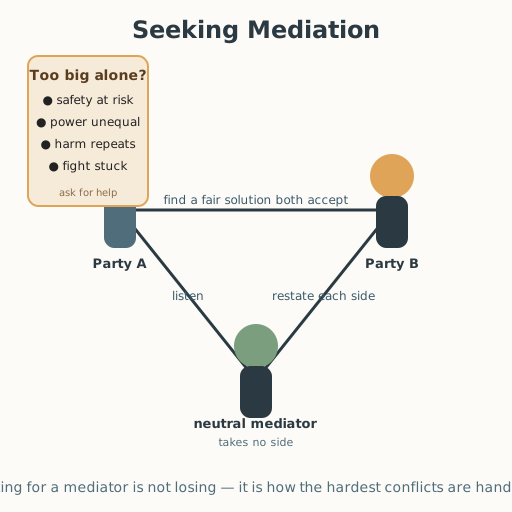
- Too-big checklist and mediation triangle diagram · 1 per learner or projected A checklist of when to seek help (safety, power imbalance, repeated harm, stuck pattern) plus a triangle of two parties and a neutral mediator, with the steps listen, restate, and find a fair solution both accept
- Role-play scenario cards (mediation) · 1 set per triad A conflict too big to solve alone (unequal power, repeated harm, a stuck fight) for triads to mediate
Low-tech / no-cost
- Paper checklist and a drawn triangle Draw the triangle on the ground with three points — two parties and a mediator — and walk the steps
- Voice and role-play Practice the mediator's moves aloud — restate each side, stay neutral, ask "what would make this fair?"
Enriched / lab & device
- Short clip of a peer-mediation session (optional) · 1 per class An age-appropriate example of a neutral third party helping two sides reach a fair agreement
- School or community mediation referral list (optional) · 1 per class Real local people to ask when a conflict is too big to solve alone
Works in different contexts
- large-group Model the mediation triangle whole-class, then triads practice; debrief which "too big" signs each scenario showed
- multi-age Younger learners name one "too big" sign; older learners run a full mediation and weigh power, safety, and repair
- self-directed A learner reads the checklist, recalls a real "too big" conflict, and writes who they could ask and why
- level-grouped Learners ready to extend connect mediation to restorative repair and the difference between punishment and making things right
- outdoor-only Stand at three points of a triangle in the ground; rotate the mediator role and practice restating each side aloud
Lesson 4 — When It’s Too Big: Seeking Mediation
Summary
Learners learn when a conflict is too big to solve alone — when safety is at risk, when power is unequal, when harm repeats, or when the fight is stuck — and how mediation works: a neutral third party who helps both sides be heard and reach a fair solution both can accept. They practice a mediation in triads and name who they would ask when a conflict outgrows them.
Objectives
- Handle conflict through de-escalation and seek mediation when a conflict is too big to solve alone — the “seek mediation” half of the standard. (D02.S1.10.02)
Connection
Not every fire can be put out by the two people standing in it. Sometimes one person holds far more power, or the hurt keeps repeating, or everyone is so angry that every word adds fuel — and asking for help is not weakness, it is judgment. A mediator is a person who stands outside the heat and helps both sides be heard, without taking a side, until a fair way forward appears. Whether that mediator is a trusted teacher, a family elder, a community worker, or a trained peer, and whether your conflict is in a home, a school, a workplace, or a neighborhood, knowing when to ask — and who to ask — is a skill that keeps small harms from becoming large ones.
Materials
- Too-big checklist and mediation triangle diagram
- Role-play scenario cards (mediation)
- Writing journal
Preparation
- Copy or draw the checklist and the mediation triangle.
- Retrieval: from Lesson 3, recall the de-escalation ramp. Today we ask: what if the ramp is not enough — how do I know, and what then?
- Prepare the scenario cards and a worked example of a mediation.
Facilitator note
This lesson is written to the learner (“you”). The idea to land: de-escalation is the first move, but some conflicts are too big to solve alone — and seeking mediation is a mature, skilled choice, not a failure. The “too big” signs to teach are concrete: safety (someone could be hurt), power imbalance (one side cannot speak freely), repeated harm (it keeps happening), and stuck pattern (the same fight loops with no resolution). Mediation is a structured process: a neutral third party lets each side speak and be restated, then helps them find a fair solution both accept (S-022, S-148). The restorative frame adds: the goal is to repair harm and restore relationship, not only to punish (S-022, S-161).
Model the process once, then let learners practice (worked example → guided practice → independent work; S-011). The social-emotional lens is the spine: naming “this is too big for me” requires honest self-awareness, and the topic can touch real hurt — invite, never force, and let learners share only what they choose. The ethics lens: seeking mediation is an ethical act — it protects the more vulnerable side and refuses to let harm go unaddressed. The egalitarian lens is essential: when power is unequal, “just talk it out” can itself be unfair, because the less powerful person cannot speak freely — that is precisely when a neutral third party matters most. The critical-thinking lens: learn to read the signs — not every disagreement is too big, and not every “too big” is obvious at first. The global lens: every culture has its own forms of third-party peacemaking — elders, councils, restorative circles — and mediation is one widely shared form among many. Preview: with conflict skills in hand, the unit turns to empathy — first across cultures (Lessons 5–6).
Procedure
- Recall (5 min). From Lesson 3, what is the ramp? (Breathe, lower voice, listen, name the feeling, find common ground.) Now ask honestly: are there conflicts where the ramp is not enough? What would make that true?
- Meet the too-big checklist (10 min). Look at the diagram. Learn the four signs: safety (someone could be hurt), power imbalance (one side cannot speak freely), repeated harm (it keeps happening), and stuck pattern (the same fight loops). For each, name a real or imagined example.
- Meet the mediation triangle (10 min). Watch a worked example: two people who keep fighting over the same thing, and a neutral mediator. The mediator does not decide who is right. They let each side speak, restate each side fairly, and ask: what would make this right — for both of you? The goal is a fair solution both accept, and repair of the harm, not just punishment (S-022, S-161).
- Practice a mediation (15 min). In a triad, take a scenario card — unequal power, repeated harm, or a stuck fight. Rotate the three roles: the two parties and the mediator. The mediator listens, restates each side, stays neutral, and helps them reach a fair next step.
- Name who you would ask (10 min). In your journal: one conflict that is (or was) too big for me to solve alone is ___, and a person I could ask is ___, because ___.
- Close (5 min). Remember: asking for a mediator is not losing — it is how adults, communities, and whole nations handle their hardest conflicts. Knowing when to ask is strength.
Differentiation
- Support: Offer a two-sign checklist (“someone could be hurt” and “it keeps happening”) and a sentence starter (“This is too big because ___, so I will ask ___.”).
- Extension: Analyze the difference between mediation, where the parties decide, and a ruling, where someone decides for them — and argue when each fits.
Assessment
- Formative (self + performance): Can the learner name the four “too big” signs, demonstrate the mediator’s moves (listen, restate, find a fair solution), and name who they would ask?
- Portfolio artifact (summative for the unit): The “too big / who to ask” journal entry, added to the unit portfolio as the mediation reflection.
Home connection
Ask an adult you trust: has there ever been a conflict too big for you to solve alone — and who helped? Compare their story with your “who to ask.”
Resources
- On mediation as a neutral third party helping both sides reach a fair agreement: International Institute for Restorative Practices, https://www.iirp.edu/ (S-022).
- On the repair-over-punishment framing and restorative justice’s roots: Zehr (1990), Changing Lenses: A New Focus for Crime and Justice, Herald Press (S-161).
- On the needs-based, listen-first core of conflict resolution: Rosenberg (2003), Nonviolent Communication, PuddleDancer Press (S-148).
- On modeling + guided practice before independent work: Kirschner, Sweller & Clark (2006), https://doi.org/10.1207/s15326985ep4102_1 (S-011).