Lesson 05 — Seeing a Community from the Inside
Learners distinguish looking *at* a community from the outside — through distance, labels, and assumptions — from understanding it *from within* — through its own history, values, and first-person voices. They practice the inside posture and choose a community to study respectfully in Lesson 6.
Objectives
Objectives
- D02.S2.10.01 Practice cross-cultural empathy by studying a community's history and values from within.
Essential question
What is the difference between looking at a community from the outside and understanding it from within?
Key vocabulary
Materials
Standard materials
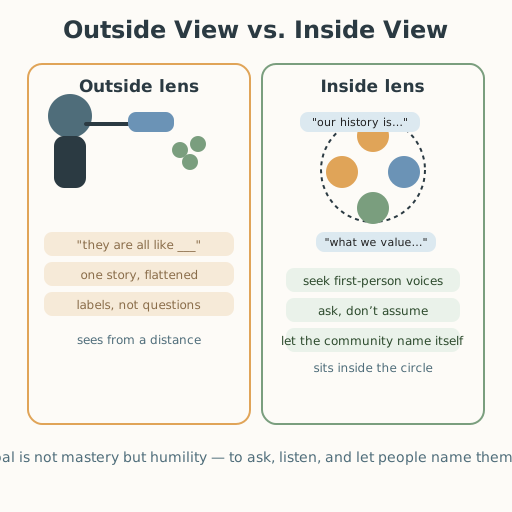
- Outside view vs. inside view diagram · 1 per learner or projected Two lenses — an outside lens (distance, labels, assumptions) and an inside lens (sitting in the circle, first-person voices, questions asked not assumed)
- Writing journal · 1 per learner
Low-tech / no-cost
- Paper folded into two lenses, or two circles drawn in the ground One circle labeled "outside" (distant, labeled), one labeled "inside" (close, first-person)
- Voice and story Tell one short true story about your own community twice — once as an outsider's stereotype, once in your own words — and feel the difference
Enriched / lab & device
- A short first-person video or audio clip from a community speaking about itself (optional) · 1 per class A clip produced *by* a community, in its own voice, to contrast with an outside description
- A news article about a community, plus a piece by a community member (optional) · 1 pair per group To compare an outside account with an inside account of the same topic
Works in different contexts
- large-group Model the two lenses whole-class, then learners compare a pair of accounts in small groups and share one insight
- multi-age Younger learners name one assumption an outsider might make; older learners analyze the ethics of who gets to tell a community's story
- self-directed A learner compares an outside and inside account of one community and writes what changed in their understanding
- level-grouped Learners ready to extend prepare their "study from within" plan (choosing a community and first-person sources) for Lesson 6
- outdoor-only Sit inside your own community's space and describe it in your own words, then imagine an outsider's one-line label for it — and compare
Lesson 5 — Seeing a Community from the Inside
Summary
Learners distinguish looking at a community from the outside — through distance, labels, and assumptions — from understanding it from within — through its own history, values, and first-person voices. They practice the inside posture: ask, listen, and let the community name itself, rather than assume. They close by choosing a community to study respectfully in Lesson 6.
Objectives
- Practice cross-cultural empathy by studying a community’s history and values from within — beginning with the posture of “from within.” (D02.S2.10.01)
Connection
Think of a group you belong to — your family, your neighborhood, your faith or team or town — and imagine how an outsider who has only seen it in one news clip might describe it: a single label, a single story, flattened. Now think of how you would describe it, in your own words: the history, the jokes, the values, the things that matter that no outsider sees. The difference between those two descriptions is the whole lesson: empathy across cultures is not looking at a community through a telescope — it is sitting inside the circle, asking questions, and letting the community tell its own story. Whether the community is across the world or across your town, this is how you come to understand a people as they understand themselves — and it is a skill for life.
Materials
- Outside view vs. inside view diagram
- Writing journal
Preparation
- Copy or draw the two-lens diagram.
- Retrieval: from Grade 9, recall empathy across difference — seeking to understand views unlike your own (D02.S2.09.01). Today we sharpen it: whose account counts, and how do we get it?
- Prepare a worked example: one outside account and one inside account of the same community, side by side.
Facilitator note
This lesson is written to the learner (“you”). The idea to land: “from within” is a posture — seek the community’s own history, values, and voices, and treat outside labels as guesses to check, not facts. The anchor is the distinction between studying at a distance and studying with and from a community’s own accounts (its members’ words, art, institutions, and histories). This is a value and a method, not a scientific claim: the egalitarian commitment is that a community is the authority on itself, and that respectful study centers first-person voices rather than repeating stereotypes (which research shows can narrow how we see whole groups of people — S-226). Present this as a skill and a commitment, and be honest that no outsider ever fully “gets inside” another person’s world — the goal is humility, not mastery.
Model the contrast once, then let learners practice (worked example → guided practice → independent work; S-011). The global lens is the spine: this is how we meet other peoples and times without flattening them. The critical-thinking lens: ask who made this account, and for whom? — an outside report and an inside account answer different questions. The ethics lens: respectful study asks permission, gives credit, and does not extract a story to use it; studying from within means the community’s dignity stays intact. The egalitarian lens: whose version of a community gets repeated is a question of power — centering inside voices is a small act of fairness. The social-emotional lens: empathy across difference can stir discomfort and humility; invite, never force, and let learners share only what they choose. Preview: Lesson 6 turns the posture into a plan — studying one community’s history and values in its own words.
Procedure
- Recall (5 min). From Grade 9: what does it mean to seek understanding across difference? (To learn how someone unlike me sees the world.) Today we sharpen the question: whose account do we trust, and how do we get it?
- Meet the two lenses (10 min). Look at the diagram. The outside lens sees from a distance and reaches for labels — a single story, a single word, “those people are like ___.” The inside lens sits in the circle and asks — how do you tell your own history? what do you value? what would you want me to understand? Watch a worked example: an outside line about a community versus the community’s own words about itself. Notice what the inside account carries that the outside one missed.
- Feel the difference on your own community (10 min). Take a community you belong to. Write one outside-style label an outsider might use, then write two sentences in your own words about what that community actually is. Compare. Which one is true?
- Learn the inside posture (10 min). The inside posture has three moves: seek first-person voices (the community’s own words, art, and stories); ask, don’t assume (check your guesses against what members actually say); and let the community name itself (use its own names and meanings, not yours). Learn each move with a small example.
- Choose a community to study (12 min). Pick a community you can study respectfully — one whose own voices you can reach (through people, books, recordings, or media the community makes). It may be near or far. Write: I will study ___ from within by seeking these first-person sources: ___.
- Close (5 min). Remember: you will never fully stand inside another person’s world — and that is the point. The goal is not mastery but humility: to ask, to listen, and to let people name themselves.
Differentiation
- Support: Offer a fill-in prompt (“One outside label is ___, but the community’s own words say ___.”) and a short list of possible communities to study.
- Extension: Analyze who controls a community’s public story (who owns the media, who is quoted) and argue why first-person voices change the account.
Assessment
- Formative (self): Can the learner state the difference between the outside and inside lenses, name the three moves of the inside posture, and choose a community to study?
- Portfolio artifact (summative for the unit): The chosen-community and first-person-sources plan, added to the unit portfolio as the start of the empathy study.
Home connection
Ask an adult you trust: what is one thing outsiders usually get wrong about a community we belong to — and what is the real story? Write their answer as a first-person source.
Resources
- On how repeated narrow media images can flatten how we see whole groups of people: Common Sense Media Research Program, https://www.commonsensemedia.org/research (S-226).
- On media literacy — asking who made an account and for whom: Common Sense Education, “News & Media Literacy” (S-063); UNESCO, “Media and Information Literacy” (S-217).
- On modeling + guided practice before independent work: Kirschner, Sweller & Clark (2006), https://doi.org/10.1207/s15326985ep4102_1 (S-011).