Lesson 06 — History and Values, in Their Own Words
Learners carry out a cross-cultural empathy study from within: they gather a community's own history, values, art and stories, and institutions from first-person sources, ask permission and give credit, and check their own assumptions. They close with a short "history and values, in their own words" account.
Objectives
Objectives
- D02.S2.10.01 Practice cross-cultural empathy by studying a community's history and values from within.
Essential question
How do I actually study a community's history and values from within — respectfully and accurately?
Key vocabulary
Materials
Standard materials
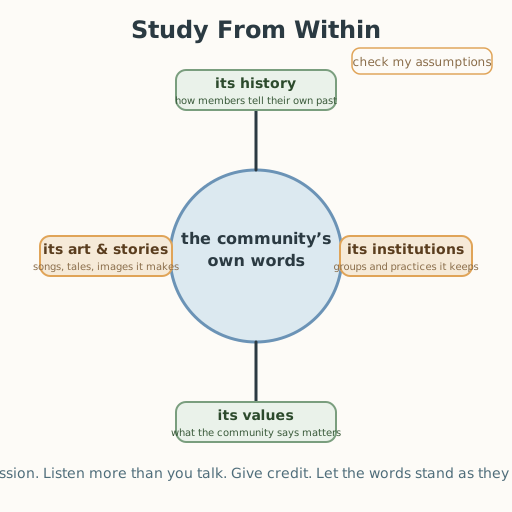
- Study-from-within organizer · 1 per learner A center circle "the community's own words" surrounded by four source slots — its history, its values, its art and stories, its institutions — plus a "check my assumptions" note
- Writing journal · 1 per learner
Low-tech / no-cost
- Paper folded into a center-and-spokes organizer, or a circle drawn in the ground The community's own words in the center; history, values, art, and institutions as four spokes
- Voice and interview Practice a respectful interview — ask permission, listen more than talk, and write down the person's own words
Enriched / lab & device
- Access to a first-person source (book, recording, film, or a willing community member) (optional) · 1 per learner or group A source produced *by* the community to study from within
- A library or online archive of oral histories (optional) · 1 per class To locate first-person voices when a live interview is not possible
Works in different contexts
- large-group Model filling one spoke whole-class, then learners complete their own organizers and share one insight in small circles
- multi-age Younger learners gather one first-person quote for each of two spokes; older learners complete all four and weigh the ethics of representation
- self-directed A learner works through all four spokes from first-person sources and writes a short "history and values, in their own words" account
- level-grouped Learners ready to extend compare two inside accounts of the same community and explain what each emphasizes and why
- outdoor-only Interview a willing elder or neighbor in person, outside, using the consent-and-listen steps; record their own words
Lesson 6 — History and Values, in Their Own Words
Summary
Learners carry out a cross-cultural empathy study from within: they gather a community’s own history, values, art and stories, and institutions from first-person sources, ask permission and give credit, and check their own assumptions. They close with a short account of the community’s history and values in the community’s own words.
Objectives
- Practice cross-cultural empathy by studying a community’s history and values from within — carrying out the study itself. (D02.S2.10.01)
Connection
When you want to truly understand a people, the best sources are the ones they made themselves: an elder’s story, a song, a founding memory, the reason a holiday matters, a rule the community lives by. These are not decorations around a “real” history written by someone else — they are the history, told by the people who live it. Gathering them takes care: you ask before you record, you listen more than you talk, you give credit, and you let the words stand as they were said. Whether you study a community across the world or the one next door, this is how empathy becomes real — not by imagining what others feel, but by listening to what they actually say.
Materials
- Study-from-within organizer
- Writing journal
Preparation
- Copy or draw the center-and-spokes organizer.
- Retrieval: from Lesson 5, recall the inside posture — seek first-person voices, ask don’t assume, let the community name itself. Today we fill the organizer with what those voices say.
- Prepare a worked example of one spoke, filled from a first-person source.
Facilitator note
This lesson is written to the learner (“you”). The idea to land: the study itself is simple and repeatable — gather the community’s own history, values, art and stories, and institutions from first-person sources, with consent and credit, and check your own assumptions as you go. This is a method and a value, not a scientific claim: the egalitarian commitment is that a community is the authority on itself, and respectful study centers its own voices rather than repeating stereotypes (S-226 documents how repeated narrow images can flatten how whole groups are seen). The ethics of representation are real and teachable: ask permission before recording or quoting, give credit, and do not turn someone’s story into a trophy — study with, not on. Be honest that “from within” is always approximate: even the most careful outsider stays partly outside, so the posture is humility, not ownership.
Model one spoke once, then let learners work (worked example → guided practice → independent work; S-011). The global lens is the spine: this is the discipline of meeting other peoples and times without flattening them. The critical-thinking lens: ask of every source who made it and for whom, and check where your own assumption has been filling a gap the community never said. The egalitarian lens: whose version of a community gets repeated is a question of power — citing inside voices is a small act of fairness. The social-emotional lens: sitting with another community’s history can stir discomfort, admiration, and humility; invite, never force, and let learners share only what they choose. Note for the facilitator: if a learner’s chosen community is Indigenous or otherwise marginalized, be especially careful to steer them to the community’s own sources and to treat consent and attribution as non-negotiable. Preview: with empathy in hand, Lessons 7–8 ask what digital platforms do to empathy itself.
Procedure
- Recall (5 min). From Lesson 5: what are the three moves of the inside posture? (Seek first-person voices; ask, don’t assume; let the community name itself.) Today we put them to work on one community.
- Meet the organizer (10 min). Look at the diagram. In the center: the community’s own words. Around it, four spokes to fill from first-person sources: its history (how members tell their own past), its values (what the community says matters), its art and stories (songs, tales, images it makes), and its institutions (the groups and practices it keeps). Watch a worked example: one spoke filled from a real first-person source.
- Learn the care rules (8 min). Before gathering: ask permission before recording or quoting; listen more than you talk; give credit (name the person or source); and check your assumptions — if you think “they must ___,” find out whether the community actually says so, and if not, let the gap stand.
- Gather (20 min). Work on your chosen community. Fill as many spokes as you can from first-person sources you can reach now — a person you can ask (respectfully), or a book, recording, song, or media the community made. Write each source’s own words down faithfully, with credit.
- Draft your account (8 min). Write a short “history and values, in their own words” paragraph: what this community says about its own past, and what it says it values — in its words, not yours.
- Close (4 min). Remember: you have not “figured out” a people — you have listened. That listening, done with care, is the whole skill.
Differentiation
- Support: Offer two spokes to fill and a sentence starter (“In their own words, this community’s history is ___, and they value ___.”).
- Extension: Compare two first-person accounts of the same community and explain what each emphasizes, and what your own assumption would have gotten wrong.
Assessment
- Formative (self): Can the learner fill at least two spokes from first-person sources, with consent and credit, and state one assumption they checked?
- Portfolio artifact (summative for the unit): The “history and values, in their own words” account, added to the unit portfolio as the cross-cultural empathy study.
Home connection
Ask a willing elder or neighbor in your own community: how would you tell our community’s history, and what do we value? Write their words down with their permission and credit.
Resources
- On how repeated narrow media images can flatten how whole groups are seen: Common Sense Media Research Program, https://www.commonsensemedia.org/research (S-226).
- On asking who made an account and for whom: Common Sense Education, “News & Media Literacy” (S-063); UNESCO, “Media and Information Literacy” (S-217).
- On modeling + guided practice before independent work: Kirschner, Sweller & Clark (2006), https://doi.org/10.1207/s15326985ep4102_1 (S-011).