Lesson 07 — Empathy Online: Near, Far, and Worn Thin
Learners evaluate how digital platforms shape empathy: they can extend it to distant voices, but they also flatten it — empathy runs strongest toward one identifiable person and weakens under a constant stream of crises, a wearing-down known as compassion fatigue. They close by choosing, deliberately, where their care will go.
Objectives
Objectives
- D02.S2.10.02 Evaluate how digital platforms shape empathy, compassion fatigue, and echo chambers.
Essential question
How do digital platforms shape my empathy — and why does a constant stream of suffering sometimes wear it thin?
Key vocabulary
Materials
Standard materials
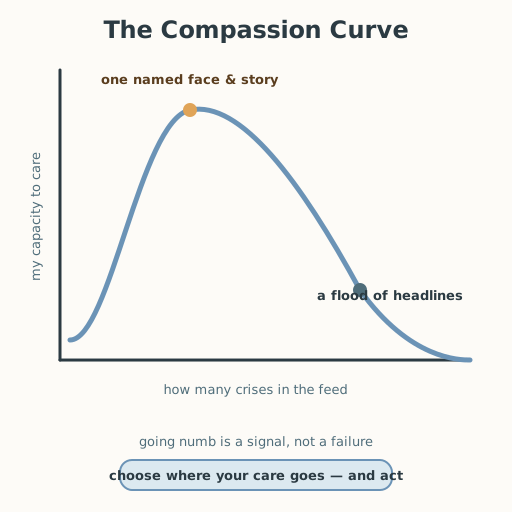
- Compassion curve diagram · 1 per learner or projected A curve that rises for one named face and story, then falls as the feed becomes an endless stream — with a note on choosing where care goes
- Writing journal · 1 per learner
Low-tech / no-cost
- Paper drawn as a rising-then-falling curve, or a line traced in the ground Mark where empathy rises (one named face) and where it falls (a thousand headlines)
- Voice and discussion Tell one named story, then list ten distant headlines, and feel the difference in your own care
Enriched / lab & device
- A news feed or social feed to examine (optional) · 1 per group To count how many distant crises pass in one minute and notice the effect on attention
- A short explainer on compassion fatigue (optional) · 1 per class An age-appropriate account of how repeated exposure to others' distress can numb the response
Works in different contexts
- large-group Model the compassion curve whole-class, then learners examine a feed in small groups and share one insight
- multi-age Younger learners name one named story and one stream of headlines; older learners trace the empathy/empathic-concern/distress distinction and the numbing effect
- self-directed A learner examines their own feed, counts the distant crises, and writes how it affects their capacity to care
- level-grouped Learners ready to extend weigh the identifiable-victim effect and argue how a platform could be designed to sustain rather than drain care
- outdoor-only Compare caring for one plant you can see and touch with hearing about a distant forest — notice how closeness and number shape care
Lesson 7 — Empathy Online: Near, Far, and Worn Thin
Summary
Learners evaluate how digital platforms shape empathy. They learn the difference between empathy (feeling with), empathic concern (caring that motivates helping), and personal distress (feeling overwhelmed), and see how a feed both extends care to distant voices and flattens it: empathy runs strongest toward one identifiable person and weakens under an endless stream of crises — a wearing-down called compassion fatigue. They close by choosing, deliberately, where their care will go.
Objectives
- Evaluate how digital platforms shape empathy, compassion fatigue, and echo chambers — beginning with empathy and compassion fatigue. (D02.S2.10.02)
Connection
One child’s face, one name, one story — and your chest tightens; you want to help. Now scroll: ten disasters, fifty headlines, a thousand faces, and something in you goes quiet. It is not that you stopped caring; it is that the same capacity that leaps toward one person buckles under a flood. This is one of the quietest effects of living with a feed in your pocket: it can carry a stranger’s joy and pain straight to you from across the world — a real gift — and it can also leave you numb, because no heart can hold a thousand crises at once. Whether your feed is yours or a shared screen at a shop, learning to read this effect — and to choose where your care goes — is a skill for staying human in a connected world.
Materials
- Compassion curve diagram
- Writing journal
Preparation
- Copy or draw the compassion curve.
- Retrieval: from Grade 6, recall the difference between empathy (feeling with) and sympathy (feeling for) (D02.S2.06.01). Today we add two finer distinctions and ask what a screen does to all of them.
- Prepare a worked example: one named story and one stream of headlines.
Facilitator note
This lesson is written to the learner (“you”). The idea to land: digital platforms both extend and flatten empathy — they carry distant voices to us, yet empathy runs strongest toward one identifiable person and weakens under a constant stream of suffering, a wearing-down called compassion fatigue — so sustaining care is a deliberate choice, not an automatic result of seeing more. The distinctions are well grounded: researchers separate empathic concern (other-oriented care) from personal distress (self-oriented overwhelm), with different motivational consequences (S-230), and document that empathy is narrow and biased — strongest toward those who resemble us and toward single identifiable victims, weaker toward large numbers — a descriptive claim about how empathy actually works, not a verdict that empathy is bad (S-413). The “identifiable victim” and “psychic numbing” effects are standard findings in this literature. The WHO frames adolescence as a formative time whose digital habits can shape wellbeing, and notes media can help or weigh down (S-311). Present all of this as description, and hold the value (choose where your care goes) as a value.
Model the curve once, then let learners work (worked example → guided practice → independent work; S-011). The technology lens is the spine: read the feed as a designed object — endless scroll and autoplay are choices that keep the stream coming. The social-emotional lens: this topic touches real exhaustion and grief; invite, never force, and let learners share only what they choose. The ethics lens: compassion fatigue is not a moral failure — it is a predictable limit, and the ethical question is how to care sustainably rather than feel guilty for going numb. The egalitarian lens: whose suffering reaches us (and whose does not) is shaped by algorithms, geography, and power — some people’s pain is endlessly shown, others’ is invisible. The critical-thinking lens: ask how many crises can I actually hold, and what does acting on one look like? The global lens: the same mechanism operates for everyone online, but its weight falls unevenly. Preview: Lesson 8 turns to the echo chamber — the other way platforms shape empathy.
Procedure
- Recall (5 min). From Grade 6: what is the difference between empathy and sympathy? (Feeling with someone vs. feeling for them.) Today we ask what a screen does to that feeling.
- Meet the distinctions (10 min). Learn three words. Empathy — feeling with another. Empathic concern — care that moves you to help. Personal distress — feeling so overwhelmed by another’s pain that you turn away to protect yourself (S-230). All three are human; only one reliably leads to helping.
- Meet the compassion curve (10 min). Look at the diagram. Watch a worked example: one named face and story — the curve rises, and you want to act. Then a stream of ten, fifty, a thousand headlines — the curve falls. This is compassion fatigue: care worn thin by a flood, and the “identifiable victim” effect: one person moves us, a statistic does not (S-413).
- Read a real feed (12 min). Look at a news or social feed (or recall one). Count how many distant crises pass in one minute. Notice your own response: which one stopped you, and why? Which ones slid past?
- Choose where your care goes (12 min). In your journal: one stream I can put down is ___, and one place I choose to put my care — concretely — is ___. Name one real action, however small.
- Close (5 min). Remember: going numb is not a moral failure — it is a signal that you have been asked to hold too much. You get to choose, deliberately, where your care goes — and to sustain it by acting, not just scrolling.
Differentiation
- Support: Offer a two-word version (“one face moves me; a flood numbs me”) and a sentence starter (“I will put my care into ___ by ___.”).
- Extension: Argue how a platform could be designed to sustain care (fewer, deeper stories; a path to act; rest) instead of draining it — and name the trade-off.
Assessment
- Formative (self): Can the learner distinguish empathy, empathic concern, and personal distress, explain the compassion curve, and name one deliberate place to put their care?
- Portfolio artifact (summative for the unit): The “where my care goes” journal entry, added to the unit portfolio as the empathy-and-compassion-fatigue reflection.
Home connection
Ask an adult you trust: do you ever feel numb after too much bad news — and what helps you care without burning out? Compare your answers.
Resources
- On empathic concern vs. personal distress and their different consequences for helping: Batson, Fultz & Schoenrade (1987), “Distress and empathy,” Journal of Personality 55(1), 19–39 (S-230).
- On the narrowness and bias of empathy, and the identifiable-victim effect: Bloom (2016), Against Empathy: The Case for Rational Compassion, Ecco/HarperCollins (S-413).
- On adolescence as a formative time whose digital habits can shape wellbeing: WHO, “Mental health of adolescents,” https://www.who.int/news-room/fact-sheets/detail/adolescent-mental-health (S-311).
- On modeling + guided practice before independent work: Kirschner, Sweller & Clark (2006), https://doi.org/10.1207/s15326985ep4102_1 (S-011).