Lesson 03 — Refreshing the Facts: Conception, Anatomy, and Rumor vs. Reality
Learners refresh the accurate basics of how pregnancy can begin — one egg and one sperm — with dignity and without shame, then practice telling fact from rumor about bodies, readying them for the contraception and infection-prevention lessons to come.
Objectives
Objectives
- D03.S4.10.01 Analyze the risks and responsibilities of sexual activity, including contraception and preventing infections, using accurate information.
Essential question
What is the accurate, non-shaming account of how pregnancy can happen — and how do I tell fact from rumor about bodies?
Key vocabulary
Materials
Standard materials
- Rumor vs. reality cards · 1 set per group Common claims about bodies and pregnancy, each to be sorted as fact or rumor with a source
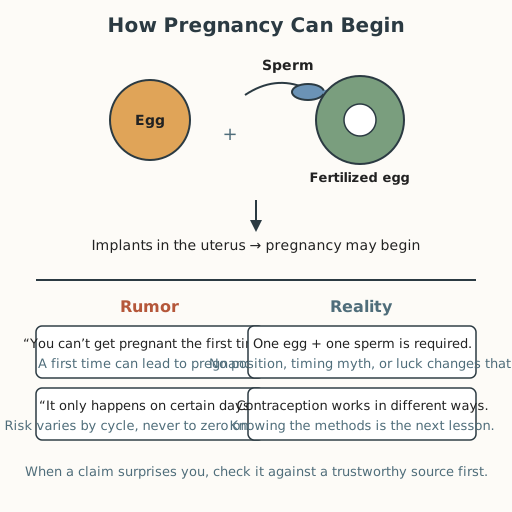
- Conception diagram · 1 per learner A simple, non-graphic diagram of egg + sperm and where pregnancy can happen
Low-tech / no-cost
- Drawn diagram on paper or ground Draw the egg-and-sperm meeting with chalk or a stick; no printed sheet needed
- Voice and a fact/rumor call-out Read each claim aloud; learners step or raise a hand for "fact" or "rumor"
Enriched / lab & device
- Animated reproductive-health explainer · 1 per group A medically accurate, age-appropriate video from a health authority to review the basics
Works in different contexts
- large-group Sort the rumor/reality cards whole-class with a show of hands, then correct each rumor with a sourced fact
- multi-age Older learners explain the diagram to younger learners in plain words; everyone sorts the claims
- self-directed A learner studies the diagram, sorts the claims, and writes one fact and one rumor with the corrected answer
- level-grouped A ready group writes a "fact-check" answer key; a still-learning group works the diagram with labels given
- outdoor-only Draw the two cells and their meeting on the ground with labels; do the fact/rumor sort as a walk (one side fact, one side rumor)
Lesson 3 — Refreshing the Facts: Conception, Anatomy, and Rumor vs. Reality
Summary
Learners refresh the accurate basics of how pregnancy can begin — one egg and one sperm meeting — with dignity and without shame, then practice telling fact from rumor about bodies. This readies them for the contraception and infection-prevention lessons that follow.
Objectives
- Analyze the risks and responsibilities of sexual activity using accurate information, beginning with an accurate account of how pregnancy can happen. (D03.S4.10.01)
Connection
Most of what you “know” about bodies may have arrived as rumor — a joke, a meme, a friend’s confident guess. When it comes to pregnancy and health, rumor is expensive: it changes decisions. An accurate picture is simple and freeing: a pregnancy can begin only when one egg and one sperm meet and implant. Nothing else — not a particular position, not a first time, not a lucky day — changes that basic fact.
Materials
- Rumor vs. reality cards
- Conception diagram
Preparation
- Copy the conception diagram and the rumor/reality cards.
- Retrieval (spiral): from Grade 9, the basics of reproductive anatomy; from Lessons 1–2, the commitments and the consent conditions.
Facilitator note
This lesson is written to the learner (“you”). Land the accurate, non-shaming facts: a pregnancy can begin only when a sperm meets an egg (ovum) and the fertilized egg implants in the uterus. The egg is released around ovulation, roughly mid-cycle for people who ovulate; sperm can survive in the body for several days. Use correct anatomical terms plainly and without giggling or shame — the body is taught with dignity. This is a review of Grade 9 anatomy, not a new graphic deep-dive; keep it simple and correct. Keep it inclusive too: pregnancy can begin only this way, but sexual intimacy is broader than egg-meets-sperm, and the consent and infection-prevention skills this unit teaches apply to every kind of relationship — learners of any gender or sexuality are neither assumed nor ranked.
Sensitive-topic guidance: no learner is asked to share anything personal. If a question suggests a learner is pregnant or unsafe, respond privately and with care — do not announce it, do not shame, and follow your safeguarding procedure to connect them with a trusted adult or health service. Correct rumors without ridiculing anyone who believed them; rumor is common because accurate education is not evenly available.
The ethics lens: giving people true information is a form of respect. The egalitarian lens: unequal access to accurate education is a justice problem — not a personal failing of the learner who heard a rumor. The global lens: what is considered “known” or “acceptable to say” about bodies varies widely across cultures; accuracy is a tool everyone deserves. The critical-thinking lens: every claim about bodies should be checked against a source — the exact skill this unit sharpens next.
Procedure
- Retrieve (5 min). From Grade 9: what did you learn about how bodies are made and how pregnancy can begin? Say one accurate fact aloud or write it.
- Meet the diagram (10 min). Study the conception diagram. Say the sequence in your own words: egg released → sperm meets egg → fertilization → implantation in the uterus. Notice what is not required: no particular timing myth, no special position, no “first time” rule.
- Sort rumor from reality (15 min). In small groups, sort each card as fact or rumor, and for each rumor, say what the accurate version is. Use the diagram and a health source to check.
- Correct together (10 min). Share your sorting. For each rumor, give the corrected fact — said kindly, because rumor is common and unlearning it is the win.
- The one-fact rule (5 min). Commit: “When a claim about bodies surprises me, I will check it against a trustworthy source before I believe or share it.”
- Reflect (5 min). Write one fact you now hold accurately, and one rumor you can now correct.
- Close (5 min). Preview: now that we know how pregnancy can begin, we can understand how contraception works — next lesson.
Differentiation
- Support: Provide the diagram already labeled; work through the fact/rumor sort as a whole group. For learners who cannot see the diagram, describe each step aloud and offer a tactile model — a small seed or stone for the egg, a grain or pinch of sand for the sperm — so the “meeting” can be felt, not only seen.
- Extension: Ask learners to write a short “myth-buster” card for a younger learner, in plain, non-shaming words.
Assessment
- Formative (peer + self): Can the learner state the egg–sperm–implantation sequence and correctly identify at least one rumor with its corrected fact?
- Artifact (portfolio): The one-fact/one-rumor reflection.
Home connection
If it feels safe, ask a trusted adult what they were told about how pregnancy happens and how accurate it turned out to be. If not comfortable, write the question for your wonder box. No home conversation is required.
Resources
- WHO — Family planning/contraception methods (fact sheet) for the accurate framing of how pregnancy is prevented: https://www.who.int/news-room/fact-sheets/detail/family-planning-contraception (S-453).
- WHO — Adolescent pregnancy (fact sheet) for the fact that accurate information reduces unintended pregnancy: https://www.who.int/news-room/fact-sheets/detail/adolescent-pregnancy (S-455).