Lesson 04 — Contraception: How the Main Methods Work
Learners learn the main methods of contraception grouped by how they work — barrier, hormonal, long-acting, and emergency — and the key fact that condoms are the method that also protects against sexually transmitted infections, then reflect on unequal access as a justice issue.
Objectives
Objectives
- D03.S4.10.01 Analyze the risks and responsibilities of sexual activity, including contraception and preventing infections, using accurate information.
Essential question
How do the main methods of contraception work, what does each one protect against, and how does access to them vary?
Key vocabulary
Materials
Standard materials
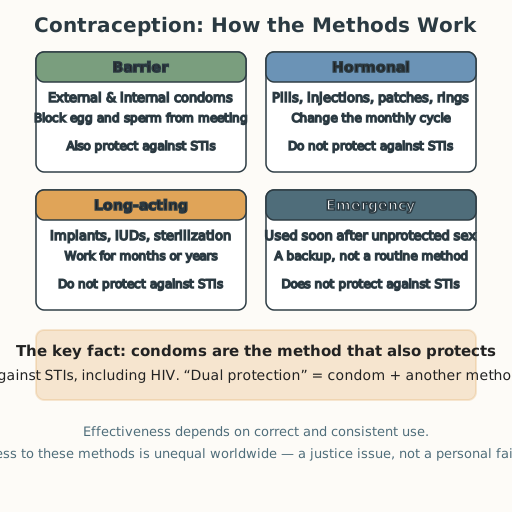
- Contraception methods chart · 1 per learner Methods grouped as barrier, hormonal, long-acting, and emergency, with what each protects against
- Scenario cards · 1 set per group Short fictional situations asking which method and which extra protection to consider
Low-tech / no-cost
- Drawn chart on paper or ground Draw four boxes and sort method names into them by hearing
- Voice and a sorting call Read each method aloud; learners say or point to its group
Enriched / lab & device
- Digital infographic from a health authority · 1 per group A current, medically reviewed summary of methods and their typical use
Works in different contexts
- large-group Teach the four groups whole-class with the chart, then small groups match scenarios to methods and check against the key
- multi-age Older learners explain the groups to younger learners; everyone practices naming what a condom additionally protects against
- self-directed A learner studies the chart, completes the scenario sort, and writes one method per group with its key fact
- level-grouped A ready group compares methods on effectiveness and dual protection; a still-learning group masters the four group names and one method each
- outdoor-only Use four marked areas as the method groups; learners walk to the group each method belongs to, then explain why
Lesson 4 — Contraception: How the Main Methods Work
Summary
Learners learn the main methods of contraception grouped by how they work — barrier, hormonal, long-acting, and emergency — and the key fact that condoms are the method that also protects against sexually transmitted infections, then reflect on unequal access as a justice issue.
Objectives
- Analyze the risks and responsibilities of sexual activity using accurate information, specifically how the main methods of contraception work and what each protects against. (D03.S4.10.01)
Connection
Contraception is not one thing — it is a set of tools that work in different ways, like the tools in a toolbox. A lock and a key both secure a door, but differently. Some methods stop an egg and sperm from meeting; some change the body’s monthly cycle; some last for years; some are for right after an unexpected situation. Knowing the toolbox — not just one tool — is what lets two people choose together, with care, what fits their lives.
Materials
- Contraception methods chart
- Scenario cards
Preparation
- Copy the contraception methods chart and scenario cards.
- Retrieval (spiral): from Lesson 3, how pregnancy begins (egg + sperm + implantation); from Lesson 2, consent. Today: the methods that let people decide if and when.
Facilitator note
This lesson is written to the learner (“you”). Land the accurate method facts (from WHO, S-453): methods fall into barrier (external and internal condoms), hormonal (pills, injections, patches, vaginal rings), long-acting (implants, intrauterine devices/IUDs, and permanent methods like sterilization), and emergency contraception (used soon after unprotected sex, not for routine use). The one fact to make unforgettable: condoms are the only method that also protects against sexually transmitted infections, including HIV — so “dual protection” (condom plus another method) is how couples get both pregnancy prevention and infection protection. Condoms are effective at preventing pregnancy if used correctly; effectiveness depends on correct and consistent use. For relationships where pregnancy is not a possibility (for example, two people who cannot conceive together), condoms and testing still matter for infection prevention — the skills apply to every kind of intimacy, and no kind of couple is assumed or ranked.
Sensitive-topic guidance: teach methods factually, not as a recommendation to be or not be sexually active — the decision to be active or abstinent is the learner’s own, and both are treated with respect. Do not distribute or demonstrate physical contraceptives unless your setting and local law permit it; the chart is enough. Learners may opt out of discussion. If a learner discloses pregnancy risk or unsafe circumstances, respond privately and follow your safeguarding procedure to a trusted adult or health service.
The ethics lens: honest information lets people decide with care rather than by accident. The egalitarian lens: access to contraception is unequal — WHO notes barriers including age, income, and misinformation — and that unequal access is a justice issue, not a personal failing. The global lens: availability, cost, and law differ enormously across countries and communities — some provide contraception free through public health services, while in others cost, distance, or legal limits put it out of reach (a difference in access, never in people’s worth). The technology lens: contraception is a technology, old and new (from barrier methods to long-acting devices), and its access — not just its existence — shapes health.
Procedure
- Retrieve (5 min). What must meet for a pregnancy to begin? What is the one word that means “deciding if and when”?
- Meet the four groups (15 min). Study the chart. For each group, say what it does in one sentence and name one or two methods: barrier (blocks the meeting), hormonal (changes the cycle), long-acting (works for months or years), emergency (used soon after, not routine).
- The key fact (5 min). Say it together: condoms are the method that also protects against STIs, including HIV. Practice “dual protection”: condom plus another method covers both pregnancy and infections.
- Sort the scenarios (15 min). In small groups, read each fictional situation. Which method group fits? What extra protection should be considered? Check your answers against the chart.
- Correct use matters (5 min). A method only works as well as it is used. Correct and consistent use is part of responsibility — both partners share it.
- Reflect (5 min). Write one sentence: “The fact I most want to remember is…” and one: “A question I still have is…”
- Close (5 min). Preview: pregnancy is one risk; infections are another. Next lesson, how to prevent them.
Differentiation
- Support: Focus on the four group names and the single condom key fact; use the drawn chart and a physical sort. For learners who cannot see the chart, read each method aloud and sort by hearing, or use four distinct found objects (a stone, a leaf, a seed, a stick) to stand in for the four groups.
- Extension: Compare two methods on how they work, typical use, and whether they protect against STIs, then write a short “what fits which life” note.
Assessment
- Formative (peer + self): Can the learner name the four method groups, one method in each, and the fact that condoms also protect against STIs including HIV?
- Artifact (portfolio): The “fact I most want to remember / question I still have” reflection.
Home connection
If it feels safe, ask a trusted adult or a health worker how people in your community access health information about contraception. If that is not comfortable, write the question for your wonder box. No home conversation is required.
Resources
- WHO — Family planning/contraception methods (fact sheet): https://www.who.int/news-room/fact-sheets/detail/family-planning-contraception (S-453).
- WHO — Sexually transmitted infections (fact sheet) for the condom-and-STI link: https://www.who.int/news-room/fact-sheets/detail/sexually-transmitted-infections-(stis) (S-454).