Lesson 05 — Preventing Infections: STIs, Testing, and Care
Learners learn that sexually transmitted infections can be prevented, detected, and often cured or managed, that many show no symptoms, and that protection, testing, and treatment are acts of care — never of shame.
Objectives
Objectives
- D03.S4.10.01 Analyze the risks and responsibilities of sexual activity, including contraception and preventing infections, using accurate information.
Essential question
How can infections be passed during sex, and what can prevent, detect, and treat them — without shame?
Key vocabulary
Materials
Standard materials
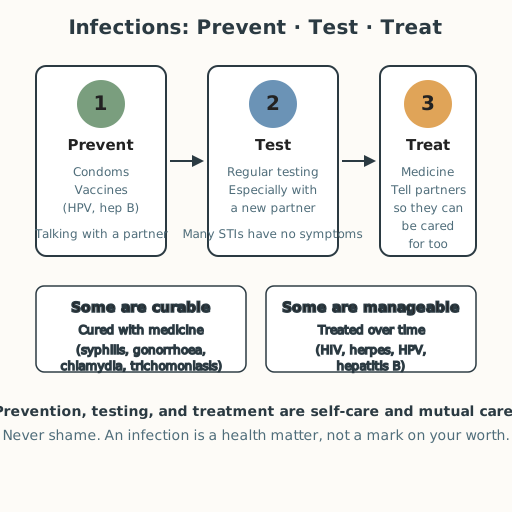
- Prevent–test–treat pathway · 1 per learner A simple diagram of how infections are prevented, detected, and treated
- Fact cards · 1 set per group Accurate, non-shaming facts about STIs, testing, and care
Low-tech / no-cost
- Drawn pathway on paper or ground Draw three steps — prevent, test, treat — and place fact cards along it
- Voice and a true/false call Read each fact aloud; learners signal true or false, then correct the false ones
Enriched / lab & device
- Health-authority STI explainer · 1 per group A current, medically reviewed summary of prevention, testing, and treatment
Works in different contexts
- large-group Build the pathway whole-class, then small groups place facts and correct the myths
- multi-age Older learners read the fact cards to younger learners; everyone learns the prevent–test–treat order
- self-directed A learner studies the pathway, sorts the facts, and writes what "prevent, test, treat" means in their own words
- level-grouped A ready group writes a "how to find testing and care" note; a still-learning group masters prevent–test–treat
- outdoor-only Mark three stations — prevent, test, treat — and walk the pathway, placing a fact at each
Lesson 5 — Preventing Infections: STIs, Testing, and Care
Summary
Learners learn that sexually transmitted infections can be prevented, detected, and often cured or managed, that many show no symptoms, and that protection, testing, and treatment are acts of care — never of shame.
Objectives
- Analyze the risks and responsibilities of sexual activity using accurate information, specifically how infections can be passed and how to prevent, detect, and treat them. (D03.S4.10.01)
Connection
Some infections — a cold, a sore throat — you notice right away. Others give no sign at all while they quietly do their work, which is exactly why check-ups exist even when you feel fine. Sexually transmitted infections are like that: many people who have one feel nothing, which is why testing matters as much as protection. Knowing the facts — and getting care — is ordinary self-care, like any other kind.
Materials
- Prevent–test–treat pathway
- Fact cards
Preparation
- Copy the pathway and fact cards.
- Retrieval (spiral): from Lesson 4, that condoms protect against STIs including HIV; from Lesson 3, accurate vs. rumor information.
Facilitator note
This lesson is written to the learner (“you”). Land the accurate, non-shaming facts (from WHO, S-454): STIs are caused by bacteria, viruses, or parasites and can pass during sex; some are curable with medicine (syphilis, gonorrhoea, chlamydia, trichomoniasis) and some are manageable with treatment (the viral ones — hepatitis B, herpes/HSV, HIV, HPV). Many STIs are asymptomatic — a person can have one and not know. Condoms offer one of the most effective protections against STIs, including HIV, and vaccines exist for hepatitis B and HPV. The three-step frame: prevent (condoms, vaccines), test (regular testing, especially with a new partner), treat (medicine, and telling partners so they can be cared for too).
Sensitive-topic guidance (essential): keep this non-frightening and non-stigmatizing. Do not show graphic images. Emphasize that having an STI is common, treatable, and never a mark on a person’s worth — the opposite of the shame many cultures attach to it. Learners may opt out of discussion. If a learner discloses a possible infection or unsafe circumstances, respond privately, without alarm, and follow your safeguarding procedure to a trusted adult or health service where they can get confidential testing and care.
The ethics lens: protecting a partner and telling them if there is risk is a form of honesty and care. The egalitarian lens: access to testing and treatment is unequal worldwide, and shame falls unevenly — both are justice problems, not moral verdicts on any person. The global lens: prevention, testing, and treatment availability differ hugely by country; the facts are the same everywhere. The social-emotional lens: talking about testing with a partner takes courage and clarity — a skill this unit builds.
Procedure
- Retrieve (5 min). From Lesson 4: which method also protects against STIs, including HIV? Say the three words of today’s frame: prevent, test, treat.
- Meet the pathway (10 min). Study the diagram. In your own words: prevent = condoms and vaccines; test = regular testing, especially with a new partner; treat = medicine, and telling partners so they can be cared for too.
- Curable vs. manageable (10 min). Some infections are cured with medicine; some are managed over time. Neither is shameful — both are ordinary medical care. Name the key fact: many STIs have no symptoms, which is why testing matters.
- Sort the facts (15 min). In small groups, place each fact card on the correct step of the pathway, and correct any myth cards with the accurate version.
- Say it without shame (5 min). Practice a calm sentence for a hard moment: “I’m getting tested, and I want you to be cared for too.” Notice: no blame.
- Reflect (5 min). Write one sentence: “The reason testing is as important as protection is…”
- Close (5 min). Reminder: prevention, testing, and treatment are self-care and mutual care — never shame. Next lesson, we weigh risks and responsibilities together.
Differentiation
- Support: Focus on the three-step frame and the “no symptoms, so test” fact; use the drawn pathway with fewer cards.
- Extension: Research (with a trusted source) where confidential testing and care are available locally or nationally, and add that to the pathway.
Assessment
- Formative (peer + self): Can the learner place prevention, testing, and treatment in order, state that many STIs are asymptomatic, and name one fact about curable vs. manageable infections?
- Artifact (portfolio): The “why testing matters” reflection.
Home connection
If it feels safe, ask a trusted adult or health worker how people in your area can get confidential testing and care. If not comfortable, write the question for your wonder box. No home conversation is required.
Resources
- WHO — Sexually transmitted infections (fact sheet): https://www.who.int/news-room/fact-sheets/detail/sexually-transmitted-infections-(stis) (S-454).
- WHO — Family planning/contraception methods (condom-and-STI protection): https://www.who.int/news-room/fact-sheets/detail/family-planning-contraception (S-453).