Lesson 06 — Risks, Responsibilities, and Decisions
Learners pull together the unit's first objective: they weigh the risks of sexual activity (pregnancy, infections, emotional and relational outcomes) against its responsibilities (consent, communication, protection, and care), and practice a four-step decision frame that works with their own values.
Objectives
Objectives
- D03.S4.10.01 Analyze the risks and responsibilities of sexual activity, including contraception and preventing infections, using accurate information.
Essential question
How do I weigh the risks and responsibilities of sexual activity — and make a decision with care, accurate information, and my own values?
Key vocabulary
Materials
Standard materials
- Decision framework worksheet · 1 per learner A four-part frame — know the facts, know my values, talk it through, decide and revisit
- Scenario set · 1 set per group Fictional situations to analyze for risks, responsibilities, and options
Low-tech / no-cost
- Voice and a drawn balance Draw a balance or two-column list; weigh risks and responsibilities aloud
- Role-play in pairs Practice a "talk it through" conversation without any props
Enriched / lab & device
- Shared digital decision template · 1 per group A collaborative document for building a worked example together
Works in different contexts
- large-group Build one worked example whole-class, then small groups apply the frame to new scenarios and share the reasoning, not the conclusion
- multi-age Older learners model the frame; younger learners practice naming one risk and one responsibility
- self-directed A learner follows the worked example, then applies the frame to a fictional scenario and reflects privately
- level-grouped A ready group debates the trickiest scenario; a still-learning group works the frame with the steps provided
- outdoor-only Use a physical balance line — place risks on one side, responsibilities on the other — then walk through the four steps aloud
Lesson 6 — Risks, Responsibilities, and Decisions
Summary
Learners pull together the unit’s first objective: they weigh the risks of sexual activity (pregnancy, infections, emotional and relational outcomes) against its responsibilities (consent, communication, protection, and care), and practice a four-step decision frame that works with their own values.
Objectives
- Analyze the risks and responsibilities of sexual activity, including contraception and preventing infections, using accurate information. (D03.S4.10.01)
Connection
Every important choice — moving to a new place, taking a job, trusting someone with a secret — involves what could go well, what could go wrong, and what you owe to the people involved. A decision made with accurate information and your own values is one you can stand behind; a decision made on rumor or pressure is one that decides itself. Sexual activity is a choice like any other in this way: it deserves the same clear thinking, the same honesty, and the same freedom to say “not yet.”
Materials
- Decision framework worksheet
- Scenario set
Preparation
- Copy the decision framework worksheet and scenario set.
- Retrieval (interleaved): from Lessons 2–5, consent, conception, the four method groups and the condom key fact, and prevent–test–treat. Today: the synthesis.
Facilitator note
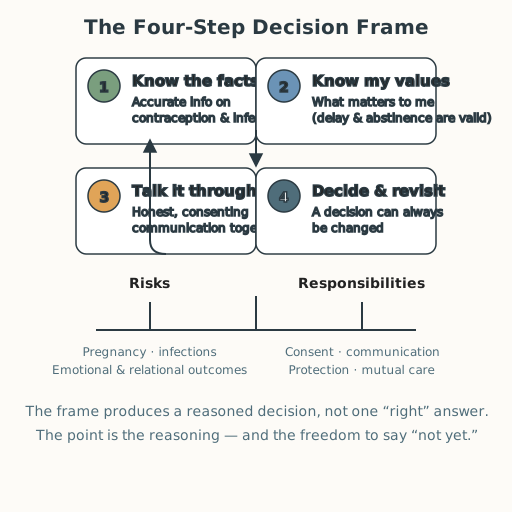
This lesson is written to the learner (“you”). Land the four-step frame: (1) know the facts — accurate information about contraception and infections (WHO, S-453/S-454); (2) know my values — what matters to me, including the freedom to delay or abstain; (3) talk it through — honest communication with a partner; (4) decide and revisit — a decision can be changed. Risks to name honestly: pregnancy, infections, and emotional or relational outcomes. Responsibilities to name: consent, communication, protection, and mutual care. The frame produces a reasoned decision, not one “right” answer — the point is the reasoning.
Sensitive-topic guidance: this is where personal disclosure is most likely — hold the line: no learner is asked to share their own experience, and any who do should be redirected to the fictional scenarios (“let’s use the cards”). Normalize delay and abstinence as complete, valid choices alongside being active; neither is ranked. If a learner discloses risk or unsafe circumstances, respond privately and follow your safeguarding procedure to a trusted adult or health service.
The ethics lens: a decision that protects and cares for everyone involved is a good decision. The egalitarian lens: the freedom to choose — and the information needed to choose well — is not equally available, and that is an injustice we name, not a fact we ignore. The global lens: norms about when and how people become sexually active differ across cultures, but the skills of weighing risk and responsibility travel everywhere. The social-emotional lens: impulse and feeling are real parts of decisions; naming them is part of deciding well.
Procedure
- Retrieve, interleaved (5 min). One line each: the five consent conditions; what must meet for pregnancy to begin; the four method groups; the condom key fact; the three words of infection care.
- Meet the four-step frame (10 min). Study the diagram. Say each step in your own words. Notice the frame is a loop — you can return and change course.
- Worked example (10 min). Follow a model: a fictional couple is deciding. Know the facts (accurate info on contraception and infections); know your values (one person wants to wait — that is honored); talk it through (they speak honestly); decide and revisit (they choose to wait and check in again).
- Apply the frame (15 min). In small groups, take a scenario. Walk all four steps. Name at least one risk, one responsibility, and one option that honors both people’s values. Write the reasoning, not just a verdict.
- Share reasoning (5 min). Share one line from your group’s thinking. Others listen without judging the conclusion.
- Reflect (5 min). Write: “When I decide, I will make sure I have… (facts / values / a conversation / the right to change my mind).”
- Close (5 min). This completes our first big question. Next, a new one: how do we know the information we’re using is even true?
Differentiation
- Support: Use the worked example step-by-step; allow the frame to be spoken rather than written; provide sentence starters.
- Extension: Write a short “decision brief” that names risks, responsibilities, and two options, and explain which you would lean toward and why — without sharing anything personal.
Assessment
- Formative (peer + self): Can the learner name the four steps, identify a risk and a responsibility in a scenario, and produce a reasoned option that honors both people’s values?
- Portfolio (unit): The decision-frame worksheet becomes the first portfolio artifact for the unit’s “risks-and-responsibilities analysis.”
Home connection
If it feels safe, ask a trusted adult how they weigh risks and responsibilities in a big decision (not necessarily about sex). If not comfortable, reflect privately or write a wonder-box question. No home conversation is required.
Resources
- WHO — Family planning/contraception methods (fact sheet): https://www.who.int/news-room/fact-sheets/detail/family-planning-contraception (S-453).
- WHO — Sexually transmitted infections (fact sheet): https://www.who.int/news-room/fact-sheets/detail/sexually-transmitted-infections-(stis) (S-454).
- On retrieval practice and spacing: Dunlosky et al. (2013), https://doi.org/10.1177/1529100612453266 (S-039).