Lesson 07 — Where Health Information Comes From
Learners begin the unit's second objective by learning five questions that open any health claim — who made it, why, for whom, what evidence, and what is left out — and practice them on mixed real-world examples.
Objectives
Objectives
- D03.S4.10.02 Evaluate sources of health information, including online, peer, and marketing sources, for accuracy and bias.
Essential question
How do I tell who made a piece of health information, why they made it, and whether the evidence backs it up?
Key vocabulary
Materials
Standard materials
- Source questions worksheet · 1 per learner Five questions — who made this, why, for whom, what evidence, what is left out
- Health-claim samples · 1 set per group Mixed real-world health claims (a news item, an ad, a post, a clinic flyer) to practice on
Low-tech / no-cost
- Voice and a questions chant Learn the five questions by heart and say them as a group for each sample
- Printed or hand-copied samples Copy a few health claims by hand; no devices needed
Enriched / lab & device
- Live web samples · 1 per group Pull current health claims from the web to evaluate in real time
Works in different contexts
- large-group Teach the five questions whole-class with one worked example, then small groups evaluate samples and report one finding
- multi-age Younger learners master "who made this and why"; older learners add evidence and omission
- self-directed A learner learns the five questions, evaluates the samples alone, and writes a one-paragraph verdict on one claim
- level-grouped A ready group evaluates a subtle sponsored post; a still-learning group practices on clearly labeled examples
- outdoor-only Write the five questions on cards; hold up each sample and walk to the question you think it fails most
Lesson 7 — Where Health Information Comes From
Summary
Learners begin the unit’s second objective by learning five questions that open any health claim — who made it, why, for whom, what evidence, and what is left out — and practice them on mixed real-world examples.
Objectives
- Evaluate sources of health information, including online, peer, and marketing sources, for accuracy and bias. (D03.S4.10.02)
Connection
Imagine two people hand you the same medicine. One is a pharmacist who explains the dose and the side effects. The other is selling it and promises it will “change your life.” The medicine is identical — but the information is not, because the people have different purposes. Every health claim comes from someone, for some reason, to some audience. Reading that — before you believe or share — is a skill you already use with prices and promises; now you sharpen it for health.
Materials
- Source questions worksheet
- Health-claim samples
Preparation
- Copy the source questions worksheet and health-claim samples.
- Retrieval (spiral): from Grade 9, evaluating body-image messages in media; from Grade 7, evaluating food marketing claims. Today: the same skill, broadened to all health information.
Facilitator note
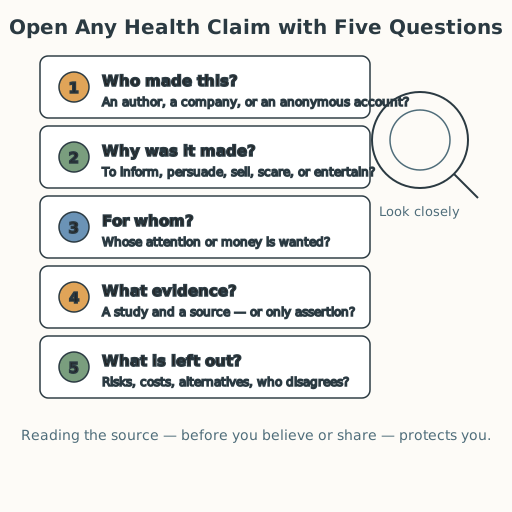
This lesson is written to the learner (“you”). Land the five questions (framed by NAMLE’s key media questions, S-151, and Common Sense’s news/media-literacy habits, S-063): (1) Who made this? (an author, a company, an anonymous account); (2) Why was it made? (to inform, to persuade, to sell, to scare, to entertain); (3) For whom? (an audience whose attention or money is wanted); (4) What evidence? (a study, a source, or only assertion); (5) What is left out? (risks, costs, alternatives, who disagrees). Model one worked example aloud before learners practice.
Sensitive-topic guidance: health claims in this unit’s samples may include sexual-health products and body claims; keep samples non-graphic and treat every claim as material to analyze, never to try. Learners may opt out. If a sample triggers a disclosure or concern, respond privately and follow your safeguarding procedure to a trusted adult or health service.
The ethics lens: using true information — not fear or deception — is the honest way to influence a health decision. The egalitarian lens: those with less access to education are targeted by weak or false claims, so the skill of checking is a form of protection for everyone. The global lens: health claims look different in different markets and languages, but the five questions work everywhere. The technology lens: the internet multiplies claims and anonymizes their sources, which makes the questions more necessary, not less.
Procedure
- Retrieve (5 min). From Grade 9: what did you learn about media images and body image? From Grade 7: how did you tell a food ad’s claim from evidence? Say one idea.
- Meet the five questions (10 min). Learn them by heart: who made this, why, for whom, what evidence, what is left out. Say them as a group.
- Worked example (10 min). Follow a model: a post claims a drink “boosts your immunity instantly.” Who? a brand account. Why? to sell. For whom? worried people. Evidence? none cited. Left out? that no drink does this. Watch how the claim falls apart under the questions.
- Practice on samples (15 min). In small groups, run all five questions on each sample. Mark each: inform, persuade, sell, scare, or entertain — and say what evidence is missing.
- Share one finding (5 min). Each group shares one claim and the question that cracked it.
- Reflect (5 min). Write: “The question I will always ask about a health claim is…”
- Close (5 min). Next: the internet makes sources feel closer than they are. Tomorrow, how to check them for real.
Differentiation
- Support: Start with clearly labeled examples (an ad, a clinic flyer); focus on the first two questions.
- Extension: Take a real claim from your own feed (screen-captured, personal info removed) and run all five questions, then write a one-paragraph verdict.
Assessment
- Formative (peer + self): Can the learner name the five questions and apply them to a sample to identify its purpose and its missing evidence?
- Artifact (portfolio): The “question I will always ask” reflection.
Home connection
If it feels safe, watch or read a health claim with a trusted adult and ask the five questions together. If not comfortable, practice on your own with any ad you see. No home conversation is required.
Resources
- NAMLE — Key Questions to Ask When Analyzing Media Messages: https://namle.org/resources/key-questions/ (S-151).
- Common Sense Education — News & Media Literacy: https://www.commonsense.org/education/digital-citizenship/topic/news-and-media-literacy (S-063).