Lesson 04 — Hidden Assumptions: Reading the Unsaid
Learners learn to critique a moral argument by finding its hidden assumptions and bias — the part that is said without being said. Using an iceberg image, they separate a stated claim from its unstated premises, test those premises, and name where bias slips in.
Objectives
Objectives
- D09.S1.10.02 Critique a moral argument for hidden assumptions or bias, and rebuild it more fairly.
Essential question
How do I find the hidden assumptions and bias inside a moral argument — the part that is said without being said?
Key vocabulary
Materials
Standard materials
- Argument iceberg sheet · 1 per learner A diagram of an argument with the stated claim above the waterline and the hidden assumptions below
- Two short moral arguments · 1 per learner Sourced, everyday arguments about technology or the environment, ready to be critiqued
Low-tech / no-cost
- A shared board or large paper Draw the iceberg and write assumptions below the waterline together
- Voice Read the arguments aloud and name the unsaid part together
Enriched / lab & device
- A set of four contrasting arguments · 1 per group Arguments from different regions or traditions, to compare what each assumes
- A shared digital document · 1 A shared "assumptions we found" list each group can add to
Works in different contexts
- large-group Model one critique whole-class, then groups critique different arguments and present the hidden assumptions
- multi-age Younger learners name what is "said" and what is "left out"; older learners write the full critique
- self-directed A learner reads an argument, fills the iceberg, and lists three hidden assumptions
- level-grouped Learners ready to extend find a counterexample that breaks the argument and say why it matters
- outdoor-only Use a real sign, rule, or claim about a shared space ("this path is for walkers") and ask what it assumes about who belongs there
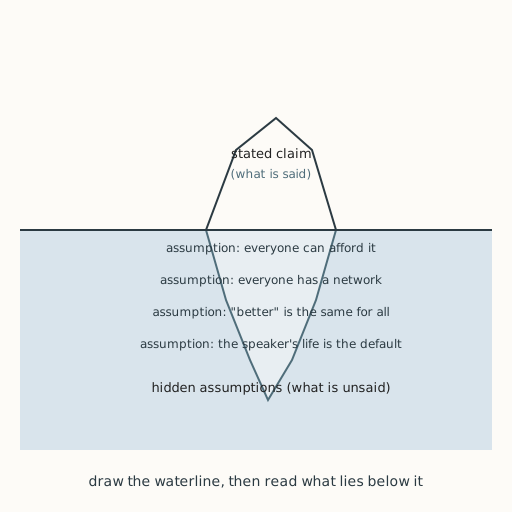
Lesson 4 — Hidden Assumptions: Reading the Unsaid
Summary
Learners learn to critique a moral argument by finding its hidden assumptions and bias — the part that is said without being said. Using an iceberg image, they separate a stated claim from its unstated premises, test those premises, and name where bias slips in.
Objectives
- Critique a moral argument for hidden assumptions or bias, by separating its stated claim from its unstated premises. (D09.S1.10.02)
Connection
Every argument is like an iceberg: only a little of it is above the water. Above the water is what the speaker says out loud — “this phone is good for everyone.” Below the water is what the speaker assumes without saying it — that everyone can afford a phone, that everyone has a network, that “good” is measured the same way for everyone. An argument can look complete and still rest on parts no one ever said out loud. Finding those parts — and asking whether they are true and whether they are fair — is the heart of reading an argument critically. It is a skill you can use on an advertisement, a speech, a news report, or your own reasoning.
Materials
- Argument iceberg sheet
- Two short moral arguments
Preparation
- Copy the iceberg sheet and the two arguments.
- Retrieval: from Grade 9, recall the difference between a fact, a belief, and a value; and that a moral argument has premises and a conclusion. Today we look for the unstated premises.
- Prepare one worked example of finding a hidden assumption.
Facilitator note
This lesson is written to the learner (“you”). The idea to land: an argument’s visible part is small; its hidden assumptions and bias are the part below the water — find them, test them, and the argument is no longer invisible. Teach the skill with a worked example, then guided practice (S-011). Frame critique as care, not attack: we read an argument closely to understand it better, and to notice who is left out. The critical-thinking lens is the spine: ask “what must be true for this to be true, and is it?” The egalitarian lens: bias often hides in the question of who is assumed to matter — “everyone” can silently mean “people like the speaker.” The global lens: arguments are shaped by where they are made; an assumption that is obvious in one place is strange in another, and that difference is information, not a mistake. Keep questions open (philosophy §11) and distinguish evidence from values (philosophy §5): finding an assumption is a claim about what the argument says; judging whether that assumption is fair is a question of values. Preview: next lesson we rebuild the argument with the assumptions brought into the light.
Procedure
- Recall (5 min). From Grade 9: what is the difference between a premise and a conclusion? Give a one-sentence example.
- Meet the iceberg (10 min). Look at the iceberg sheet. Above the water: the stated claim. Below the water: the hidden assumptions — the things that must be true for the claim to hold. Read one short argument together and mark where the waterline is.
- Worked example (10 min). Watch one critique done step by step for “Everyone should switch to smartphones; they make life better for all of us.” (a) What is said? (b) What is assumed? — that everyone can afford one; that everyone has a network and the skills to use it; that “better” is the same for everyone. (c) Test each assumption: is it true for everyone? (d) Where does bias slip in? — the argument speaks for “all of us” while assuming a life like the speaker’s.
- Guided practice (15 min). In a pair, take the second argument and repeat the four moves. Write down at least two assumptions, then test each one. Swap and compare what you found.
- Independent practice (10 min). In your journal, choose one argument and write: the stated claim, two hidden assumptions, and where bias slipped in. Mark “not yet” and retry if you only found one.
- Close (5 min). Share one hidden assumption you found. Notice how the same sentence looked different once the waterline was drawn.
Differentiation
- Support: Provide a half-filled iceberg (claim written, one assumption already placed) to complete.
- Extension: Find a counterexample — one real person or place where the assumption fails — and say how it changes the argument.
- Expression: Learners who do not speak aloud can write the claim and assumptions on the iceberg, point to the hidden parts, or have a partner read their written critique — no step requires the voice.
Assessment
- Formative (peer + self): Can the learner separate a stated claim from its hidden assumptions, test one assumption, and name where bias slips in?
- Portfolio artifact (unit): The completed iceberg, kept as the first page of the “critique” section of the portfolio.
Home connection
Find a claim in an advertisement or a headline at home. Ask: what must be true for this to be true? Name one assumption together.
Resources
- On worked examples and guided practice: Kirschner, Sweller & Clark (2006), https://doi.org/10.1207/s15326985ep4102_1 (S-011).
- On asking “who made this and why” about any message: NAMLE, “Key Questions to Ask When Analyzing Media Messages,” https://namle.org/resources/key-questions/ (S-151).