Lesson 06 — Purpose and a Meaningful Life
Learners meet purpose as a *direction* rather than a single destination, drawing on the ideas of possible selves and open exploration. They write a short reflection on what a meaningful life looks like for them, extending their values-and-purpose statement.
Objectives
Objectives
- D01.S2.11.01 Articulate their developing values, purpose, and sense of what a meaningful life looks like for them.
Essential question
What is purpose, and what does a meaningful life look like for me?
Key vocabulary
Materials
Standard materials
- Journal · 1 per learner
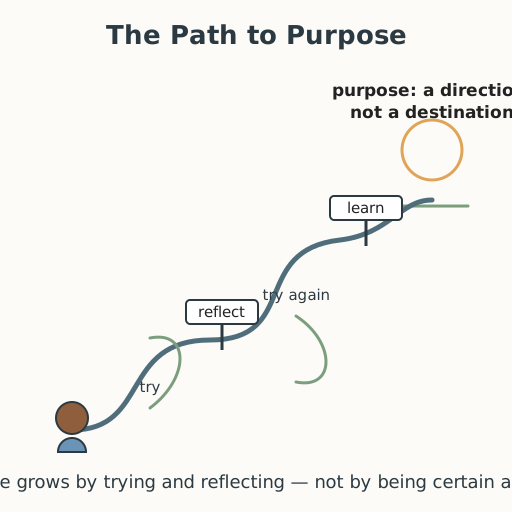
- Path-to-purpose diagram (print or draw) · 1 per learner A winding path with detours and signposts toward a horizon labeled "a direction, not a destination"
Low-tech / no-cost
- Voice and a walk Walk a winding path and notice that the point is the direction, not a fixed end
- A stick drawn in sand Draw a path with loops and talk through the detours you have already taken
Enriched / lab & device
- A short video of someone describing their path to purpose · 1 Choose one that shows detours and uncertainty, not a sudden calling
Works in different contexts
- large-group Read the detour idea together; then learners write privately about their own direction
- multi-age Younger learners name something they love doing that helps someone; older learners write the full purpose reflection
- self-directed A learner works the diagram alone and writes a one-page "direction, not destination" reflection
- level-grouped A ready group distinguishes purpose (a direction) from goal (a destination) and explains the difference with an example
- outdoor-only Walk toward a far landmark and notice: you can hold the direction even while the path winds
Lesson 6 — Purpose and a Meaningful Life
Summary
Learners meet purpose as a direction the self moves toward — not a single destination to arrive at by a deadline. They learn that purpose grows by trying and reflecting rather than by sudden certainty, that open exploration is a normal and healthy stage, and that only a minority of young people feel a clear sense of purpose yet. They extend their values-and-purpose statement.
Objectives
- Articulate their developing values, purpose, and sense of what a meaningful life looks like for them. (D01.S2.11.01)
Connection
A compass does not tell you the exact house you will live in; it tells you which way is north so you can walk. Purpose is like that: it is a direction, not a destination. You do not need to know your one career or your one calling today — very few people do at your age, and many people’s purpose changes across a life. You only need to notice which way you keep turning: toward making things, toward helping people, toward understanding, toward protecting the living world. That turning is the beginning of a meaningful life.
Materials
- Your journal
- A path-to-purpose diagram (see the asset)
Preparation
- Print or draw the path-to-purpose diagram.
- Retrieval (spaced): from Lesson 5, what is the difference between a fact and a value, and which values did you name? Today we ask what direction those values point you toward.
Facilitator note
This lesson is written to the learner (“you”). The idea to land: purpose is a direction, not a destination; it grows by trying and reflecting; open exploration is normal and healthy; and “I don’t know yet” is a complete answer. Teach the distinction between direction and destination with a worked example (S-011).
The social-emotional lens: identity consolidation is the developmental work of adolescence, and Erikson framed this stage as one of exploration toward commitment (S-155); Marcia’s research showed that open exploration (“moratorium”) is a normal, healthy part of identity formation, not a failure (S-403). The ethics lens: a purpose worth having is one that considers its effect on others — meaning and harm are connected questions. The egalitarian lens: research finds only about one in five young people has a clear sense of purpose yet, and purpose grows with support and reflection (Damon, S-400) — so uncertainty is the norm, not a deficit, and no learner is behind for not having their life figured out. The global lens: what a “meaningful life” means differs across cultures — some center contribution to family, others to a craft, others to a faith, others to a cause — and none is above another. The technology & environment lens: our imagined future selves are shaped by what we see around us, including screens (which futures look visible and possible?), and a meaningful life now often includes the question of what we owe the living Earth.
Emotional safety. Purpose is loaded with pressure in many cultures. Explicitly lower the pressure: this is not the day to choose a career. “I don’t know yet” is celebrated, not repaired. No learner should leave feeling behind.
Procedure
- Recall (5 min). Which values did you name yesterday? Keep them where you can see them — they are the needle of your compass.
- Direction, not destination (15 min). Worked example: a person who keeps turning toward helping others learn might become a teacher, a coach, a trainer, a parent who reads to children — many destinations, one direction. The direction is the “toward”; the destination is the specific place. Also, psychologists who study identity describe an open, exploring stage — “moratorium” — as a normal and healthy part of forming who you are (Marcia, S-403): not having chosen yet is part of choosing. Write the two words and the difference in your own words.
- Notice your turning (15 min). What have you repeatedly turned toward — even before anyone asked? Making or fixing things? Understanding how things work? Defending someone? Creating beauty? Growing food? Asking big questions? Write the “toward” you keep feeling, and one small piece of evidence (a project, a habit, a choice you keep making).
- Imagine possible selves (15 min). Picture two or three possible selves — the people you hope to become (Markus & Nurius, S-399). For each, write one line: what that self cares about, and what it does. Then circle the direction they share in common. That shared direction is the seed of your purpose.
- Close (5 min). Add today’s reflection to your values-and-purpose statement. Remember: about one in five young people feels a clear purpose now, and purpose grows by trying and reflecting (Damon, S-400) — so wherever you are on that path is exactly a place to be.
Differentiation
- Mode (expression): Writing is one way, not the only way — respond by speaking, pointing to a word card, arranging found objects, drawing, or gesturing; a response that uses neither writing nor speaking is still a full response.
- Support: Offer sentence frames (“I keep turning toward ___; I know because ___”) and a list of possible directions to consider.
- Extension: Write one paragraph connecting a value (Lesson 5) to a direction (today) to a possible self, naming what each link adds.
Assessment
- Formative (self): Does the reflection name a direction (not only a job), with one scrap of evidence, and hold “not yet” as acceptable?
- Portfolio: The direction/possible-selves reflection, extending the values-and-purpose statement toward D01.S2.11.01.
Home connection
Ask an adult: “What did you think you’d become, and what did you actually turn toward?” Listen for how their purpose changed — that is normal, and it is the point.
Resources
- Erikson (1950), Childhood and Society (identity as a developing, lifelong process) (S-155).
- Marcia (1966), identity statuses — exploration before commitment is normal (S-403).
- Damon (2008), The Path to Purpose (purpose grows by trying and reflecting; only a minority of young people hold a clear sense of purpose) (S-400).
- Markus & Nurius (1986), Possible Selves (S-399).
- On worked examples and guided practice: Kirschner, Sweller & Clark (2006), https://doi.org/10.1207/s15326985ep4102_1 (S-011).