Lesson 07 — My Place in a Global World
Learners map their concrete connections to people far away — through food, water, climate, work, news, and medicine — and begin to see themselves as part of a global, interdependent whole. They write a first place-in-the-world reflection.
Objectives
Objectives
- D01.S2.11.02 Reflect on their place in a global, interconnected world and what they owe to people unlike themselves.
Essential question
How am I connected to people far away, and what does that connection ask of me?
Key vocabulary
Materials
Standard materials
- Journal · 1 per learner
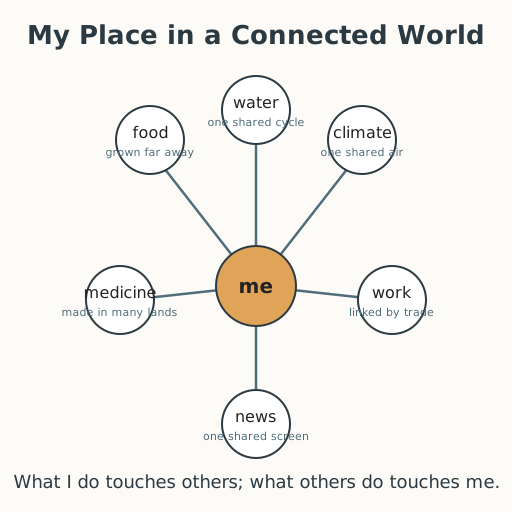
- Global-web diagram (print or draw) · 1 per learner A center node "me" linked to food, water, climate, work, news, medicine
Low-tech / no-cost
- An everyday object in hand Trace where its parts came from by memory and guess — a shirt, a tool, a spice
- Voice Tell the story of one object's journey without any chart
Enriched / lab & device
- A supply-chain map or product footprint lookup · 1 per pair To trace a real product's origins across countries and see the links concretely
Works in different contexts
- large-group Build one giant web with yarn between learners standing in for places; tug one thread and watch the whole web move
- multi-age Younger learners trace one object's journey; older learners analyze the uneven distribution of benefit and harm along the chain
- self-directed A learner traces an everyday object's journey and writes where its benefits and burdens land
- level-grouped A ready group maps the *power* in a chain — who decides, who benefits, who bears the risk
- outdoor-only Trace a food from seed to plate outdoors, naming every hand and place along the way
Lesson 7 — My Place in a Global World
Summary
Learners trace the threads that tie their own daily life to people far away — the food they eat, the water they drink, the climate they share, the work their things represent, the news on their screens, the medicines they may one day need. They see themselves as a node in a global web, and they write a first reflection on their place in it.
Objectives
- Reflect on their place in a global, interconnected world and what they owe to people unlike themselves. (D01.S2.11.02)
Connection
Pick up the shirt you are wearing, or the fruit you ate this morning, or the phone in your pocket. Somewhere, a hand you will never shake helped make it, and somewhere the earth gave something for it — water, cotton, metal, energy. You are not a separate island; you are a knot in a net that wraps the whole planet. Seeing that net honestly — where its benefits and its burdens fall — is the beginning of knowing what you owe to people who do not look or live like you.
Materials
- Your journal
- A global-web diagram (see the asset)
Preparation
- Print or draw the global-web diagram.
- Retrieval (spaced): from Lesson 5–6, recall the values and the direction you named. Today we ask what that direction owes to distant others — people unlike you.
Facilitator note
This lesson is written to the learner (“you”). The idea to land: daily life is made of concrete threads to people far away, and tracing those threads — with an honest eye to where benefit and burden fall — grounds the abstract idea of a “global world” in something real. Teach with a worked example of one object’s journey (S-011).
The global & anthropological lens is the core: this is interdependence as lived fact, traced through real goods and systems, never romanticized. The ethics lens: once the thread is visible, the question “what do I owe the people on the other end?” becomes real rather than abstract. The egalitarian lens: the benefits and burdens of these threads are unevenly distributed — where one is born, the work available, and the risks carried are shaped largely by structure, not individual worth (World Bank poverty/inequality data, S-234; UNDP human-development data, S-283). Keep that distinction explicit: this is about systems, never about ranking people. The technology lens: much of the web runs on technology — global supply chains, shipping, and screens that carry news and feeling across borders in an hour. The environment lens: every thread also touches the living world — water, soil, climate — and the people most affected by environmental harm are often those who contributed least to it; that is a fact to hold alongside the value that they are owed care.
Emotional safety. This lesson can surface guilt. Keep the frame on connection and agency, not blame: a learner is not personally guilty for the structure of the world, but is capable of choosing how to live within it. “What do I owe?” is an open question, not an accusation.
Procedure
- Recall (5 min). What values and direction did you name in Lessons 5–6? Today we widen the frame: who else is on the other end of the life you live?
- Trace one thread (15 min). Worked example, together: a cup of rice. It was planted, tended, and harvested by farmers — often in a country far from the one where it is eaten — then milled, shipped across an ocean, and sold. Every step held someone’s labor and used water and soil. Trace your own everyday object the same way, in three to five steps: where did its parts come from, whose hands touched it, and what did the earth give?
- Draw the web (15 min). On your global-web diagram, write your object’s journey at the matching nodes (food, water, climate, work, news, medicine). Then add the honesty check: along this thread, who benefits most, and who carries the risk? Remember — this is about systems, not about ranking people.
- First place-in-the-world reflection (15 min). In your journal, write a short reflection: Here is one concrete way my life is tied to people far away; here is where the benefit and the burden fall; and here is one thing I now wonder about what I owe them. Keep it honest and open — a question is a fine way to end.
- Close (5 min). Put the web and the reflection in your portfolio. Say or write: I am a knot in a net that wraps the planet.
Differentiation
- Mode (expression): Writing is one way, not the only way — respond by speaking, pointing to a word card, arranging found objects, drawing, or gesturing; a response that uses neither writing nor speaking is still a full response.
- Support: Trace one object together step-by-step first, with a word bank of places and roles.
- Extension: Trace a second object and compare the two threads — which is more just, and by what measure?
Assessment
- Formative (peer + self): Does the reflection trace at least one concrete thread, name where benefit and burden fall, and raise a genuine “owe” question?
- Portfolio: The global-web and reflection, gathered toward D01.S2.11.02.
Home connection
Choose one thing in your home and, with someone there, trace its journey together — out loud, guessing where you are unsure. Notice how much of the world lives in one room.
Resources
- World Bank, Poverty and Inequality (structural drivers of who benefits and who bears risk): https://www.worldbank.org/en/topic/poverty/overview (S-234).
- UNDP, Human Development Reports (data on global inequality and poverty): https://hdr.undp.org/data-center (S-283).
- On worked examples and guided practice: Kirschner, Sweller & Clark (2006), https://doi.org/10.1207/s15326985ep4102_1 (S-011).