Lesson 03 — Mapping My Local Health System
Learners map the health system they actually live in, from self-care at home through community helpers — pharmacists, community health workers, and traditional healers — to primary clinics and hospitals. They name who works at each stop and trace a referral path, turning an abstract "system" into a concrete set of doors they know how to find.
Objectives
Objectives
- D03.S4.11.01 Plan for their own health-care needs, including how to access care, advocate for themselves, and navigate health systems.
Essential question
Where do I actually go for different kinds of care, and who helps me there?
Key vocabulary
Materials
Standard materials
- Care-pathway map sheet · 1 per learner A blank flow (self/home → community → clinic → hospital) to fill with local places and people
- Health journal · 1 per learner
Low-tech / no-cost
- Large paper and markers Draw one shared community map of care on the ground or a big sheet
- Paper and pencil To list local places and the people who work in them
Enriched / lab & device
- Local directory or internet access · 1 per group To look up real local services, hours, and contact details
Works in different contexts
- large-group Build one shared care map on the board, then pairs each fill a personal copy with their own household's usual places
- multi-age Younger learners name the people who help when they are sick; older learners map the full pathway and note costs and distances
- self-directed A learner lists every place they or their household has used for care, sorts them by level, and writes who works at each
- level-grouped Group by familiarity with the local system; a ready group also traces a referral path from clinic to specialist and back
- outdoor-only Draw the care map on the ground with sticks and stones, placing people and places at each station
Lesson 3 — Mapping My Local Health System
Summary
Learners map the health system they actually live in, from self-care at home through community helpers — pharmacists, community health workers, and traditional healers — to primary clinics and hospitals. They name who works at each stop and trace a referral path, turning an abstract “system” into concrete doors they know how to find.
Objectives
- Describe the levels of a health system and identify the places and people a person turns to at each level in their own community. (D03.S4.11.01)
Connection
When a cold will not go away you do not go straight to a surgeon; you start somewhere small and work outward — a rest at home, a pharmacist, the clinic, and only then the hospital. Every place has its own version of this ladder, and the people on each rung — the community health worker who walks your neighborhood, the pharmacist on the corner, the healer your family trusts — are the real face of “the health system.” If you can draw that ladder for your life, you can find care when you need it.
Materials
- Care-pathway map sheet
- Health journal
Preparation
- Copy the blank pathway map; gather large paper or markers for a shared map.
- Retrieval: from Lessons 1–2, the types of care and the fairness question. Today we ground it: where is care, and who gives it.
- Prepare a local example set (if possible) so the shared map has concrete anchors.
Facilitator note
This lesson is written to the learner (“you”). The idea to land: a health system is a set of levels — self/home care, community helpers, primary clinic, hospital — and knowing your own local version is the practical core of “navigating health systems” (D03.S4.11.01). The levels here are a teaching scaffold, not a universal truth: every place orders them differently, and traditional medicine is a real, valued knowledge tradition that sits alongside clinics, not beneath them (WHO traditional medicine, S-145). Community health volunteers are part of this landscape in many countries — the Red Cross and Red Crescent movement alone links millions of them across the world (S-329).
The community lens: this lesson is explicitly about the learner’s own community — its doors, its people, its distances. The global lens: learners compare their map with a partner’s or a different place’s, seeing that systems differ widely. The intellectual lens: building a structured map is organization — a transferable skill. Watch for learners who have no easy access at any level; treat that not as their failure but as the fairness problem from Lesson 2 made visible. Preview: Lesson 4 asks when to use each door.
Procedure
- Recall (5 min). From Lesson 2, what made access uneven? Today: where would you go, and who would help, in your own life?
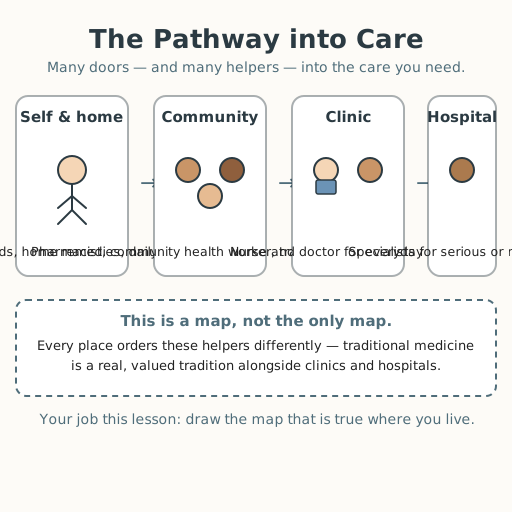
- Meet the pathway (10 min). Health systems tend to have levels: self & home care (rest, fluids, home remedies, daily habits), community helpers (a pharmacist, a community health worker, a traditional healer), a primary clinic (nurse and doctor for everyday illness), and a hospital (specialists for serious or rare needs). Notice that traditional medicine is a real, valued tradition that many families use alongside clinics — not a lesser option (S-145).
- Who helps? (10 min). For each level, name a person and a place you actually know or could reach: a corner pharmacy, a clinic, a community health volunteer, a trusted healer. Community volunteers are the backbone of care in many places — humanitarian networks link millions of them worldwide (S-329).
- Draw your map (15 min). On the pathway sheet, draw your community’s ladder. Add for each stop: the place’s name (or what kind of place it is), one person who works there, and how you would get there (walk, bus, phone, a parent’s help).
- Trace a referral (8 min). Pick one need — a sore throat that will not clear, an injury, an ongoing medicine you take. Trace the path: where you start, who might send you further (a referral), and where it ends. Mark the moment help-seeking moves from home to a person.
- Compare (5 min). With a partner, compare maps. What is different? What is missing from one map that the other has? What does that difference say about access?
- Close (2 min). Say one thing you now know about where to go in your own place that you did not put into words before.
Differentiation
- Support: Fill only two levels — home and one place/person you already use — and name who helps there.
- Extension: Add two maps side by side (your community and one other you know of, in another town or country) and write what each makes easier or harder.
Assessment
- Formative (peer + self): Can the learner place real places and people at each level, trace a referral path, and compare their map with another’s?
- Portfolio artifact (unit): The completed care-pathway map, kept for the unit’s health-care plan.
Home connection
Ask someone at home to add two places or people to your map that you did not think of. Write down one new door into care.
Resources
- On traditional, complementary, and integrative medicine as a valued knowledge tradition: World Health Organization (S-145).
- On community-level care and the world’s humanitarian volunteer network: IFRC, International Red Cross and Red Crescent Movement (S-329).