Lesson 04 — Knowing When and How to Seek Care
Learners build the skill of matching a health need to the right response: self-manage at home, book a routine appointment, seek urgent care soon, or call emergency help now. They sort real-feeling scenarios onto an urgency ladder, learn that emergency numbers are country-specific, and rehearse the help-seeking words — including for mental-health needs.
Objectives
Objectives
- D03.S4.11.01 Plan for their own health-care needs, including how to access care, advocate for themselves, and navigate health systems.
Essential question
How do I decide whether to care for something at home, book an appointment, or get help now?
Key vocabulary
Materials
Standard materials
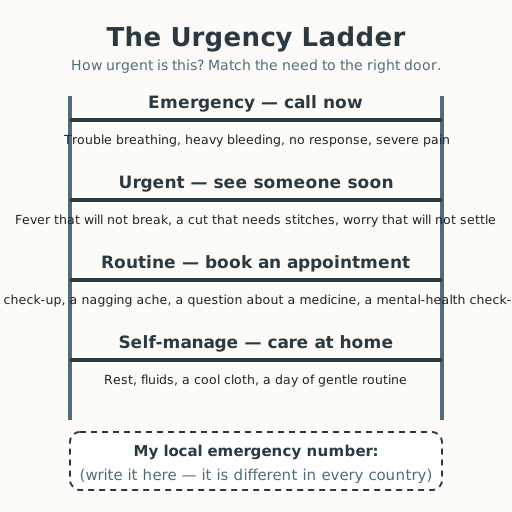
- Urgency-ladder sheet · 1 per learner A four-rung ladder (self-manage, routine, urgent, emergency) with a blank for the local emergency number
- Scenario cards · 1 set per group Everyday health moments to place on the ladder
Low-tech / no-cost
- Paper and pencil Draw the ladder and sort scenarios by hand
- A local emergency-number card to copy So every learner can record and keep the number that applies where they live
Enriched / lab & device
- A short first-aid reference · 1 per group Basic steps for common minor injuries and the signs that mean "get help now"
Works in different contexts
- large-group Sort scenarios whole-class onto a big ladder, then pairs practice stating their local emergency number and what to say
- multi-age Younger learners sort only self-manage vs get-help; older learners place all four rungs and justify edge cases
- self-directed A learner sorts the scenarios alone, records their emergency number, and writes a "when to call" rule in their own words
- level-grouped Group by prior first-aid knowledge; a ready group also rehearses the first-aid signs that mean a minor injury is not minor
- outdoor-only Mark the four rungs as four spots on the ground and have learners walk each scenario to its rung
Lesson 4 — Knowing When and How to Seek Care
Summary
Learners build the skill of matching a health need to the right response: self-manage at home, book a routine appointment, seek urgent care soon, or call emergency help now. They sort scenarios onto an urgency ladder, learn that emergency numbers are country-specific, and rehearse the help-seeking words — including for mental-health needs.
Objectives
- Decide the appropriate level of response to a health need, and describe how to get help at each level. (D03.S4.11.01)
Connection
Almost everyone faces the same small decision many times a year: is this a “rest and water” day, a “book an appointment” week, or a “call for help now” moment? Getting the match right matters in both directions — treating every sniffle as an emergency wastes care and frightens people, while calling a serious sign “nothing” delays help. This lesson is not about becoming a doctor; it is about knowing which door to knock on, and what to say when you do.
Materials
- Urgency-ladder sheet
- Scenario cards
Preparation
- Copy the urgency ladder and scenario cards; prepare a local emergency-number card.
- Retrieval: from Lesson 3, the pathway into care (home → community → clinic → hospital). Today we add when to use each door.
- Confirm the emergency number(s) that apply locally (e.g., 112, 999, 000, 911, or a national number) so learners record the correct one.
Facilitator note
This lesson is written to the learner (“you”). The ideas to land: health needs sit on an urgency ladder — self-manage, routine, urgent, emergency — and the skill is matching need to response. Two anchored facts: emergency numbers are set country-by-country (there is no single universal number; e.g., 112 across much of Europe, 999 in the UK, 000 in Australia, 911 in the US/Canada, 119/110/10111 elsewhere — S-195), and basic first aid — and knowing when a “minor” injury is not minor — is part of knowing when to seek care (S-082, S-313). Keep it safety-first: help-seeking is part of first aid, never a sign of failure, and learners rehearse words, not medical procedures they are not trained to do.
The physical lens: reading the body’s signals — what is serious, what is not. The critical-thinking lens: judging urgency without panic and without denial. The social-emotional lens: mental-health needs belong on the same ladder; seeking help for a mind is as normal as for a body. Watch the emotional register — normalize both “it is okay to rest” and “it is okay to ask.” Preview: Lesson 5 turns to the rights a learner has once they walk through the door.
Procedure
- Recall (5 min). From Lesson 3, what are the doors into care in your place? Today: when do you use each one?
- Meet the ladder (10 min). Four rungs: self-manage (rest, fluids, a cool cloth, a day of gentle routine), routine (book an appointment — a check-up, a nagging ache, a medicine question, a mental-health check-in), urgent (see someone soon — a fever that will not break, a cut needing stitches, a worry that will not settle), and emergency (call now — trouble breathing, heavy bleeding, no response, severe pain).
- Sort the scenarios (12 min). With a partner, place each scenario on a rung and defend it. Watch the edge cases: a “small” burn, a headache that is suddenly much worse, a low mood that will not lift for weeks. Notice that mental-health needs sit on the same ladder as physical ones.
- Your emergency number (6 min). Emergency numbers are set country by country — there is no single universal number (S-195). Write the one that applies where you live, and memorize the words: your name, where you are, what is wrong.
- First aid and when to get help (10 min). Basic first aid for a minor cut or burn — clean water, a clean cover, cool (never ice) on a burn — is only the first step; the second is knowing the signs that mean “this needs professional help” (S-082, S-313). Rehearse aloud: “This cut is deep and will not stop bleeding — I need help.”
- Practice the call (8 min). Role-play calling for help with a partner: state the number, your location, what is wrong, and what help you need. Swap roles.
- Close (4 min). Write your own one-line rule for “when to self-manage” and your one-line rule for “when to call now.”
Differentiation
- Support: Sort only two categories — “rest at home” and “get help” — and practice saying the emergency number clearly.
- Extension: Build a personal “my red flags” list — the specific signs, for a condition or situation relevant to you or a loved one, that mean “seek care now.”
Assessment
- Formative (peer + self + performance): Can the learner place a scenario on the correct rung, justify it, state their local emergency number, and rehearse the help-seeking words?
- Portfolio artifact (unit): The completed urgency ladder with the recorded local emergency number and the two written rules.
Home connection
At home, confirm the emergency number with an adult and write it somewhere everyone can see. Add one “get help now” sign your household agrees on (e.g., trouble breathing) and one “rest at home” sign (e.g., a mild cold).
Resources
- On emergency numbers being country-specific: ITU Recommendation E.161.1 (S-195).
- On basic first aid and recognizing when to seek help: IFRC First Aid guidelines (S-082); IFRC Global First Aid Reference Centre (S-313).
- On adolescence as a time to build help-seeking habits (general authority): WHO, Mental health of adolescents (S-311).
- On worked examples and guided practice for a decision skill: Kirschner, Sweller & Clark (2006) (S-011).