Lesson 05 — My Records, My Rights, My Consent
Learners build the private, personal tool of a health-information card — their conditions, allergies, medicines, emergency contact, and questions — and meet the three rights that travel with them into any care setting: to understand, to agree (informed consent), and to privacy. They discuss scenarios about records, consent, and confidentiality, turning "navigating the system" into a matter of their own agency.
Objectives
Objectives
- D03.S4.11.01 Plan for their own health-care needs, including how to access care, advocate for themselves, and navigate health systems.
Essential question
What belongs to me when I walk into a care setting — my information, my agreement, my privacy?
Key vocabulary
Materials
Standard materials
- Health-information card template · 1 per learner Blank fields (conditions, allergies, medicines, emergency contact, questions) to fill privately
- Rights-and-consent scenario cards · 1 set per group Short situations about records, consent, and privacy to discuss
Low-tech / no-cost
- Paper and pencil Draw the card by hand and write one's own health history
- Index cards To draft a personal "three questions to ask" reminder
Enriched / lab & device
- A sample consent form (blank or example) · 1 per group To read the parts of a real consent process (what is being asked, risks, alternatives)
Works in different contexts
- large-group Discuss the three rights whole-class, then learners each complete a private health-information card and one scenario in pairs
- multi-age Younger learners focus on knowing their allergies and emergency contact; older learners analyze consent and confidentiality scenarios
- self-directed A learner completes their card alone, then writes one consent and one privacy scenario and what they would do in each
- level-grouped Group by reading comfort; a ready group reads and annotates a sample consent form's parts
- outdoor-only Discuss the three rights in a circle outdoors; learners write their card in the open air as a private task
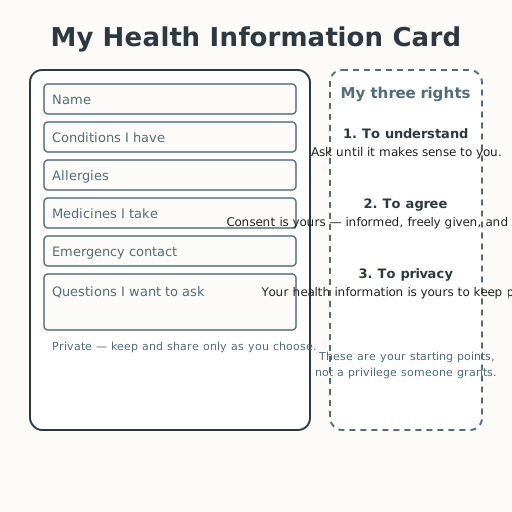
Lesson 5 — My Records, My Rights, My Consent
Summary
Learners build the private, personal tool of a health-information card — their conditions, allergies, medicines, emergency contact, and questions — and meet the three rights that travel with them into any care setting: to understand, to agree (informed consent), and to privacy. They discuss scenarios about records, consent, and confidentiality, turning “navigating the system” into a matter of their own agency.
Objectives
- Explain one’s rights around health information, consent, and privacy, and use a personal health-information tool. (D03.S4.11.01)
Connection
Walking into a care setting, you are not just a body to be treated — you are a person carrying information (what you are allergic to, what you take, who to call) and rights (to know what is happening, to say yes or no, and to keep your information private). The person who knows their own health history and their rights is harder to overlook, quicker to be helped, and safer. That is not a doctor’s skill; it is yours to build now.
Materials
- Health-information card template
- Rights-and-consent scenario cards
Preparation
- Copy the card template and scenario cards.
- Retrieval: from Lessons 3–4, where and when to seek care. Today: what you carry in and what you are owed inside.
- Prepare a plain explanation of informed consent and confidentiality, and a sample consent form if available.
Facilitator note
This lesson is written to the learner (“you”). The ideas to land: a learner carries two things into care — their own health information (conditions, allergies, medicines, emergency contact) and their rights (to understand, to agree, to privacy). The rights rest on two anchors: consent is informed, freely given, and reversible (UNESCO’s international guidance on sexuality education names exactly these three features of consent — S-412), and privacy from arbitrary interference is a recognized right (UDHR, Article 12 — S-149). Emphasize that these are starting points a learner can lean on, never a legal lecture; keep all personal information private and optional to share.
The ethics lens: consent and confidentiality are ethics in action. The critical-thinking lens: reading a form and asking “what am I actually agreeing to?” The professional lens: learners practice the stance they will need with clinicians — clear, prepared, entitled to ask. Guard confidentiality in the room: learners may complete the card privately and share nothing. Preview: Lesson 6 turns these rights into words — self-advocacy in a care visit.
Procedure
- Recall (5 min). From Lesson 4, what did you decide about when to seek care? Today: what do you carry into the room, and what are you owed inside it?
- Build your card (12 min). Fill the health-information card privately: your conditions, allergies, medicines you take, emergency contact, and questions you want to ask. This is yours — keep it and share only as you choose. Knowing these facts about yourself is the first half of advocating for yourself.
- Meet the three rights (10 min). Every person walking into care carries three rights: to understand (ask until it makes sense to you), to agree — consent is informed, freely given, and changeable, never assumed (S-412) — and to privacy (your information is yours; protection from arbitrary interference is a recognized right, S-149).
- Discuss the scenarios (12 min). With a partner, work through the scenario cards: a record shared without asking, a treatment explained in words you cannot follow, a form you are told to sign without reading. For each: which right is at stake, and what could the person say or ask?
- Read a consent form (10 min). If you have one, look at a sample consent form. Find the parts: what is being proposed, the risks, the alternatives, and your right to say no or change your mind. Practice the question: “What are my options, and what happens if I wait?”
- Close (4 min). Write your “three questions to ask” reminder on an index card: one about understanding, one about agreeing, one about privacy.
Differentiation
- Support: Focus on two facts you know about your own health (e.g., an allergy and your emergency contact) and one right (to ask questions).
- Extension: Draft a short “what I would want a clinician to know about me” note, and evaluate where consent or privacy might be hardest to exercise (e.g., in emergencies, as a minor, or in a language you do not speak).
Assessment
- Formative (peer + self): Can the learner complete a health-information card, name the three rights, and identify which right is at stake in a scenario and what to say?
- Portfolio artifact (unit): The completed card (kept private) and the “three questions” reminder, added to the unit’s health-care plan.
Home connection
With a trusted adult, review your card for accuracy and add anything they know that you did not (a family condition, a past reaction). Keep the card where you can find it.
Resources
- On consent as informed, freely given, and reversible: UNESCO, International Technical Guidance on Sexuality Education (S-412).
- On privacy as a recognized right: UN Universal Declaration of Human Rights, Article 12 (S-149).