Lesson 06 — Speaking Up: Self-Advocacy in a Care Visit
Learners turn their rights into words: they prepare a before/during/after question list for a care visit, learn the assertive middle path between passive and aggressive, and rehearse asking clearly — including when to bring a support person or translator and when to seek a second opinion.
Objectives
Objectives
- D03.S4.11.01 Plan for their own health-care needs, including how to access care, advocate for themselves, and navigate health systems.
Essential question
How do I prepare for a care visit and speak up for what I need while I am there?
Key vocabulary
Materials
Standard materials
- Care-visit question sheet · 1 per learner Before/during/after question prompts for a visit
- Role-play scenario cards · 1 set per pair Visit situations to rehearse (a rushed visit, an unclear explanation, a language gap)
Low-tech / no-cost
- Paper and pencil Write a "before" question list and a "during" script in one's own words
- Paired role-play (no props) Two chairs and voices are enough to rehearse asking and answering
Enriched / lab & device
- A sample "what to bring to an appointment" checklist · 1 per learner To refine preparation (records, medicine list, questions, support person)
Works in different contexts
- large-group Model one role-play whole-class, then pairs rehearse and a few share a line they found useful
- multi-age Younger learners practice one clear ask ("please explain again"); older learners rehearse a full before/during/after script
- self-directed A learner writes their own before/during/after question list and a one-paragraph plan for a real or imagined visit
- level-grouped Group by confidence speaking up; a ready group also practices responding when a clinician seems rushed or dismissive
- outdoor-only Rehearse the visit standing or walking in pairs outdoors — the physical space can lower the pressure of speaking
Lesson 6 — Speaking Up: Self-Advocacy in a Care Visit
Summary
Learners turn their rights into words: they prepare a before/during/after question list for a care visit, learn the assertive middle path between passive and aggressive, and rehearse asking clearly — including when to bring a support person or translator and when to seek a second opinion.
Objectives
- Prepare for a care visit and use assertive self-advocacy to make sure one’s needs are heard. (D03.S4.11.01)
Connection
Most people have felt it: the visit ends and you realize you never understood the answer, or forgot the question you meant to ask. Speaking up in a care setting is a skill, not a personality — it can be planned before you walk in, and practiced until it feels natural. Being heard is not about being loud or rude; it is about coming prepared and asking directly, clearly, and without apology.
Materials
- Care-visit question sheet
- Role-play scenario cards
Preparation
- Copy the question sheet and scenario cards.
- Retrieval: from Lesson 5, the three rights (understand, agree, privacy). Today we put them into words.
- Prepare a worked example of one full before/during/after script to model.
Facilitator note
This lesson is written to the learner (“you”). The ideas to land: self-advocacy is a prepared skill — before (write what you want to know; bring a support person or translator), during (ask directly: “can you explain again,” “what are my options,” “what are the risks,” “what if I wait”), after (restate the decision in your own words; know the next steps). The communication frame: assertiveness is the middle path — expressing your own needs directly and respectfully, distinct from passive (suppressing them) and aggressive (trampling others’) (S-405); the “I” statement and needs-based asking come from the same tradition (S-148). Discussion moves like “can you restate that?” and “help me understand” support clear asking (S-238). Model one script explicitly (worked example), then guided role-play (S-011).
The social-emotional lens: speaking up sits on self-awareness and regulated confidence, and it is harder in a second language or under authority — normalize that. The critical-thinking lens: learners choose questions that actually get the information they need. Honor cultural differences in how directly needs are stated (S-405 note); the lesson teaches one effective register, not the only right one. Preview: Lesson 7 turns to the information side — reading health claims and deciding together.
Procedure
- Recall (5 min). From Lesson 5, what are your three rights? Today: how do you actually say them in a visit?
- Meet the three styles (8 min). Three ways to speak up: passive (stay quiet, swallow the question), aggressive (demand, blame, raise the voice), and assertive (ask directly, clearly, respectfully). Assertive is the middle path — you state your need without trampling anyone else’s (S-405).
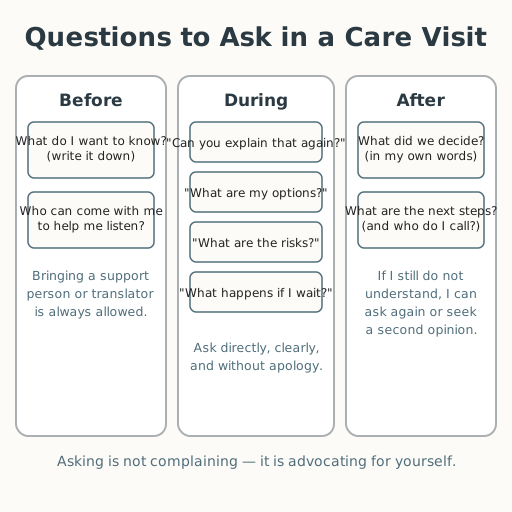
- Build your question list (12 min). Before: write what you want to know, and who could come with you to help you listen — a support person or translator is always allowed. During: “Can you explain that again?” “What are my options?” “What are the risks?” “What happens if I wait?” After: restate the decision in your own words and name the next steps. Keep your sentences in the “I” form: “I still don’t understand — could you say it another way?” (S-148).
- Model the visit (8 min). Watch one full script: a learner who comes prepared, asks two “during” questions, and ends by restating the plan. Notice the tone — calm, clear, unhurried (S-011).
- Rehearse (12 min). In pairs, role-play a visit from the scenario cards — a rushed clinician, an explanation you cannot follow, a language gap. Practice your three “during” questions and one “after” restatement. Swap roles.
- Know your exits (6 min). You can always ask again, bring someone next time, or seek a second opinion — a different clinician’s view. That is not disloyalty; it is part of advocating for yourself.
- Close (4 min). Write one sentence you now feel ready to say aloud in a real visit, and say it to your partner.
Differentiation
- Support: Practice one clear ask (“please explain that again”) until it feels natural, and rehearse bringing one support person by name.
- Extension: Write and rehearse a response for a harder moment — being talked over, offered something you do not understand, or needing an interpreter — and refine it with a peer.
Assessment
- Formative (peer + self + performance): Can the learner produce a before/during/after question list and rehearse an assertive ask with a support-person or second-opinion plan?
- Portfolio artifact (unit): The completed question sheet, folded into the unit’s health-care plan.
Home connection
Rehearse your “during” questions once with someone at home, and ask them to name one question they would add. Note what they add.
Resources
- On assertiveness as the middle path between passive and aggressive: Alberti & Emmons, Your Perfect Right (S-405).
- On needs-based “I” statements: Rosenberg, Nonviolent Communication (S-148).
- On discussion moves that keep asking clear and respectful: Michaels & O’Connor, Accountable Talk (S-238).
- On worked examples and guided practice for a communication skill: Kirschner, Sweller & Clark (2006) (S-011).